
What India’s ODI World Cup win really means for the future of women athletes in the country
India’s women’s ODI World Cup win has underlined the explosive growth of the sport in recent years. With non-cricket men’s sport long in the shadow of cricket, does a similar fate await non-cricket women’s sport in India?
On the morning of November 3, as always, Pritam Rani Siwach began the warm-up session at the hockey academy she founded in Sonipat. Several members of the Indian women’s hockey team learned their trade here, and the academy enjoys a well-earned reputation as one of the country’s finest for women’s hockey.
Yet, as Pritam, a former Commonwealth Games gold medallist turned Dronacharya Award-winning coach, soon realised, hockey was not on top of her trainees’ minds.
“I asked them, how many of you watched the match yesterday? And all the girls put their hands up. I’d myself been watching the match the previous evening, and so we talked about it and what a big thing it was for women in India,” Pritam tells Sportstar.
The match she referred to was the final of the Women’s Cricket World Cup between India and South Africa in Navi Mumbai, which the host won to claim its first-ever world title. Coach Pritam and her pupils were far from the only ones who watched it. About 185 million viewers streamed the final, and another 92 million watched it on TV. That is roughly the same number who tuned in for the 2024 men’s T20 World Cup.
These are remarkable numbers. In Indian sport, it has long been accepted that no sport draws eyeballs like men’s cricket. Those eyeballs translate into advertiser interest and a commercial windfall. According to a KPMG report, cricket accounted for 85 per cent of all revenue in the Indian sports sponsorship market in 2025, with men’s cricket drawing the lion’s share.
If viewership is directly proportional to sponsorship, the direction in which women’s cricket in India is heading is clear.
That is what Tuhin Mishra, CEO of Baseline Ventures, which manages several top Indian athletes across sports, believes.
Tuhin adds that while the Women’s Cricket World Cup was historic, it only reinforced an already established trend. “There’s no two ways about it. If men’s cricket is the biggest sport in the country, women’s cricket is clearly the second biggest sport in India. I don’t think it was a matter of India winning the World Cup to make this point. I think it’s already happened a while back,” he says.
The numbers back him. According to KPMG, the media rights valuation for the first cycle of the Women’s Premier League, the women’s counterpart to the IPL, is 951 crore, with the BCCI stating that it earned 377 crore from the WPL in its first season in 2023. Even by itself, the WPL accounts for about three per cent of the revenue of the entire Indian sports market, making it the richest league in India outside the IPL.
According to Tuhin, women’s cricket already has the highest-paid women sportspersons in the country. “We have been managing Smriti Mandhana for the last eight years, and I can say that for the last three, she has been the highest-paid female athlete in the country. This is from before the World Cup. She might endorse a few more now, but she was already endorsing 16 brands before the World Cup win,” he says.
With money and fame flowing in, the future of women’s cricket in India looks bright. The outlook is less certain for non-cricket women’s sport. In recent years, women athletes in what were traditionally termed Olympic sports (a label now blurred by cricket’s inclusion in the 2028 Los Angeles Olympics) have contributed significantly to India’s performance at the highest levels. Since 2012, women have won nine of India’s 21 Olympic medals while forming nearly 40 per cent (175 of 429) of the contingent. But while their numbers have grown, doubts remain about whether non-cricket sports can compete, both financially and in attracting talent.
Uncertain future
The general sentiment is that women’s sport in India is likely to be dominated by women’s cricket, with other sports appearing less promising to prospective talent.
“I think this World Cup win will be a pivotal moment for women’s sport and of course it will be dominated by women’s cricket,” says Divyanshu Singh, CEO of JSW Sports, which owns a WPL team (Delhi Capitals) and a women’s hockey team (Soorma Hockey Club), and also operates the Inspire Institute of Sport that trains male and female athletes in Olympic disciplines such as track and field, boxing, wrestling and judo.
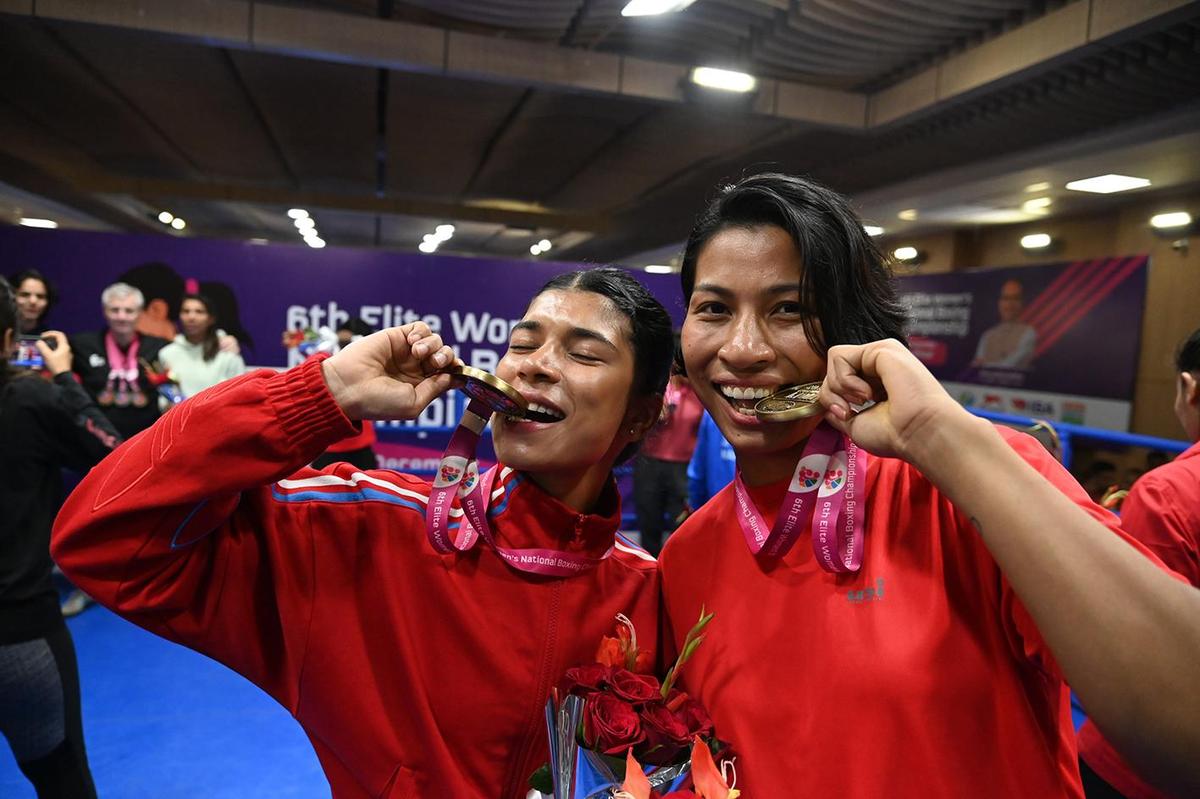
Underlit greatness: The success stories of boxers Nikhat Zareen and Lovlina Borgohain highlight a truth the numbers often miss. Women’s excellence in India runs far beyond cricket, yet the reason it feels otherwise is simple. These sports rarely get the visibility that cricket does.
| Photo Credit:
The Hindu Photo Library

Underlit greatness: The success stories of boxers Nikhat Zareen and Lovlina Borgohain highlight a truth the numbers often miss. Women’s excellence in India runs far beyond cricket, yet the reason it feels otherwise is simple. These sports rarely get the visibility that cricket does.
| Photo Credit:
The Hindu Photo Library
“It’s brilliant that India have a World Cup champion in women’s cricket. But even before that, we have had World Champions in women’s sport,” Singh says. “I was looking at the numbers and we have had 23 women’s World Champions across boxing (Nikhat Zareen, Lovlina Borgohain, Mary Kom), weightlifting (Karnam Malleswari, Mirabai Chanu, Bindyarani Devi), shooting (Tejaswini Sawant), and badminton (P.V. Sindhu). In some of these sports, the global level of competition is certainly a lot tougher than it is in cricket, which only a few countries play competitively. But relatively few of these world champions are household names,” he says.
The reason comes down to visibility. “When you look at what we call Olympic sports, the only real time these get visibility is during the Olympics and to a smaller extent, the Asian and Commonwealth Games. They often aren’t on TV at all. Some of them don’t compete through the season or don’t have regular high-profile competition like the WPL for women cricketers,” says Tuhin.
Lower visibility leads to lower commercial prospects and, potentially, lower participation.
Women’s cricket coach Ashwani Singh has seen such shifts before. “When I was a young boy in the 1970s and 1980s, cricket was just one of many sports that kids played. Football was popular, and field hockey was considered the national game. Then we won the World Cup in 1983, and slowly cricket started gaining popularity. It took off completely in 2003 when money started coming into the sport. Now compare where men’s cricket and men’s hockey are. Cricket is everywhere and men’s hockey is struggling,” says Ashwani, coach of Shafali Verma, who scored 87 and took two wickets in the World Cup final.
When Ashwani first opened his cricket academy in Rohtak for women in 2008, he had to visit homes to convince parents to let their daughters play. “At that time, women’s cricket was still in its early years. Parents weren’t even keen to let their daughters join my academy because they didn’t feel comfortable that they would be playing alongside boys. I actually had to go to different states to scout players in that first year,” he recalls.
Today, things are very different. “Every day, I have girls who want to join and play. I can’t keep up right now because we are in the middle of the domestic season. We will only start taking children next year, and that’s when you are going to see the real numbers.”
This boom, Ashwani admits, will come at the expense of girls who might otherwise have chosen another sport. “Right now in India, we aren’t at that stage where kids pick up sports because they enjoy it. A lot depends on what their parents choose. Like it or not, cricket is a far more glamorous sport than others. Parents can see that even the top 40 or 50 players in India will play the WPL, and they will be taken care of financially. How many other sports in India can say that their top 40 players have a future in the sport?
“Right now, when you see the money in cricket, the visibility, the fact that at least in Haryana this is a sport considered safe for girls, and the clear pathways for success, you can understand why parents want to put their daughters in cricket. Why would you want to see your child compete in a sport where the rewards don’t match the struggle?” he says.
Indian women’s cricket has already seen players switch from other sports (Jemimah Rodrigues represented Maharashtra’s Under-17 hockey team and N. Shree Charani played badminton and ran track before taking up cricket), but none go the other way.
Not the end of the world
Not everyone believes the trend is inevitable. “I don’t agree that money or career prospects are what motivate girls to choose a sport. When parents, especially in rural India, want to put their daughter in a sport, they usually pick something they have some connection to. If you have some attachment to wrestling, then chances are you would first want your child to wrestle as well,” says Olympic bronze medallist Sakshi Malik, now a coach and mother of a one-year-old daughter. “Apart from this, you will also see what sports facilities are near your home. If you are from a village in Haryana, chances are you will pick an akhara because that is what is accessible,” she says.
Former table tennis Olympian Neha Aggarwal agrees. “Sport in India is extremely geographically coded. In the North East, kids will pick up boxing or football, or weightlifting. In rural Haryana, they will pick up wrestling or kabaddi. These sports are extremely popular at a local level.
“Moreover, I think India is big enough. We have 1.5 billion people. Women’s cricket has been popular for a while now, but our girls have been improving their performance across sports steadily. We aren’t stagnating. That shows that our population is more than enough to find talent. Everyone isn’t going to go into cricket,” says Aggarwal, who is also head of partnerships at Olympic Gold Quest.
Even if much of the talent gravitates towards cricket, hockey coach Pritam is not worried. “If you speak to a lot of male non-cricket athletes, they seem to carry a huge grudge against cricket because they feel they aren’t being given their due, because cricket gets all the support. Maybe if I were a man, I might feel the same way, but I’m not. I don’t think you will find many women sportspersons who are jealous of women’s cricket. I’m very happy they are doing so well.
“When I hear about parents wanting to put their daughters into cricket, I don’t see it as a loss for hockey. I see it as one more girl getting the chance to play any sport. Even now, there are so few girls who play sport in India. When it starts becoming normal for a girl to play sport, that is a win for me. Once women’s sport is accepted in society, I am sure enough girls will choose other sports as well,” she says.
Published on Nov 19, 2025


