
The recalibration of Twenty20: Batters pushing the limits and bowlers striving to bridge the gap
After India clinched the 2024 T20 World Cup, Suryakumar Yadav has overseen a seamless transition — not only of its ranks but of pursuit as well. Since June 30, 2024, India has enjoyed a win rate of 75 per cent — the highest for a Full-Member nation. Australia is a close second at 70 per cent.
This success is built largely on defining a template. India abandoned its approach of stocking its resources for a final surge at the death, instead opting for an immediate, all-in, relentless pursuit of the leather that has sent run rates bursting through the roof.
India has scored at 10.34 runs an over in PowerPlays in 2025, the fastest it has batted in the phase. India still attacked in the death overs, but the gulf in intent between the first six overs and the death overs has shrunk significantly. For instance, in 2007, when it first won the World Cup, India’s run rate in the PowerPlay was 8.25, compared to 10.73 at the death.
However, the defending champion is not the only one pivoting to this rebranded take on the game.
The approach is mirrored in how Australia (9.77), England (10.18) and New Zealand (9.80) have thrust impetus up front, all scoring at nearly 10 an over in the first six overs, setting the stage for flamboyant opening batters like Phil Salt, Travis Head and Abhishek Sharma.
On relatively flatter strips and smaller ground dimensions, this approach will permeate into the World Cup as well.
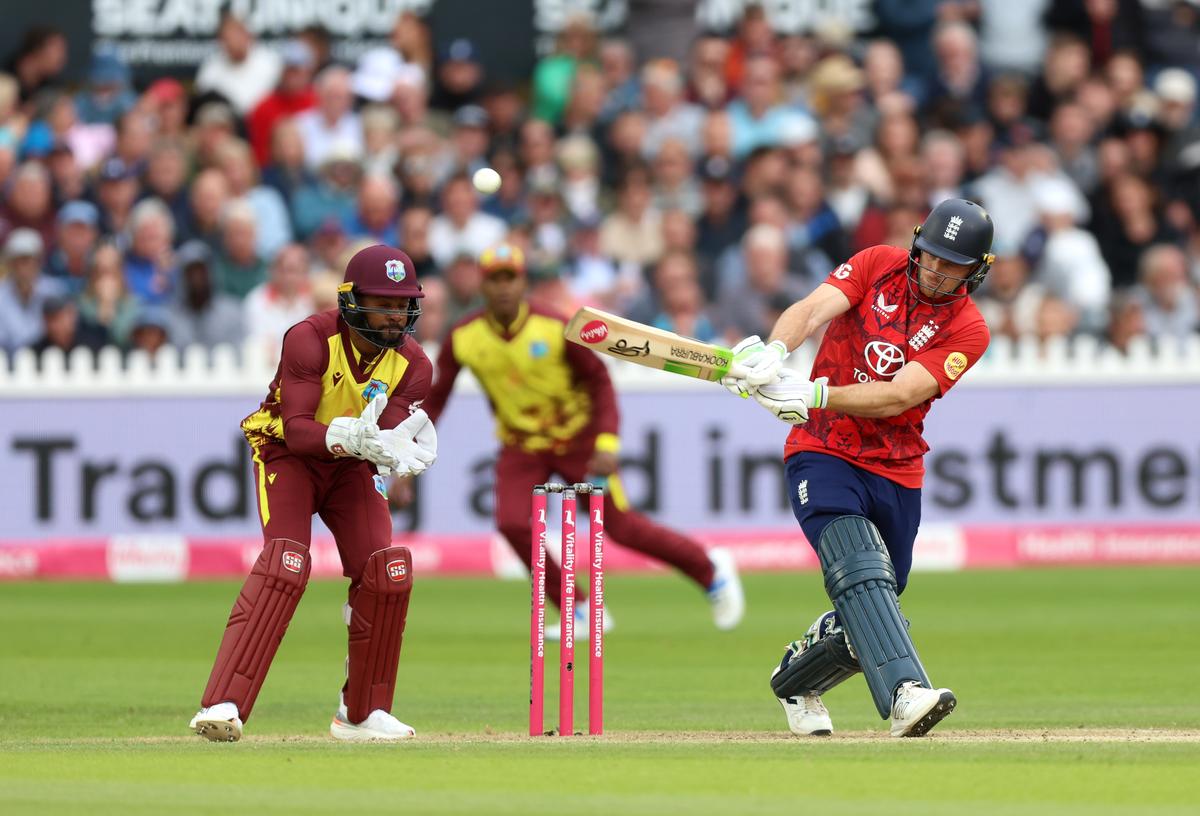
Flipping it: In T20s, since 2021, right-handed batters have deployed the reverse sweep at least 200 times against leg-spinners every year.
| Photo Credit:
Getty Images

Flipping it: In T20s, since 2021, right-handed batters have deployed the reverse sweep at least 200 times against leg-spinners every year.
| Photo Credit:
Getty Images
The necessity to pocket quick runs has prompted batters to revise their playbooks and search for novel options to outsmart bowlers. Batting as a craft once revered shots played along the ground, targeting ‘the V’ in front — safe and risk-averse. But the modern siege by batters has opened avenues behind the wicket too, through fine leg and third man regions.
Runs in the fine-leg region have seen an astronomical surge. In 2022, across all T20s, batters accumulated at a strike rate of 107.53 through fine leg. In the three years since (2023, 2024, 2025), the lowest strike rate through fine leg has been 195.96, in 2024.
The scoring rate through third man is not as skewed, but has still seen an uptick since the turn of the decade. Batters have pocketed runs at strike rates in excess of 185, compared to pre-2020 figures that hovered between 160-170.
The runs flowing in torrents behind square, on either side, are a result of batters giving innovation a shot. It is also partly an attempt to nullify any advantage for the bowler. As bowling units have put more emphasis on match-ups, particularly with spinners, batters have reverted to options that help them play with the turn — even if that has translated to putting a lower price on their wicket.
In T20s since 2021, right-handed batters have deployed the reverse sweep at least 200 times against leg-spinners every year. In 2025, it was used 335 times. Before 2020, its most frequent use came in 2018 (168 times). Southpaws have embraced the reverse sweep too, trusting it more often against off-spinners and left-arm unorthodox bowlers.
The use of the switch hit and scoop has more than doubled since 2021. In the wake of this no-holds-barred modus operandi, bowlers have been forced to adapt. Playing shots behind square requires pace, and the quicks have responded by not offering any at all.
A well-disguised slower delivery has always been a refuge for pacers in T20 cricket, but its use has surged of late. And the change-up is no longer merely about taking pace off; pacers have leaned heavily on their cutters. In T20Is in 2025, the off-cutter was used more than 1,600 times by pacers — its most frequent use to date — dragging the batting strike rate down to 134.05.

Slow way to go: In T20Is in 2025, the off-cutter was used more than 1,600 times by pacers. Jasprit Bumrah, one of the quickest in the game, has been its most frugal proponent.
| Photo Credit:
AP
Slow way to go: In T20Is in 2025, the off-cutter was used more than 1,600 times by pacers. Jasprit Bumrah, one of the quickest in the game, has been its most frugal proponent.
| Photo Credit:
AP
That Jasprit Bumrah, one of the quickest in the game, has been the most frequent proponent of the off-cutter is indicative of its growing popularity against modern willow-wielders. The Indian pacer has deployed it 49 times since July 2025, conceding under six runs per over and picking up five wickets.
The leg-cutter was more sparsely used — 204 times, at a strike rate of 145.58 — but is becoming a more fashionable choice. Kyle Jamieson, Jofra Archer, and Kagiso Rabada are some frontline bowlers who have incorporated the variation into their arsenal, and it won’t be long before more follow suit.
The need for variation has not been lost on the tweakers either, though how those variations have evolved has been a tale in itself.
T20 demanded variation from spinners much earlier. Over time, those who could turn the ball both ways were preferred over regulation finger spinners. In T20Is since 2020, four of the five bowlers who have bowled the most deliveries are leg-spinners — Adam Zampa, Wanindu Hasaranga, Adil Rashid, and Ish Sodhi.
But batters daring to employ horizontal-bat shots have added another layer of filtration. Its effect will be evident at the upcoming World Cup in the form of mystery spinners. Since the tournament’s last edition, they have emerged as among the most trusted options.

Against the norm: In T20Is since July 2024, Varun Chakaravarthy has opted for a variation on 47 per cent of his deliveries.
| Photo Credit:
K. R. Deepak
Against the norm: In T20Is since July 2024, Varun Chakaravarthy has opted for a variation on 47 per cent of his deliveries.
| Photo Credit:
K. R. Deepak
Varun Chakaravarthy leads this pack by some distance. In T20Is since July 2024, he has opted for a variation on 47 per cent of his deliveries — nearly every alternate ball. Abrar Ahmed of Pakistan, though branded a leg-spinner, has enough variety to pull off the mystery gambit. He is second in terms of variation usage, throwing a curveball every fourth delivery.
The resurgence of the arm-ball has also equipped spinners to deal better. In T20Is in 2025, it was used more than 500 times, with bowlers snaffling 45 wickets at an average of 11. The numbers were slightly better in 2024 — 53 wickets at an average of 10. The arm-ball has worked particularly well for Akeal Hosein. Pairing it with his regular left-arm orthodox, he has used the variation 126 times since the last World Cup, conceding under six an over.
Yet, despite the rich range, safety may still be elusive for bowlers if dew plays a major role at the World Cup.
In a format that demands constant refinement, batters undoubtedly hold an edge. Factors like ground sizes and dew only exacerbate the predicament for bowlers.
But therein lies the spectacle — batters pushing to tilt the game in their favour, and bowlers striving to bridge the gap as much as possible.
For cricket, a game of fine margins, the current T20 template is a reminder of its own adage.
Published on Feb 04, 2026


