
South Africa’s series win forces India to face the mirror
The point of denial is over.
India’s 2-0 Test series defeat to South Africa at home all but confirms that its capitulation to New Zealand last year was not an aberration.
This was a stark assertion of the flaws that run through the current Indian Test team, marking an end to a long-standing era of home dominance.
If we were to be generous, we could partly attribute India’s defeat in Kolkata to the unfortunate injury Shubman Gill suffered early in the Test. South Africa’s 30-run margin could have been overturned if the Indian skipper had batted through.
India’s surrender in the second Test, though, was as abject as it comes. Except for the opening day, when the game hung in the balance, India was outplayed on every single day, on every single front.
At the post-match press conference in Guwahati, Indian coach Gautam Gambhir cited his squad’s lack of experience as a defence for its performance against the Proteas.
The transition excuse, though, is a disservice to the quality of players at Gambhir’s disposal. In Jasprit Bumrah, Ravindra Jadeja and Rishabh Pant, he has three players who would ideally walk into the country’s all-time Test XI. Add to that Kuldeep Yadav, who is arguably the best left-arm wrist-spinner in Test history.

This series win, its first in India in 25 years, is the strongest stamp of validation South Africa has received since its coronation as World Test Champion earlier this year.
| Photo Credit:
RITURAJ KONWAR

This series win, its first in India in 25 years, is the strongest stamp of validation South Africa has received since its coronation as World Test Champion earlier this year.
| Photo Credit:
RITURAJ KONWAR
Lesser teams, with fewer generational players, have managed to present a more credible face in Test cricket, at least at home.
Central to India’s downfall was its brittle batting line-up – across four innings against the Proteas, the side crossed 200 just once.
The Indian batters exhibited a particular sense of dread while facing off-spinner Simon Harmer. The 36-year-old bagged 17 wickets in the series at an incredible average of 8.94.
It was not just spin that troubled them. In Guwahati, India’s short-ball frailties were exposed by Marco Jansen, who delivered a devastating spell of pace bowling in the first innings, determining the fate of the Test.
The home team also went out of its way to undercut itself by destabilising its batting order. After projecting B. Sai Sudharsan as its future No. 3, the Indian management dropped him for the first Test and promoted Washington Sundar to that role.
Washington, to his credit, was the most stable-looking Indian batter in Kolkata. He faced more deliveries than any other batter on the minefield that was the Eden Gardens pitch.
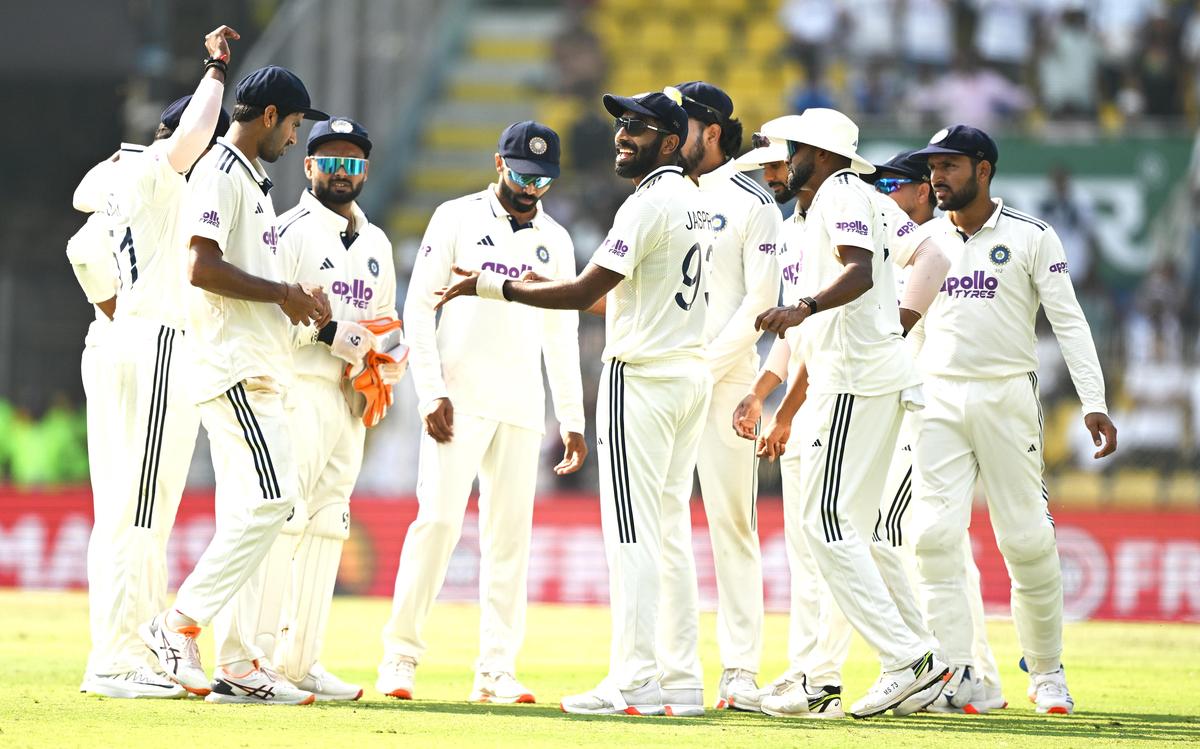
The transition excuse is a disservice to the quality of players at Gautam Gambhir’s disposal.
| Photo Credit:
RITURAJ KONWAR
The transition excuse is a disservice to the quality of players at Gautam Gambhir’s disposal.
| Photo Credit:
RITURAJ KONWAR
Gill’s injury then forced a reshuffle in Guwahati – Sai Sudharsan returned to his No. 3 position, while Washington was ‘rewarded’ for his assured batting with a demotion to No. 8.
India’s batting line-up was also weakened by an over-representation of southpaws. It was an issue the team failed to identify until Harmer exposed it in Kolkata.
Even after Gill succumbed to injury, the home team did not add a specialist right-handed batter and instead went into the second Test with all-rounder Nitish Kumar Reddy.
India’s persistence with Nitish is symptomatic of Gambhir’s obsession with all-rounders, an idea he has carried over from white-ball cricket.
There is no denying that great all-rounders are an incredibly valuable asset to any team, in any format. But Gambhir appears to have overestimated their value in Test cricket, where specialised abilities still retain merit.
The Nitish conundrum is a fine example. Despite earmarking the 22-year-old as a pace-bowling option, the team was hesitant to hand him the ball.
India bowled a whopping 229.4 overs in Guwahati, with Nitish delivering just 10 of them. In fact, in the second innings, part-time leggie Yashasvi Jaiswal bowled an over before him.
Nitish struggled to make an impact with the bat as well. Jansen bounced him out in the first innings and he was caught behind off Harmer in the second.
If India desires to mould Nitish into a genuine pace all-rounder, force-fitting him into the Test side for the sake of experience and then underusing him is certainly not the way to do it.
This brings us back to the selection question – would India have been better served by a specialist batter in Guwahati? Say, a Karun Nair, Sarfaraz Khan, or even a Ruturaj Gaikwad?
It was only natural that India’s undercooked pre-game planning spilt onto the field.
In Kolkata, despite having watched South African skipper Temba Bavuma bat his way out of trouble, the Indian batters, except for Washington, struggled to apply themselves, eventually strangling their chase of 124.
In Guwahati, India allowed the game to slip away in the morning session of Day 2. Having reduced South Africa to 246 for six on Day 1, many would have expected India to swoop in for the kill.
But stand-in skipper Rishabh Pant afforded Senuran Muthusamy and Kyle Verreynne breathing room with overtly defensive field set-ups. South Africa batted through the session before Jansen launched the innings out of orbit with a furious assault.
Also read | From Kolpak exile to series hero in India, Simon Harmer revels in late career revival
Having seen the merits of playing out the tricky morning session, one would have expected the Indian batters to exhibit the sort of restraint Muthusamy and Verreynne showed.
Instead, they went the other way, sabotaging their chances of levelling the series with miscalculated shot-making early on Day 3, as India collapsed from 95 for one to 122 for seven in the space of 68 deliveries.
The blinding inability to adapt was also evident at the individual level. Take the case of Jaiswal.
Despite knowing that his tendency to cut at rising deliveries angling away from him has become a well-identified weakness, the left-handed opener failed to deny himself the temptation. Three of his four dismissals in the series came against Jansen, all from ill-advised cut shots.
For all one could harp on India’s shortcomings, it was also a case of being bettered by a South African side – anchored by captain Bavuma and coach Shukri Conrad – which appears close to its zenith.
This series win, its first in India in 25 years, is the strongest stamp of validation South Africa has received since its coronation as World Test Champion earlier this year.
One could argue that the team benefited from several crucial moments going its way, such as Gill’s injury and winning both tosses.

Proteas spinners, led by the uncontainable Simon Harmer, outbowled their Indian counterparts.
| Photo Credit:
RITURAJ KONWAR
Proteas spinners, led by the uncontainable Simon Harmer, outbowled their Indian counterparts.
| Photo Credit:
RITURAJ KONWAR
But to reduce this win to those instances would be to discredit South Africa’s precision in planning, clarity in approach and ruthlessness in execution.
Over the last decade, South Africa’s tours of India were characterised by the domination of Indian spinners.
But this time, there was a reversal of roles. Proteas spinners, led by the uncontainable Harmer, outbowled their Indian counterparts.
South Africa also made a few surprising selection choices that delivered immediate dividends – for instance, opting for Corbin Bosch in Kolkata and bringing back Muthusamy in Guwahati. Both delivered the goods with the bat while also chipping in with wickets.
To top it off, South Africa won the contest despite a significant handicap – its biggest star, pacer Kagiso Rabada, missed the series due to a rib injury.
It is another matter that the visiting team sealed its landmark triumph in front of near-empty stands, a continuation of Guwahati’s lukewarm response to its first-ever Test match.
Even at its best, on Day 2, a Sunday, the Barsapara Stadium was far from full. As India’s fortunes dwindled in the Test, so did the enthusiasm in the stands.
More importantly, India struggled to adapt to Guwahati’s conditions, having almost no red-ball experience at this venue.
Taking Test cricket to newer venues like Guwahati definitely expands the horizon of red-ball cricket in the country. However, if it comes at the cost of India squandering its home advantage, is it worth it?
But, again, is this Indian team capable of capitalising on any such benefit?
Published on Nov 27, 2025


