
Labyrinth of Lahli — How Harayana was undone by spin, nature and a tricky surface in its own den?
Haryana’s qualification hopes went up in smoke on Saturday against Bengal after Shahbaz Ahmed’s quick, stump-to-stump left-arm orthodox bowling ripped through its batting order on the third day.
It was only fitting that a tweaker pulled the strings on the final day of First-Class cricket this season at the Chaudhary Bansi Lal Stadium in Lahli, Rohtak.
Spinners have been the kingpins to success at the ground this year.
The 23 out of the 40 wickets for spinners in this Ranji Trophy match are still evenly balanced. In the previous three games here this season, spinners had 88 wickets to pacers’ five. This has been a stark departure from the trend that has prevailed since the last decade.
In the game that shot the Lahli stadium into cricketing folklore–Sachin Tendulkar’s domestic swansong in 2013–pacers had picked 28 of the 34 wickets.
Twenty-two wickets through 2025/26 are the lowest yields for quicks in a season since First-Class cricket came to Lahli in 2006/07. On the other hand, the closest that spinners have been to this season’s 111-wicket tally is 61 wickets in 2018/19.
The pitch at Lahli was not this placid for pacers until as recently as last season. That is because it was not the same pitch until last season.
A relay of the square in April 2025 is the reason for the drastic turn in nature. It was not that the change was intended to create this disruption, but factors beyond anyone’s control greatly shaped what came out.
“Everyone knows about the Ranji Trophy, that this is happening. Nobody knows what transpired before that. It usually takes some time for the new surface to settle. The rains were extreme this time. Just two weeks before the Ranji Trophy began, we had rain here,” Ashok Menaria, a player-mentor with Haryana.
“That affects the preparation of a new pitch. You cannot fight nature. And after that, winters do not help either because there’s the dew factor, which brings moisture into play.”
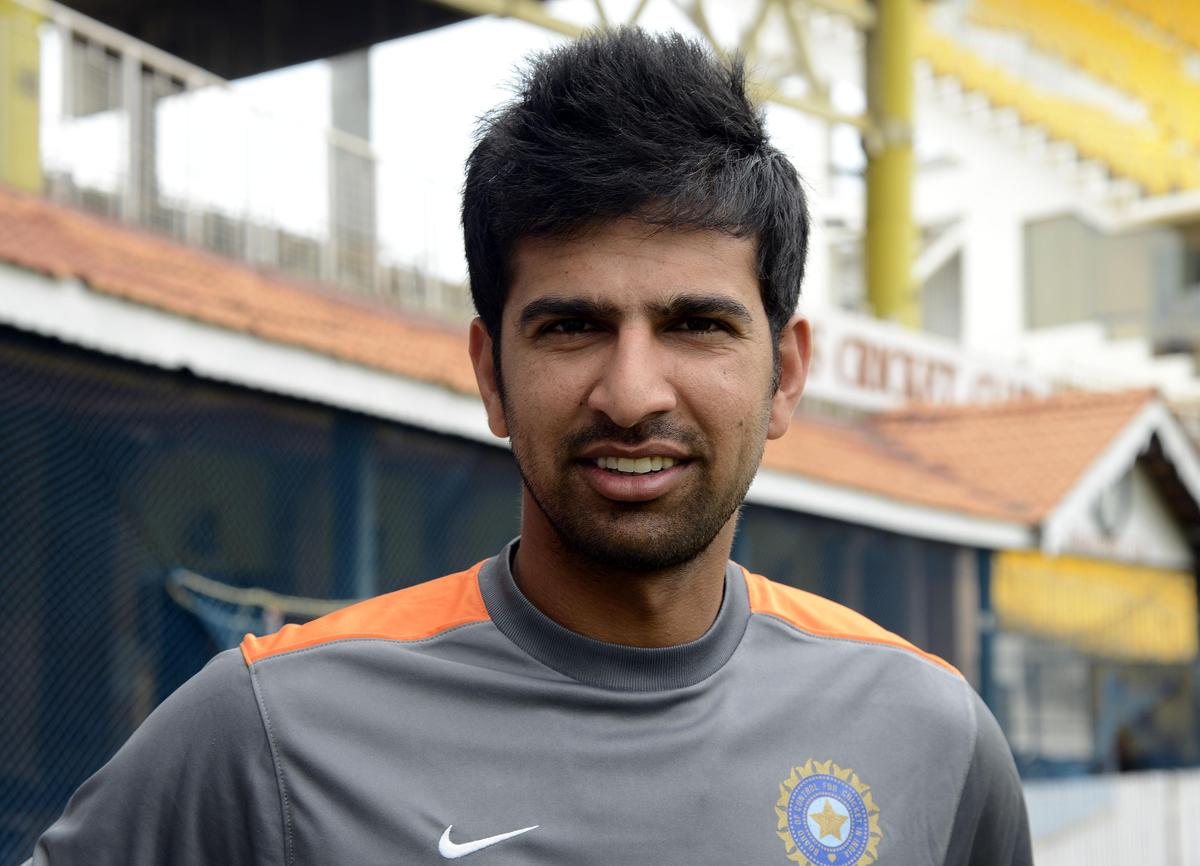
File photo: Ashok Menaria said that though the Ranji Trophy schedule was known in advance, effects of natural factors such as rain were unprecedented.
| Photo Credit:
The Hindu

File photo: Ashok Menaria said that though the Ranji Trophy schedule was known in advance, effects of natural factors such as rain were unprecedented.
| Photo Credit:
The Hindu
The culmination of this is a myriad of possibilities. The pitch holds enough moisture to support a patchy, uneven smattering of grass. This grass helps carry and bounce. The moisture also does not expose the cracks, yet somehow allows enough purchase for the tweakers to trouble batters.
“I saw that the wicket here was not dry; it had moisture, and the turn was happening due to moisture, not because the wicket was dry. My focus was to hit the ball as fast as I could, and the batter would be confused whether to play inside or outside [the line]. There was more grass on one side of the pitch, and where there was no grass in the wicket, the ball was turning more,” said Shahbaz, explaining what landed him with a career-best 11/80.
The grass at the other end played its part too. Akash Deep and Anshul Kamboj used it from the Pavilion End to nab batters in clusters.
It was this venture into the unknown with the square at Lahli that compromised Haryana’s Ranji Trophy season. It won all its games on the road, against Assam, Gujarat, and Railways, but lost three of its four games at home here.
The season’s outcome begs the question of timing – Could another ground have been used for this season? Haryana, however, has been stationed at this ground since 2006.
Domestic outfits have expanded their base to two grounds, in places even three, but for Haryana, this is the only base. It played a few games in Sirsa before the jump, and at the Nahar Singh Stadium in Faridabad before that.
However, the effect of relaying was not expected to be this drastic. Historically a pace-friendly ground, the intent was to retain its identity even on the new surface.
“This will be a seaming track again from next year. That is what we were trying. Because we wanted bounce when we thought of relaying, and you saw that was abundant through this match. So, yeah, we wanted a proper seaming track and hopefully by next year we will have that,” said Menaria.
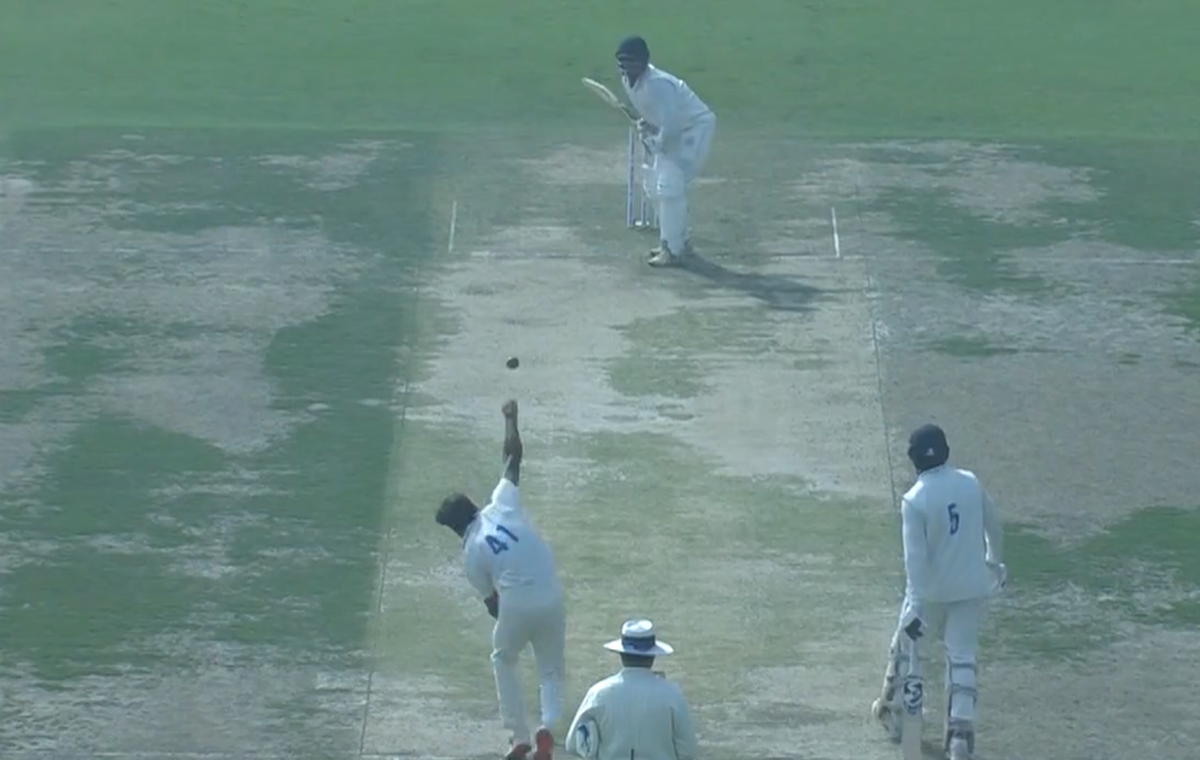
The grass at the other end of the pitch played its part too: Akash Deep (bowling) and Anshul Kamboj (not in picture) used it from the Pavilion End to nab batters in clusters.
| Photo Credit:
Screengrab
The grass at the other end of the pitch played its part too: Akash Deep (bowling) and Anshul Kamboj (not in picture) used it from the Pavilion End to nab batters in clusters.
| Photo Credit:
Screengrab
Though Haryana’s plans, even strengths perhaps, fell on the wrong side after this pitch, it had itself to blame for its exit too. In conditions that demanded more application than usual, Haryana’s batters succumbed to a lack of patience. Injuries did not help the side either, Menaria adds.
“These two losses to Services and Uttarakhand matches [cost us]. We played poorly. If we had won one of them, we would have qualified. We did mess up with the batting a little this match as well.
“Plus, we don’t have a few of our mainstays. Nishant Sindhu, Sumit Kumar and Yashvardhan Dalal are all injured. If three good players are missing in a team, then not only us but for any team in India, things will get worse,” said Menaria.
If the pitch indeed plays out as expected, pandering to a full-strength Haryana side, the outcome and mood will be very different for Haryana and Menaria at this time of the year next season.
Published on Feb 01, 2026


