
IND vs SA: Batting deficiencies send India’s formidable home Test record into tailspin
India and spin are one of cricket’s most established associations. It is an entwinement built simultaneously on the country’s turning tracks and the legendary spinners who thrived on them.
A natural byproduct of this was the spin-playing ability of Indian batters, which remained largely on par with the quality of the country’s tweakers.
ALSO READ | IND vs SA: Nitish Reddy strong candidate for Guwahati if Gill fails to recover in time
But over the last few years, this notion has been pushed, nearly to the breaking point, by visiting spinners who have exposed Indian batters’ deficiencies against the turning ball.
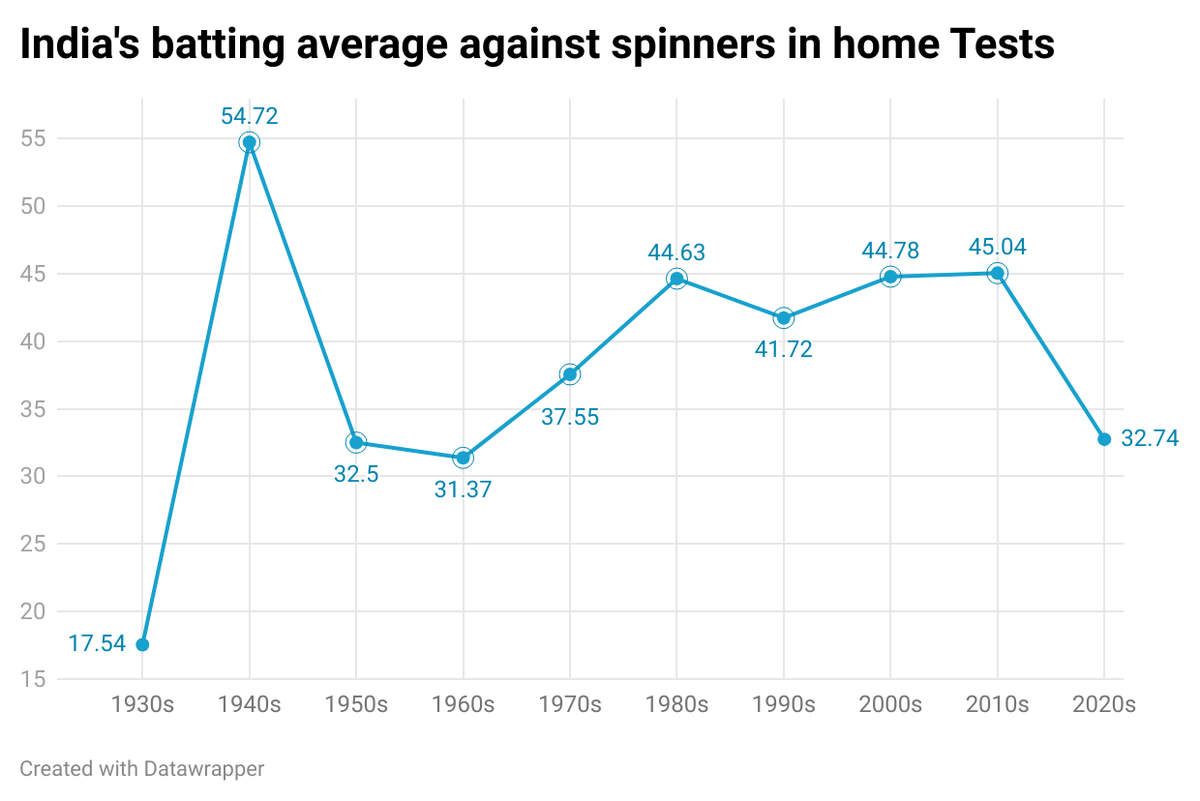
Since 2020, Indian batters have averaged just 32.74 against spinners at home. The last time this figure dipped below 40 in a decade was in the 1970s.
On Sunday, South Africa cashed in on India’s growingly evident vulnerability against spin to claim a famous win at the Eden Gardens.
Seven of the nine Indian wickets to fall in India’s failed 124-run chase were claimed by the Proteas spinners, who made the most of the unpredictable bounce on offer.
The home batters struggled primarily against the precise off-spin of Simon Harmer, who ended the Test with two four-wicket hauls.
It would be hard not to connect the Kolkata Test to India’s series defeat against New Zealand in 2024, where it suffered devastation at the hands of spinners Ajaz Patel and Mitchell Santner.
A temperament issue
Despite questions being raised over the Indian batters’ technical ability – or rather lack of it – against spin, Indian coach Gautam Gambhir believes it is a matter of temperament.
“In Test cricket, there is not only a need for skill, there is also a need for mental toughness,” said Gambhir after the Kolkata defeat.
“Because, in Test, if you are not able to absorb pressure, no matter how much of a turning wicket it is, the first 10-15 minutes are tough. Once you see that off, you get used to the pace of the wicket, and things start getting easier. So, I believe, more than the skill, it is the ability to absorb pressure,” added Gambhir.
Irrespective of the root cause, it is evident that India’s spin-batting capabilities in Test cricket, particularly on home soil, have declined.
Playing no small part in this drop-off has been India’s insistence on home pitches that offer turn right from Day 1, a trend which began in the 2021 series against England.
The case was no different at the Eden Gardens, where the ball spun and bounced sharply right from the first day. Gambhir reiterated after the game that this was exactly the surface the team management wanted.
“We have always said we want turning wickets where the ball turns a little on day one so that the toss doesn’t become an important factor. We’ve never said we want to play on bad wickets or rank turners,” said Gambhir.
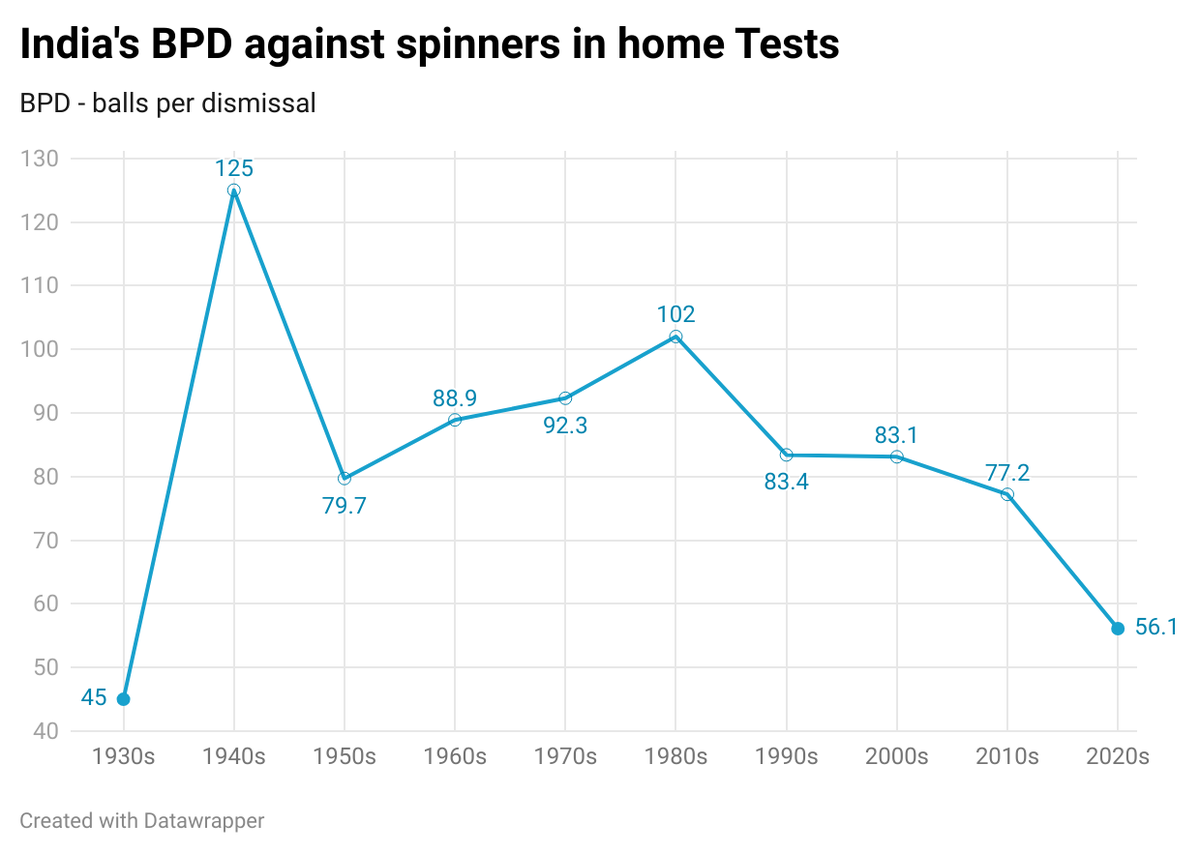
On pitches that are turning more dynamically than before, the home batters have found it hard to bat out time. India has lost a wicket every 56 balls to spinners in home Tests this decade, the lowest it has ever been since the 1930s.
In Kolkata, South African skipper Temba Bavuma showcased the value of old-fashioned grunt work, with a hard-earned fifty in the second innings, which eventually proved to be the difference between the two sides.
The ability to trust one’s defence and stick through challenging phases of play, as displayed by Bavuma, was what Gambhir wanted from his players on such wickets.
“This is a wicket where your technique can be judged, your mental toughness can be challenged. Because if you are looking to grind, if you are looking to bat long, then you can make runs. But if you are in an attacking mindset, you will [eventually] lose your wicket. Whoever has defended well, whether it’s KL Rahul, Bavuma or Washington Sundar, they made runs. So, ultimately, if you have a solid defence, then it wasn’t a wicket where you can’t make runs,” added Gambhir.
Swept under the rug
While one could question several facets of Indian batting against spin, one anomaly that stands out is the sweep shot, a critical tool in playing spinners.
Since 2020, only Afghanistan has used the sweep – combining conventional sweep, reverse and slog – less frequently against the spinners than India in Test cricket.
Even when Indian batters do play the sweep, it is more often an attacking option than a way to rotate the strike.
It is worth noting that this is a continuation of India’s ‘sweeping’ approach in the last decade – only 3.6 per cent of all balls faced by Indian batters in Tests, from 2010 to 2020, were swept.
But, as the nature of Indian pitches changed, visiting batters have opted to sweep more often, while India refused to adapt. With the deviation off the surface increasing, an excessive reliance on straight-batted shots has been a low-percentage scoring option.
In the last decade, South Africa played nine Tests in India and employed the sweep shot against just 2.9 per cent of all the balls it faced against spinners. In Kolkata, that number swelled to 9.2. For India, the corresponding figure was 5.8.

Bavuma, at the post-match interaction, explained how he and his team utilise the sweep shot.
“I guess sometimes it’s [sweep] not necessarily to get a boundary. It’s just a way of rotating strike. It is a bit on the high-risk end, because their bowlers are generally quite wicket-to-wicket. But as you would have seen, you can’t kind of just sit there and block and block and block. You’ve got to try and keep the scoreboard ticking. Fortunately, they’d spread the field so there were singles on offers and ones and twos,” said Bavuma.
While incorporating more sweep shots into its batting plan could help India enhance its run-scoring options, it remains to be seen what the side can do on the defensive front, which is where Gambhir believes his team is lacking.
Published on Nov 17, 2025


