
IND-A vs SA-A: Ruturaj Gaikwad flaunts subtlety with his century, reminds anchors can still run the show
In an era where strike rates and six-hitting range define white-ball batting, Ruturaj Gaikwad’s 117 off 129 deliveries on Thursday at the Niranjan Shah Stadium was a reminder that the modern anchor — the one who keeps a chase moving without theatrics — still wins games.
India-A’s pursuit of 286 against South Africa-A in the first One-Day fixture wasn’t a walk in the park as many expected. The surface had grip, especially for the slower balls, and stroke-making wasn’t straightforward. Yet it offered true, even bounce — the kind that rewards batters willing to settle in. South Africa-A’s Dian Forrester (77) and Delano Potgieter (90) showed that in the first innings, Gaikwad reinforced it later with greater authority.
READ | Bumrah’s Enter the Dragon-esque horrors haunt Proteas
Marques Ackerman’s decision to bat first was wiser than it first appeared. Rajkot has staged batting-friendly games, but without dew, chases here demand calculation. The visitor would have been far ahead had it not slipped to 16 for four. Its recovery – powered by Forrester’s composure and Potgieter’s timing – offered a template for the surface.
The 28-year-old followed that blueprint almost perfectly. He began briskly alongside fellow opener Abhishek Sharma, the designated PowerPlay disrupter. But when Abhishek fell and the innings lost its early rhythm, Gaikwad slid into stabiliser mode without letting the scoring rate dip. He rarely took the aerial route. The one upper cut over the wicketkeeper came only once he’d fully assessed the pitch, and by the time he repeated it, he had already crossed his century.
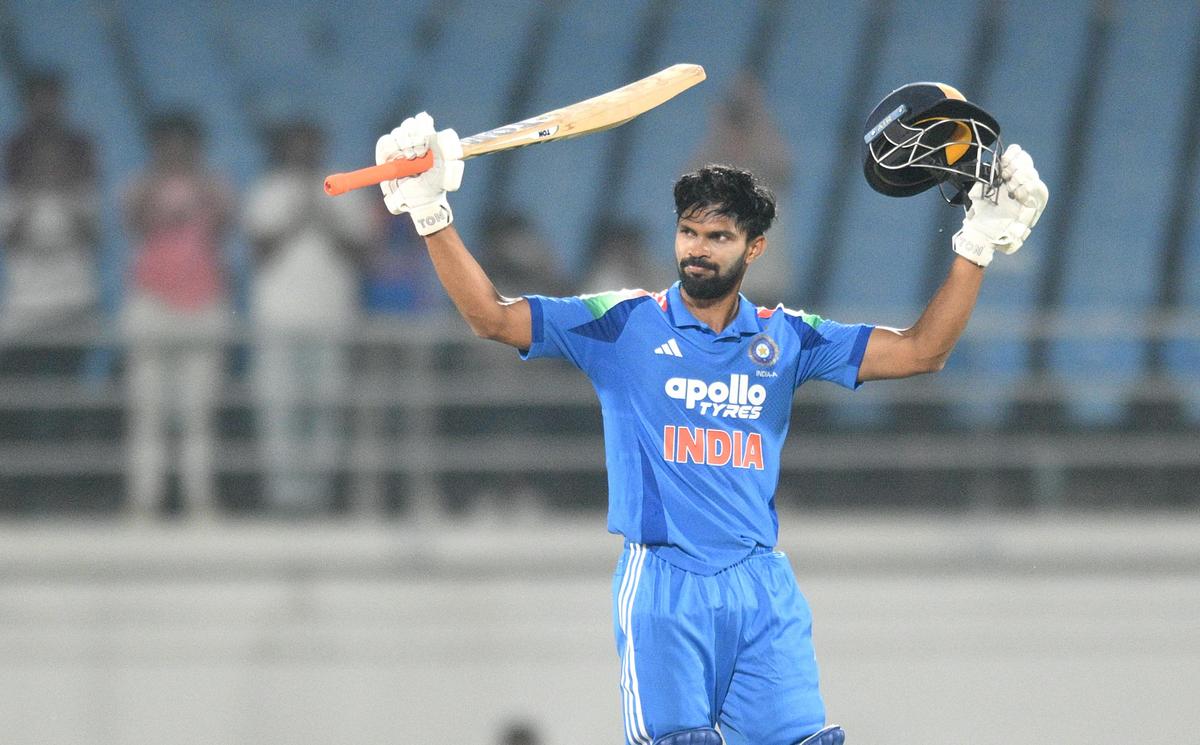
The 28-year-old’s essay reminded that Indian management may not be able to overlook anchors entirely, at least in the One-Day format.
| Photo Credit:
Vijay Soneji

The 28-year-old’s essay reminded that Indian management may not be able to overlook anchors entirely, at least in the One-Day format.
| Photo Credit:
Vijay Soneji
With Tilak Varma, he added 89 runs built on rotation. When Tilak struggled to find gaps, Gaikwad swept and pulled the spinners to keep the innings moving, giving his captain time to settle. While Tilak managed 39 off 58 deliveries with just two boundaries, Gaikwad ensured South Africa-A never tightened the noose.
His hundred, brought up with a pick-up over midwicket for a four, was a culmination of control and awareness.
The knock brings up a larger question that India’s white-ball setup continues to wrestle with: In a system obsessed with players having an X-factor, where does a player like Gaikwad, with a subtler approach, fit? He has already played six ODIs and 23 T20Is for India, last featuring in early 2024, yet he remains on the fringes, overshadowed by flashier profiles.
In a generation sprinting towards aggression, Gaikwad is proof that an anchor’s art hasn’t disappeared – and that Indian management may not be able to overlook it for much longer, at least in the One-Day format, where he has scored 4,441 runs at an average of over 56.
Published on Nov 14, 2025


