
Eden Gardens’ fabled concourses gear up for another taut World Cup clash
On the eve of a World Cup match, stadiums often appear interchangeable. Fresh paint. Sponsor boards aligned. Practice pitches are shaved into neutrality. Eden Gardens resists that anonymity. Not because of architecture, but because of accumulation. Too much has happened here for the present to feel entirely self-contained.
Established over 160 years ago, the venue is often described as iconic. Accurate as that may be, it still feels insufficient, even a bit cliched. Many grounds are old, but few operate as pressure chambers. Now, as the Eden Gardens prepares to host the first semifinal of the 2026 T20 World Cup between New Zealand and South Africa, it does so with a record of turning cricket matches into moments of reckoning.
In 1991, when South Africa returned from apartheid-era isolation, its first officially sanctioned international fixture was staged here against India. More than 90,000 spectators arrived. The figure matters not as trivia but as testimony. This was not merely a bilateral contest; it was cricket acknowledging a geopolitical correction. Eden absorbed that symbolism and magnified it.
Two years later, South Africa was back, and the reckoning was sporting rather than political. In the 1993 Hero Cup semifinal, six runs were required from the final over. Mohammad Azharuddin handed the ball to Sachin Tendulkar. A run-out off the first ball, three dots to Allan Donald, a single, and then Brian McMillan deceived in flight. India won by two runs. Eden did what it often does: it tightened the screw.
Pressure at this ground has produced mastery as well as mayhem. In the Hero Cup final days later, Anil Kumble returned figures of 6 for 12 against West Indies, conceding four runs in four overs. It remained India’s best ODI bowling return until Stuart Binny surpassed it in 2014.
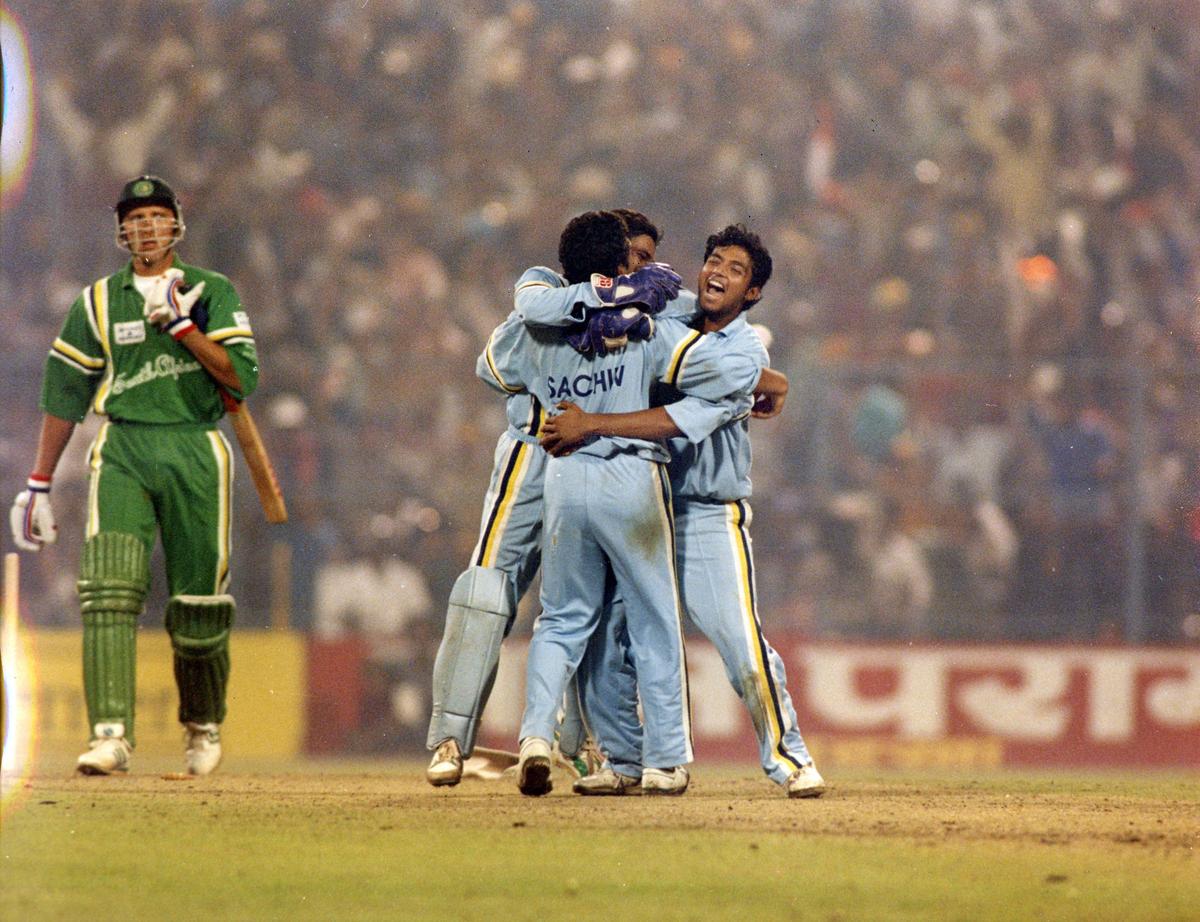
Sachin Tendulkar being hugged by Ajay Jadeja and keeper Vijay Yadav after India’s final over win over South Africa in the Hero Cup 2024 semifinal at the Eden Gardens.
| Photo Credit:
V.V. KRISHNAN

Sachin Tendulkar being hugged by Ajay Jadeja and keeper Vijay Yadav after India’s final over win over South Africa in the Hero Cup 2024 semifinal at the Eden Gardens.
| Photo Credit:
V.V. KRISHNAN
But compression does not always yield control. In the 1996 ODI World Cup semifinal against Sri Lanka, it was India which buckled. Chasing 252, it slid from stability to 120 for 8, seven wickets falling for 22. The crowd followed the collapse. Bottles were thrown, fires lit, and the match was awarded away. On this occasion, Eden’s weight settled on the host and its faithful. The pressure it had once imposed on visiting sides returned home.
Even the global balance of the game has shifted under its gaze. The 1987 World Cup final, won by Australia against England, confirmed that the subcontinent was no longer a peripheral host but a central force in cricket’s economy and imagination. Eden was not merely a backdrop; it was a statement of where the sport’s emotional centre now lay.
And then there was 2016. In the ICC T20 World Cup final, Carlos Brathwaite struck four successive sixes off Ben Stokes to deliver the West Indies its second T20 title. It was a finish so abrupt it felt fictional. Yet it also illustrated something consistent about Eden in the floodlit age: it accommodates the modern game’s violence without losing its sense of occasion. The old amphitheatre can handle new rhythms.
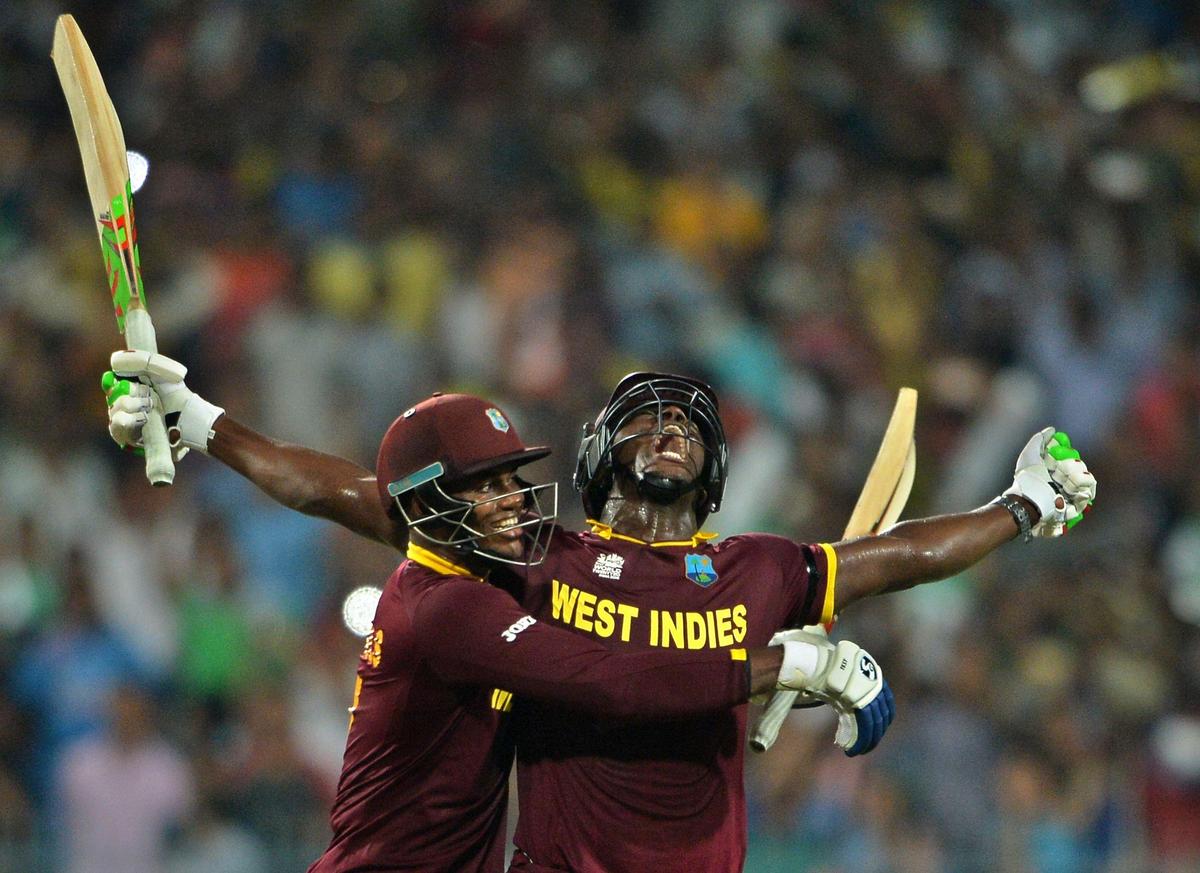
West Indies’ Carlos Brathwaite and Marlon Samuels celebrate victory in the World T20 final against England at the Eden Gardens Stadium in Kolkata.
| Photo Credit:
K. R. DEEPAK
West Indies’ Carlos Brathwaite and Marlon Samuels celebrate victory in the World T20 final against England at the Eden Gardens Stadium in Kolkata.
| Photo Credit:
K. R. DEEPAK
What, then, does all this mean for a semifinal between New Zealand and South Africa? Nostalgia does not alter lengths or slow a yorker. Yet venues exert subtler pressures. South Africa’s association with Eden is layered. It re-entered international cricket here in 1991. It was denied in the 1993 Hero Cup and again, by the narrowest of margins, in the 2023 ODI World Cup semifinal. But the ground has not been uniformly unkind. Last year, it yielded South Africa’s first Test victory in India since 2010. Eden has tested the Rainbow Nation and occasionally rewarded it.
New Zealand, for its part, is well acquainted with cricket’s margins. It has inhabited semifinals often enough to know that these matches are decided less by narrative than by execution.
Eden will not care for backstories once the ball is released. It clearly has a penchant for matches that tilt quickly and linger long. New Zealand and South Africa will bring their plans and their players. The ground will supply the rest: the noise, the memory, the sense that something here has a habit of slipping beyond calculation.
Published on Mar 03, 2026


