
Asia Cup Tour Diary: Dubai’s order meets India–Pakistan’s chaos
The forces of entropy have reigned supreme in the orderly streets of Dubai, where even supercars respect traffic signals at empty crossroads in the middle of the night. The Diary witnessed the metropolis’ emphasis on discipline and safety first-hand, an hour after having landed there, when it left its backpack containing legal documents and government IDs in an airport cab. The Diary’s restlessness was assuaged by the hotel’s concierge desk’s soothing words, ‘Nothing goes missing in Dubai.’ The bag was promptly returned within half an hour.
But the Asia Cup has infused considerable chaos, with bitter rivals India and Pakistan slugging it out off the field rather than on it. The cricketing order has been upended; the tables have turned.
A match referee, only fleetingly in the news when players are slapped with demerit points and captains fined for slow-over rates, has found himself in the crosshairs of simmering geopolitical tensions between India and Pakistan that spilled onto the cricket field recently.
Andy Pycroft, a moral arbiter of the sport since 2009, was accused of breaching the ICC’s hallowed Code of Conduct by asking the captains of India and Pakistan not to shake hands at the toss. The 69-year-old Zimbabwean was suddenly thrust into the spotlight; team combinations were forgotten, the toss became a formality, and the keen eyes of the media would trace Pycroft’s heavy gait to the pitch when the ICC decided he would stay on as match referee for Pakistan’s subsequent games against the UAE and India in the wake of the ‘handshake gate’.
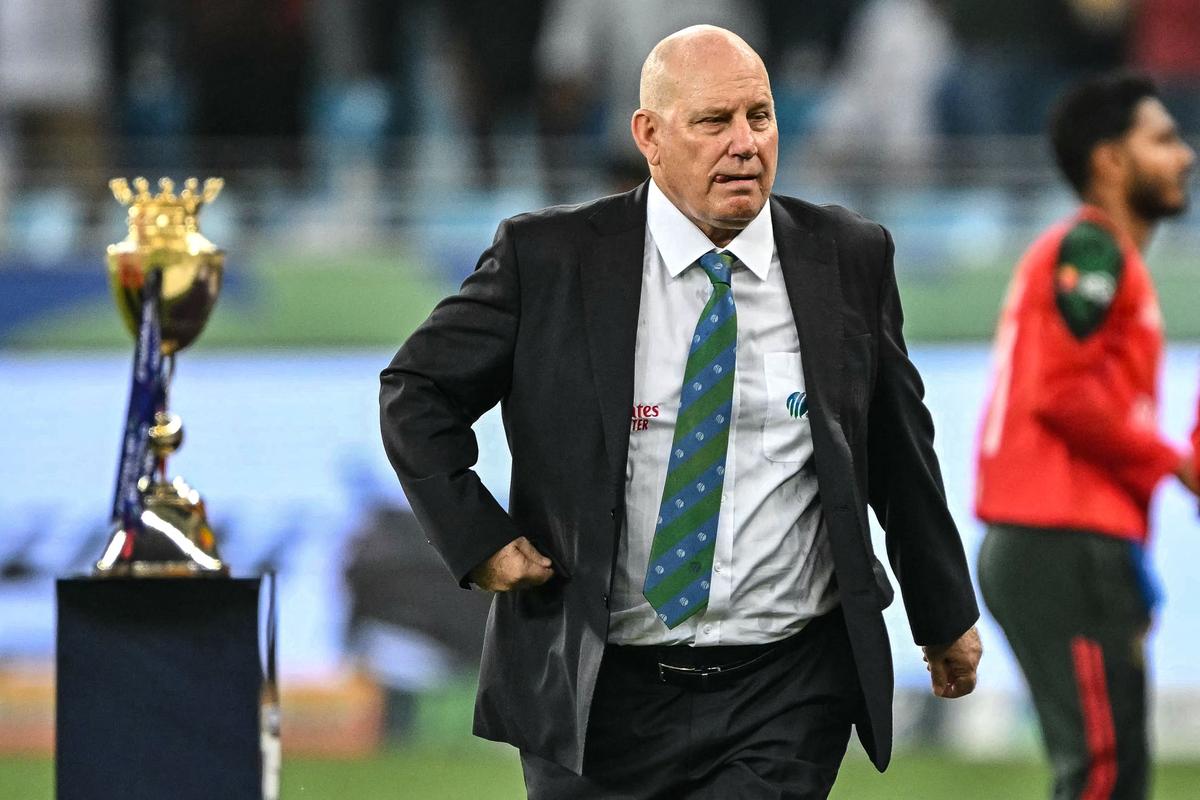
‘Handshake row’: Match referee Andy Pycroft was accused of breaching the ICC Code of Conduct after reportedly asking the India and Pakistan captains to skip the toss handshake.
| Photo Credit:
AFP

‘Handshake row’: Match referee Andy Pycroft was accused of breaching the ICC Code of Conduct after reportedly asking the India and Pakistan captains to skip the toss handshake.
| Photo Credit:
AFP
Pakistan was left miffed by the Indian team’s ‘unsporting’ decision not to shake hands, but ironically kept the UAE’s players waiting after Pakistan Cricket Board (PCB) chairman, Mohsin Naqvi, asked his players to deboard the bus at the team hotel, leading to an hour’s delay in proceedings. Such a puerile stunt in any professional sport would have led to the opposition being granted a walkover, but this is the Asia Cup, a tournament that now seems shoehorned into the calendar to milk the ‘India vs Pakistan’ cash cow.
There were calls from the Indian public to boycott the game against Pakistan, followed by the PCB’s protestations and pull-out threats, but the authorities from either country didn’t relent. Much like in the world order, economics can strike an awkward compromise even amongst bitterness. Meanwhile, the media from both countries were united on most fronts, sharing notes, news and banter, and were at the receiving end of the only boycott that was enforced, with Pakistan cancelling consecutive pre-match press conferences.
The press meetings that were conducted came with the rider of ‘no political questions’, but Suryakumar Yadav invariably defused the tensions. Despite leading the team in a tense atmosphere and tackling off-the-field issues, a wry smile always floated around his lips in all interactions. Even when the media exhausted its allotment of questions, he entertained an additional one. “Bindaas pucho (ask freely),” he remarked.
A couple of days after his birthday on September 14, Suryakumar obliged the travelling Indian media contingent with a cake-cutting and photo session following a gruelling training stint at the ICC Academy.
The 34-year-old exudes an aura of calm authority and retains an air of exclusivity without being aloof or supercilious. Rudyard Kipling anachronistically saw his apparition when he wrote, “If all men count with you, but none too much,” in his oft-quoted poem ‘If’.
Even in his cheekiness, there is respect, and in his implied answers, a direct message. “Close your room, switch off your phone, and sleep” is his mantra to shut out the outside noise and advice to those caught up in the rigmarole of quotidian life.
He also came closest to striking any semblance of peace between the neighbours when he coolly proclaimed that India vs Pakistan ‘is not a rivalry anymore’ after the Men in Blue did the double over Salman Agha’s men. The pronouncement momentarily caused a flutter; the Indian media had its headline, and a quiet acquiescence settled over the Pakistani tribe of scribes.
The madness of the relations between the neighbours needed the method of Dubai to survive. It is no surprise then that five of the last 10 encounters between them have been held in the UAE, where expatriates from both countries count as one. With your phone constantly buzzing with stern Public Safety Alerts from Dubai Police to ‘comply with instructions and guidelines’ during and after India-Pakistan matches, the scope for miscreants is limited.
With India being considered a runaway leader in T20I cricket, the Asia Cup has been more about competing for the tag of ‘Asia’s second-best team’. While that debate remains unresolved, Dubai is a frontrunner to be ‘Asia’s best host’.
Published on Sep 24, 2025


