
Women’s World Cup 2025: I lead others not through words, but through actions, says New Zealand’s rising star Brooke Halliday
There’s an easygoing warmth to Brooke Halliday — jovial, soft-spoken, and modest about her achievements—guided by her belief in “staying true to herself” no matter the circumstance.
That quiet confidence was on full display during one of the biggest moments of her career—New Zealand’s 2024 ICC Women’s T20 World Cup triumph. In a tense final, what stood out about Halliday was her contributions—a crucial partnership with Amelia Kerr, the big wicket of South Africa’s Sune Luus—and a calm presence that has become her hallmark.
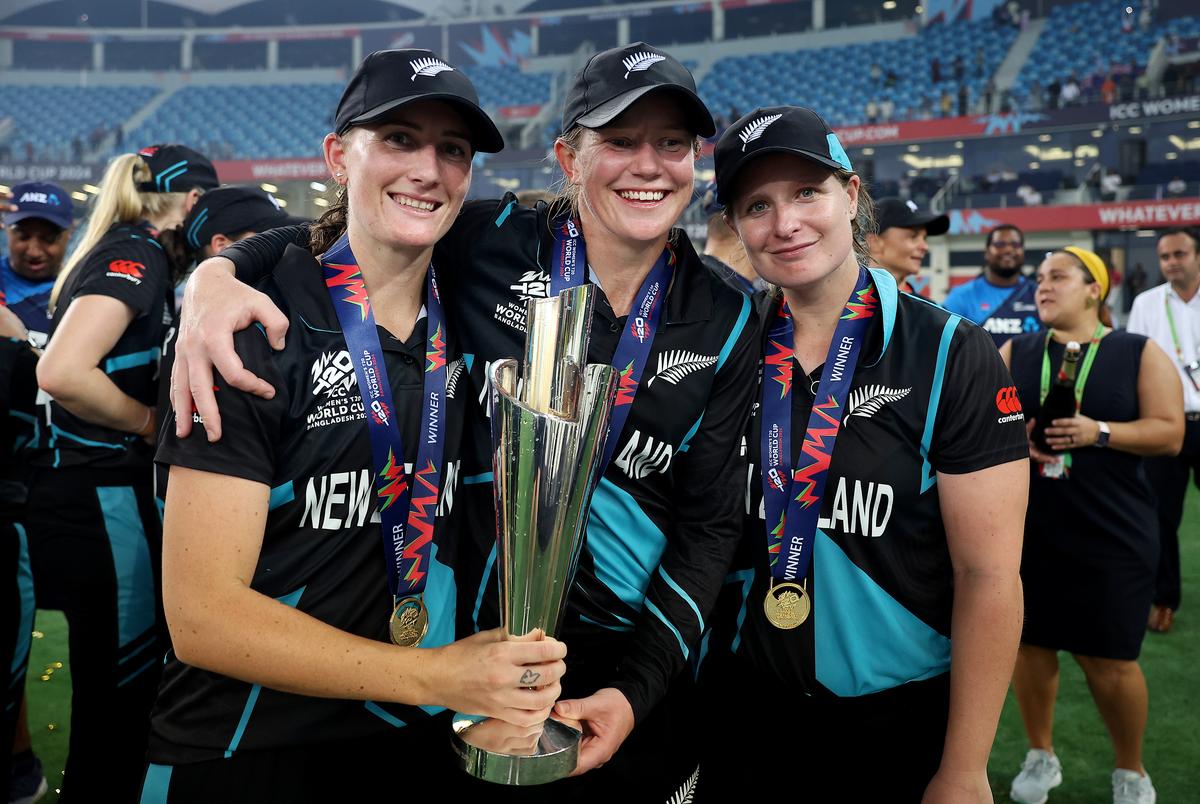
Rosemary Mair, Maddy Green and Brooke Halliday of New Zealand pose for a photo with the ICC Women’s T20 World Cup Trophy after defeating South Africa.
| Photo Credit:
GETTY IMAGES

Rosemary Mair, Maddy Green and Brooke Halliday of New Zealand pose for a photo with the ICC Women’s T20 World Cup Trophy after defeating South Africa.
| Photo Credit:
GETTY IMAGES
As she recalls that day, she can’t stop laughing. The memory—or rather, the lack of it—still amuses her deeply.
“I actually didn’t realise I had bowled in the game until I heard a couple of the coaches and players,” she laughs. “We even asked ChatGPT how the White Ferns won the final—it mentioned me bowling! But I have no recollection of it.
“From an emotional point of view, it’s all a blur. I was just fortunate that day that the shots that I played, whether it was the reverse or going deep in my crease and sweeping it, all paid off. I was able to change that momentum and put us in a position to have a competitive total. It was a big win and a great achievement for us in the end,” she tells Sportstar.
That victory was not only a defining moment for New Zealand cricket but also a reflection of Halliday’s evolution. Four years on from her debut, she has quietly become one of White Ferns’ most dependable performers—a middle-order mainstay, a handy option with the ball, and a leader in her own understated way.
A family affair
For Halliday, the journey began in Auckland, where cricket was almost an inheritance.
“A little bit of family history is there,” she quips. “My dad and my uncles played cricket every Saturday down at a ground in Auckland, the Manukau City Cricket Club. My grandfather and my great-uncle also played for the club.
“From there, my brother and I ended up playing junior cricket, with our father coaching us,” she says. “When you see your dad, uncle, and brother all doing something, you naturally end up doing the same thing—and cricket surely has its moments. But otherwise, I have enjoyed it right from the start.”
Her rise through domestic cricket with Northern Districts was gradual but marked by consistency. Years of solid performances in the Hallyburton Johnstone Shield finally opened the door to international cricket, and in February 2021, she made her debut against England.
She made an immediate impact—scoring back-to-back half-centuries in her first two ODIs—and has since cemented herself as a player who delivers in tight situations. Those early performances set the tone for what would follow—an ability to rise when it matters most.
Stepping into new roles
Over time, she has seen the team transform, with new faces arriving and veterans nearing retirement. “Over the last 12–18 months, my role has changed in the sense that I am probably looked at as more of a leader in the group, which at times doesn’t come all too naturally to me,” she admits.
“I’m not the most outspoken person. I probably lead others not through words, but more through actions.”
That leadership has extended to mentoring younger players, such as Izzy Gaze and Georgia Plimmer, both of whom are finding their feet in international cricket.
“Georgia and I were talking about how I played in the game against Bangladesh. She was asking questions about how she might be able to learn something from it,” she says, referring to her slow-burning knock in New Zealand’s first win of the Women’s ODI World Cup 2025.
With senior players like Sophie Devine nearing the end of their careers, Halliday knows her role will grow further. “We’ll be losing a lot of experience soon,” she acknowledges. “Then it becomes about how I can still be me, but also help lead others in the team.”
Even with expanded leadership duties, batting remains central to her all-round focus. “To be honest, I prioritise batting over bowling. I’m not one of the first five bowlers on the team, so it’s not something I spend too much time on. But at the same time, it is still something that I do slowly behind the scenes.”
Lessons from legends
Guiding others is also a learning process for Halliday. That sense of balance—staying authentic while taking on more responsibility—has been shaped by years spent alongside some of the game’s greats.
“The biggest thing I have learnt from Suzie (Bates) and Sophie is the way they trust their abilities,” she says.
“Just a prime example, but not the nicest one: Suzie started this tournament with two ducks, and a lot of people would maybe cave. But Suzie is being Suzie. Being able to see someone of that calibre take the criticism on board and be in a sticky situation, but go out there with a smile on their face is great,” she says.
It’s a mindset Halliday has adopted as well. “I’ve also learnt not to ride the highs and lows of cricket,” she adds. “It can be tough at times, but you’ve got to back yourself and enjoy the game.”
It’s an advice Halliday has carried into her own game—whether it’s the 69 against Bangladesh recently, or her highest ODI score, the 86 against India in the 2024 ODI series decider.
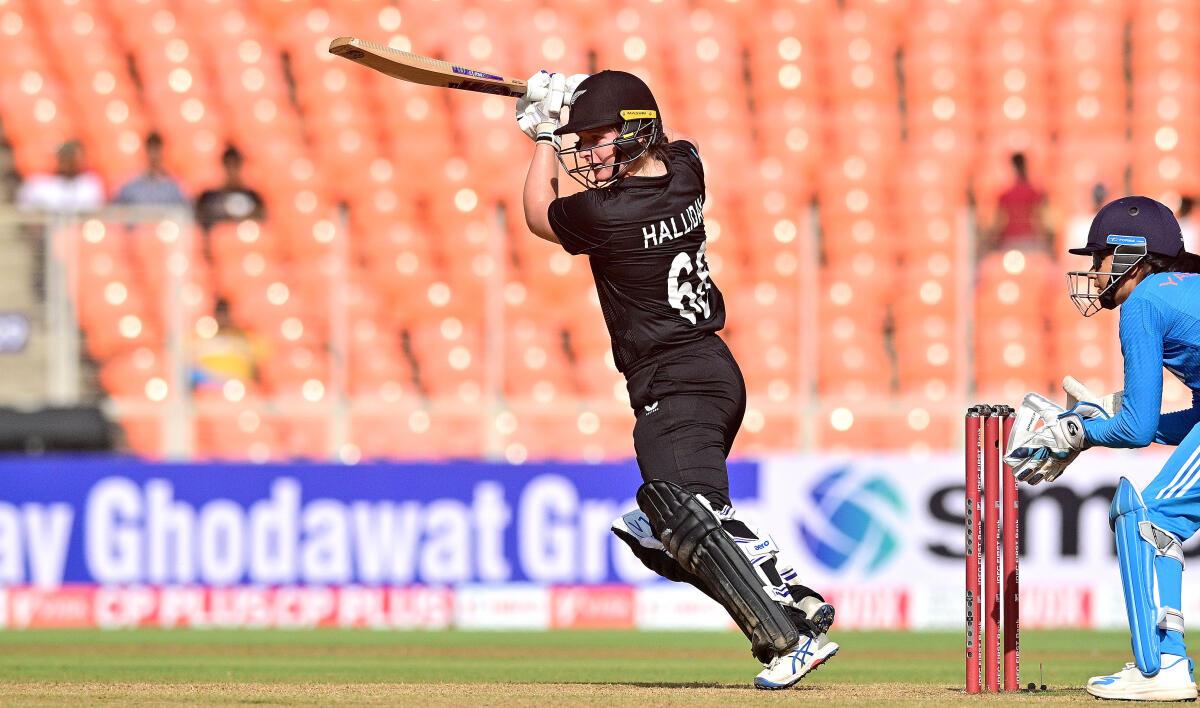
Brooke Halliday in action during the third and final ODI against India Women at Narendra Modi Stadium in Ahmedabad on October 29, 2024.
| Photo Credit:
VIJAY SONEJI
Brooke Halliday in action during the third and final ODI against India Women at Narendra Modi Stadium in Ahmedabad on October 29, 2024.
| Photo Credit:
VIJAY SONEJI
“The biggest part of batting at no. 5 is that you never really know what position you are going in at,” she says.
“At times, it could be to continue the momentum that the top-order has built or change it in a way that puts us in favour. I have to go in with quite an open mind,” she remarks.
“The day, last year in India, was exactly that. We were in a tough position. I just tried to simplify it as best as possible, watch the ball and get myself into a position where I can get our team a winning chance. A couple of days ago, it was a similar situation (against Bangladesh).”
A new era
Those experiences—of adapting, simplifying, and finding solutions under pressure—also shape her view of the women’s game today.
“It has grown so much in terms of professionalism, a lot more players who are now full-time cricketers,” she says.
“The competitions around the world, like the Women’s Premier League (WPL), the Women’s Big Bash League (WBBL) and the Hundred, are making the quality of cricket a lot better. And that means the international game is also growing.”
New Zealand Cricket has played a significant part in that evolution, being one of the first boards to introduce equal pay for its men’s and women’s cricketers—a landmark decision that Halliday says has transformed the domestic ecosystem.
“Having equal match payments has allowed players the freedom to focus full-time on cricket,” she explains.
“It’s helped develop our game massively. The cool thing about our contracts—the White Ferns 17—is that those of us who are full-time can go back and show the part-time players how to train purposefully, and that lifts everyone’s standards.”
She also points to the reintroduction of the New Zealand ‘A’ programme and the expansion of domestic fixtures, like North vs South, as crucial pathways for developing players.
“The more cricket that we get to play, the better cricket we’ll play,” she says. “It’s a stepping stone in the right direction.”
After years of quiet graft and steady growth, Halliday’s story has come full circle—the same simple joy, just a bigger stage. Along the way, somewhere back home in Auckland, she may have inspired another young girl to pick up a bat for the first time, and embark on a similar journey that started with a family’s weekend game.
Published on Oct 16, 2025


