
Women’s ODI World Cup 2025: Lower order at the forefront, feat. Richa Ghosh and Nadine de Klerk
For much of the Women’s ODI World Cup 2025, the lower order was the story: rescuing innings, turning games, and redefining what it meant to bat at No. 8 to 11.
But in the final, the top and middle-order batters held firm, leaving little for the tail to do as the contest was largely decided before they were needed.
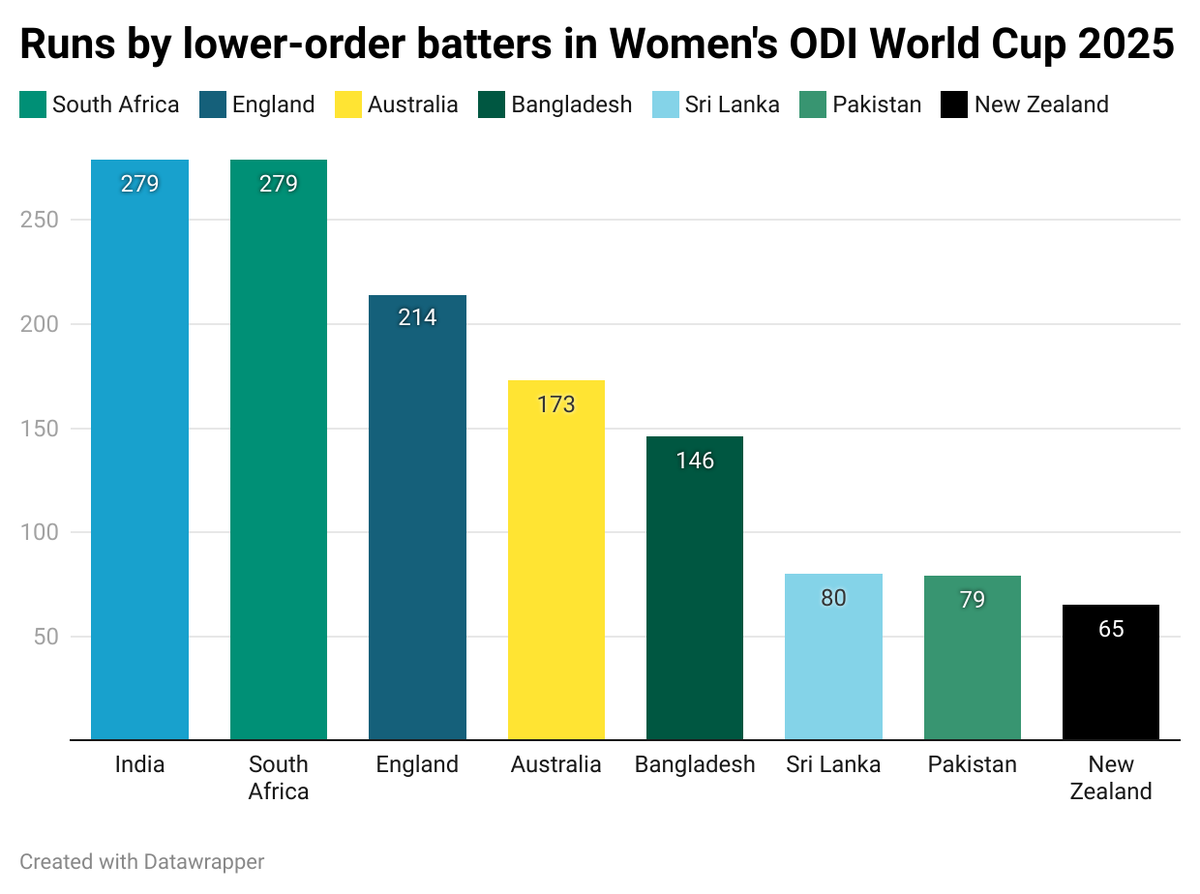
Yet, the deeper story of the tournament lay in a rare symmetry: India and South Africa, the two sides with the most productive lower-order hitters, reached the final and closed their campaigns with identical tallies — 279 runs from their last four batters.
It was as if the late-order architects themselves had mapped out the path to the title clash, proving that in modern women’s cricket, depth and resilience at the bottom could shape the destiny of a World Cup.
Australia’s blueprint
The early signs of this lower-lineup revolution can be traced to Australia, a team long recognised for its batting depth.
“They bat so deep and we know the talent they’ve got,” said Sophie Devine after New Zealand’s loss to the Aussies in the opener. “You just can’t take your foot off the throat because they bat all the way to 11.”
The warning became a reality against Pakistan. Australia, teetering at 76 for seven, saw No. 10 Alana King rewrite the script with an unbeaten 51, her highest-ever ODI score coming under intense pressure. Together with Beth Mooney, she stitched a record 106-run ninth-wicket partnership.
The tournament statistics underlined the trend. The four teams with the most productive lower orders reached the semifinals: India and South Africa led the way, followed by England (214) and Australia (173).
Depth that delivers
While Australia set the early tone, the tournament’s defining showcase of lower-order batting came in the clash between India and South Africa, with the spotlight firmly on Richa Ghosh and Nadine de Klerk.
Richa, batting at No. 8, made an immediate impression with a highest score of 94, keeping her team competitive with stability and aggression when the top faltered.
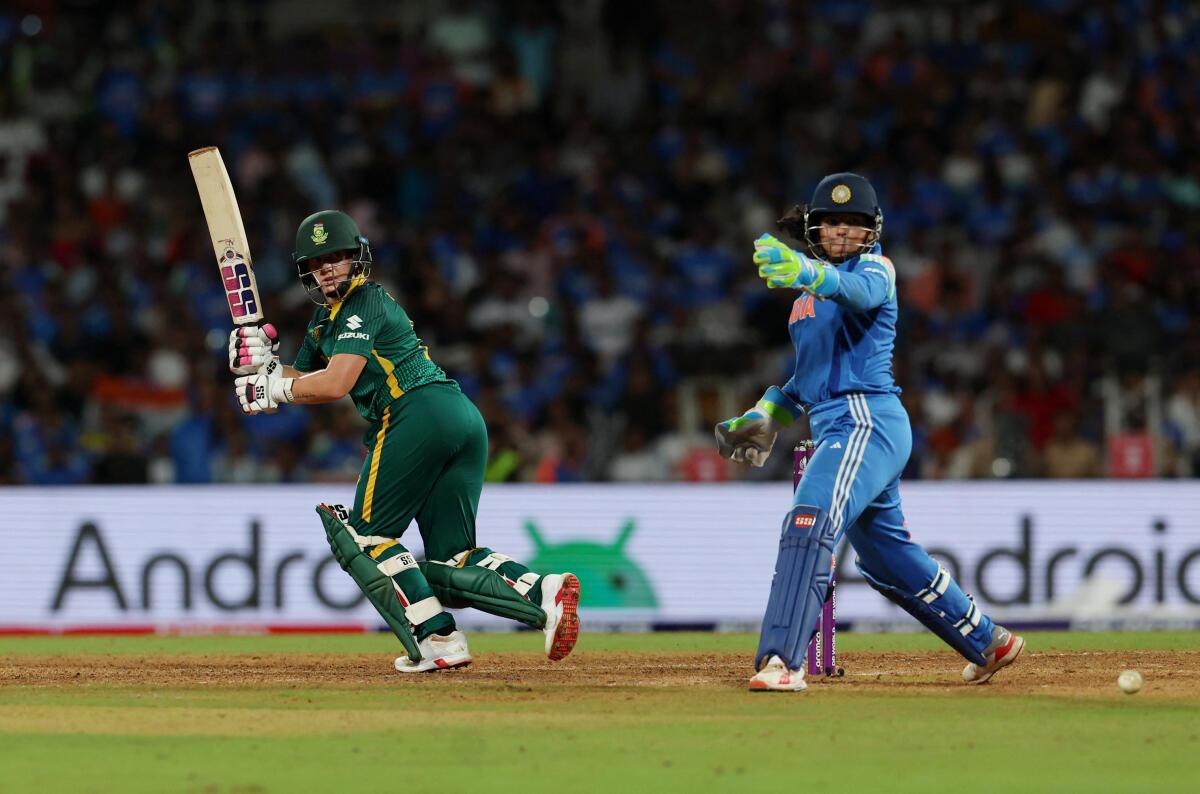
South Africa’s Nadine de Klerk in action during the Women’s World Cup 2025 final against India in Navi Mumbai.
| Photo Credit:
REUTERS

South Africa’s Nadine de Klerk in action during the Women’s World Cup 2025 final against India in Navi Mumbai.
| Photo Credit:
REUTERS
De Klerk, walking in at No. 8, responded in style, demonstrating why she has become South Africa’s go-to finisher. In seven innings, she scored 208 runs, striking at 131.64 and averaging 52.
“We’ve always known Nadine’s very talented. It seems like this year, her batting is really clicking,” said Marizanne Kapp after South Africa’s comprehensive win over Pakistan in Colombo. De Klerk joined forces with the veteran to hammer 52 runs off 20 balls while racing to an individual score of 41 off just 16.
Statistical leaps at No. 8
The contrast between the finishers and those who merely survived was evident throughout the tournament. England’s Charlie Dean, another regular at No. 8, scored 124 runs in six innings, but her strike rate of 67.39 and boundary percentage of 5.97 lagged far behind De Klerk’s and Richa’s.
Meanwhile, Richa was strategically shuffled around the order, held back to unleash her natural aggression in the closing overs. Even though she batted at No. 8 only twice during the tournament, she outscored Dean and trailed only De Klerk, compiling 129 runs at a strike rate of 132.98.
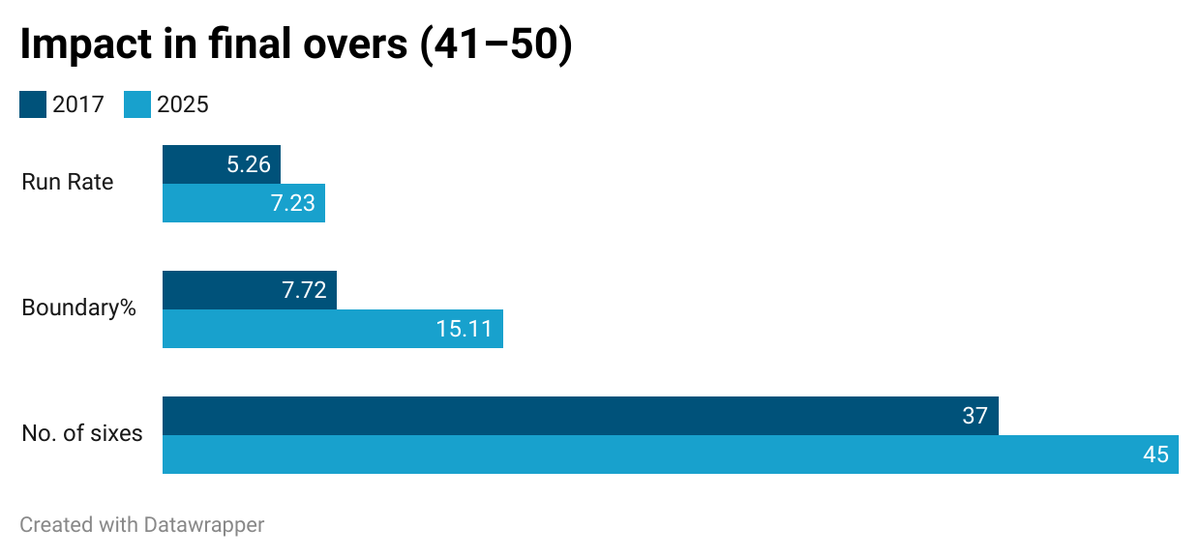
Naturally, the No. 8 position emerged as the pivotal spot for late-order impact. Compared to 2017, averages increased from 17.68 to 24.34, and boundary percentages rose from 6.45 to 10.28, indicating both greater consistency and increased attacking intent. Between overs 41 and 50, the run rate also surged from 5.26 to 7.23, and the boundary percentage from 7.71 to 15.11, showcasing a growing ability to dictate momentum in the closing stages.
Notably, of the record 133 sixes hit in the tournament, 45 came in the final 10 overs — just seven short of the 52 struck during the entire 2022 edition.
India’s stronghold
This surge in late-order impact was perhaps most evident in India’s campaign, with the team’s strike rate touching 120 this year, compared to 94.52 in 2022. In the opener against Sri Lanka, Deepti Sharma and Amanjot Kaur stitched together a crucial 103-run partnership, with Amanjot contributing a match-saving 57 off 56 balls.
“You can’t say India was in trouble. I was yet to bat,” quipped Amanjot, who, along with Richa and Sneh Rana, embodied the calm self-belief that allowed the lower-order hitters to thrive.
Glimpses of Richa’s special knock against South Africa in the league stage resurfaced in the final. Walking in at No. 7, she imposed herself immediately, smashing a 24-ball 34 that included three fours and two sixes at a strike rate of 141.66.
Though the summit clash largely defied the trend of the lower order coming to the party, the rearguards of all the top teams were worth their weight in gold throughout the tournament and proved that the last line of defence could no longer be overlooked.
Published on Nov 04, 2025


