
What’s ailing Gautam Gambhir’s Test team: The slow mechanics behind India’s eroding home advantage
As Simon Harmer continued to spin his web around the Indian batters in Guwahati during the second Test, broadcasters kept highlighting how much slower the South African spinners were operating compared to their Indian counterparts.
A few minutes after he closed off the game and the series with a six-wicket haul, Harmer revealed that slowing down was a deliberate ploy, tailored to the red-soil pitch in Guwahati.
“Coming here, we spoke about it and with the red soil pitch being a bouncier, quicker turn sort of wicket, we felt that the slower pace would be better,” said Harmer at the post-match press conference.
It was also, in effect, an inadvertent double bluff.
In the Kolkata Test, played on a diabolically unpredictable surface, Harmer and Co. were quicker through the air. It was a trick lifted directly from the Indian spin playbook, and it delivered spectacular results. Harmer, Keshav Maharaj and Aiden Markram combined for seven of the nine wickets to fall in India’s doomed 124-run chase.
“If you look at the Indian finger spinners, they’re extremely accurate. On surfaces that assist spin, it becomes very difficult because at that pace, you force a batter to commit very early. Slower pace allows the batter to adjust once the ball is bounced,” explains Harmer.
As it turned out, the Indian tweakers amped up their speed in Guwahati, only to discover that the South Africans had gone the other way.
“I don’t know if they got caught up in what happened in the first Test because I think the comparison was that our speeds were a little bit quicker than theirs, that they felt that maybe they needed to be quicker,” said Harmer.
The variance in delivery speed offers a snapshot of how South African spinners outthought their counterparts to help their side reign supreme.
Spin leadership
The current Indian spin attack, comprising Ravindra Jadeja, Kuldeep Yadav, Washington Sundar and Axar Patel (only in Kolkata), lacks a lead bowler in the manner R. Ashwin once conducted proceedings in home Tests.
There was also a lack of coherence in the game plan on display. In Guwahati, despite realising that the pitch was not working in their favour, the Indian spinners persisted with their flatter trajectories, with only Kuldeep making a consistent effort to beat batters in the air with drift and dip.
Blunting their wicket-taking potency further were India’s conservative field set-ups. For example, in Guwahati, Indian skipper Rishabh Pant had just one close-in catcher for the spinners for most of the morning session on Day 2, despite South Africa being six down. The visiting side’s lower order ticked off easy singles as it saw off a tricky phase to set up a massive first-innings total.
Pitch volatility
The current Indian spin quartet has also been forced to bowl in drastically different conditions, thanks to the team management’s oscillating pitch choices.
In the West Indies series in October, India played on truer surfaces that held together longer into the Tests.
But after witnessing Indian bowlers being pushed back by Caribbean batters in the second Test in Delhi, the team management pivoted to a dry surface in Kolkata, which bounced unpredictably right from Day 1.
It proved to be a fatal call, as India lost the toss and had to bat last on a devious pitch, resulting in a collapse and a 30-run defeat.
The Indian think-tank backtracked immediately and opted for a flatter track in Guwahati. But the side lost the toss again and watched South Africa bat it out of the game, with its spinners proving ineffective on unfavourable conditions.
Driving the failure was a lack of adaptability, which proved to be the biggest difference between the two sets of spinners, as suggested by Proteas skipper Temba Bavuma.
Harmer and his spin colleagues averaged just 15.48 in the series, while the Indian tweakers nearly doubled that at 30.33. It was a dramatic flip from the way Tests had unfolded in India over the last decade.
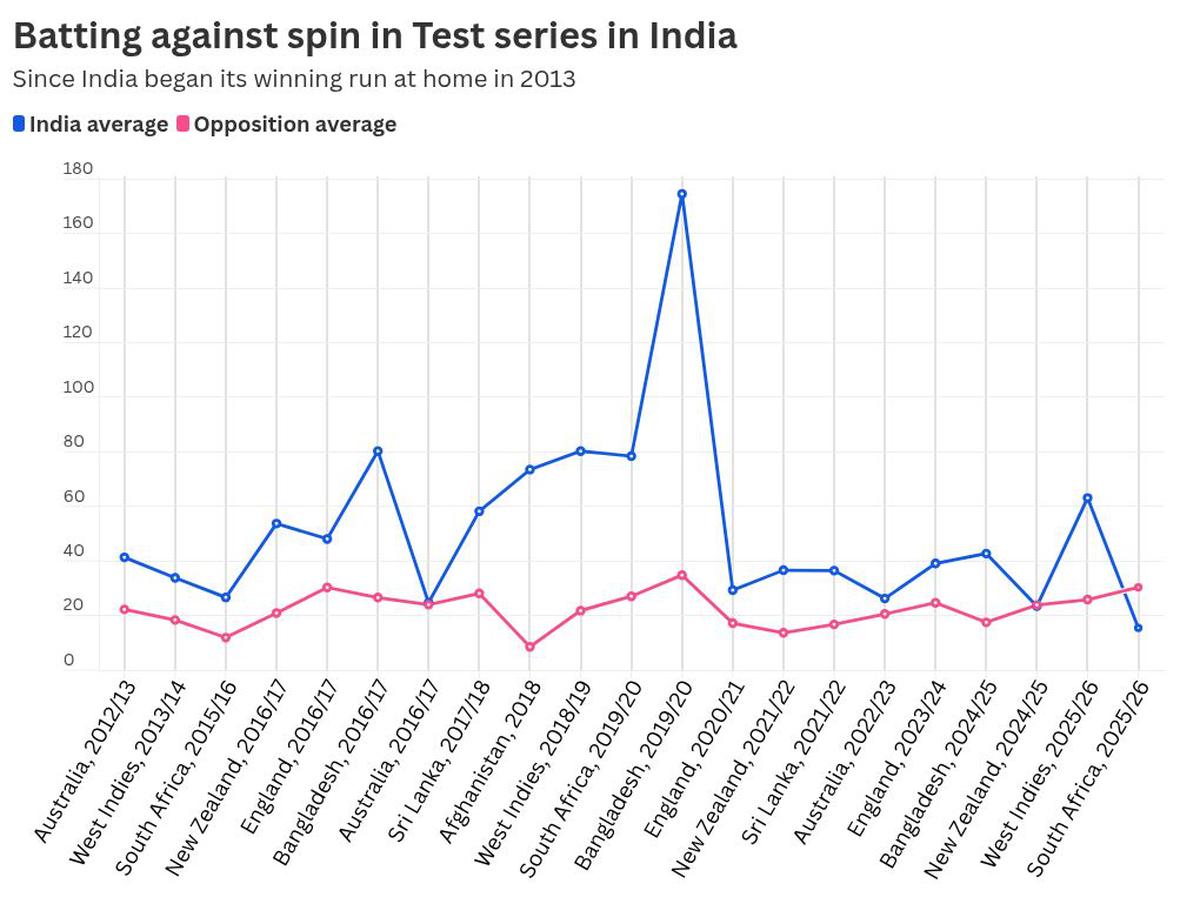
Golden era
India’s supremacy at home, which lasted from 2012 to 2024, was founded on the margin of difference the side created with spin, with both bat and ball.
This era of dominance sprang into existence in the aftermath of a startling defeat to England in 2012.
English spinners Graeme Swann and Monty Panesar combined for 37 wickets in the four-match series. The duo unsettled the Indian batting line-up, barring Cheteshwar Pujara, as England secured a 2-1 win.
England’s spinners averaged 28.61 in the series, while the home tweakers went at 40.62, a key divergence that determined the fate of the contest. The away side’s batting charge was led by opener Alistair Cook, who amassed three centuries on the way to 562 runs from eight innings. Kevin Pietersen had a strong tour too, scoring 338 runs, including a stunning 186 at the Wankhede.
The ruins of this defeat pushed India into a forced transition, in which it found the pieces to build the winning machine it would eventually become.
Ashwin, who was part of that series, was soon joined by Ravindra Jadeja, and they quickly formed one of the most devastating spin duos in the history of Test cricket.
During India’s winning run at home, Ashwin and Jadeja collected a combined 539 wickets at just 20.18 runs apiece.
With time, the pair refined their batting to the point that they came to be regarded as genuine all-rounders, offering significant steel to the Indian lower middle order.
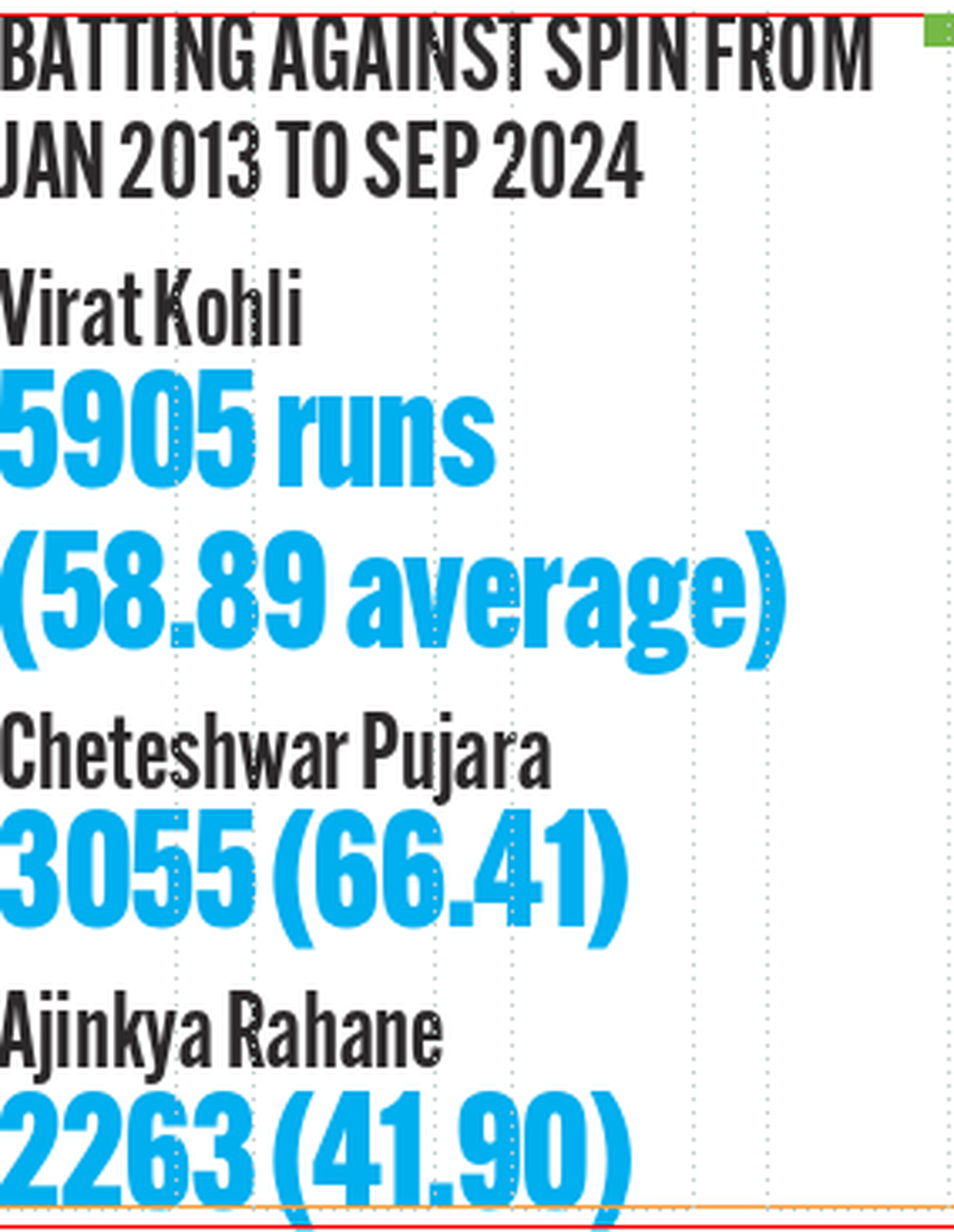
Meanwhile, Ajinkya Rahane joined Virat Kohli and Pujara to form a middle-order trio that provided India with substantial stability.
Their aptitude in negotiating spin, along with Ashwin and Jadeja’s sharpness with the ball, allowed India to keep visiting sides at arm’s length in home Tests.
Australia, in 2016/17, was the only team to come close to bridging this gap in the period, running India close in an intense series that finished 2-1.
Narrowing gap
The arrival of the World Test Championship in 2021 brought with it a need for more decisive results, prompting India to dial up its home advantage through pitches that began to spin square from Day 1.
What this did, unwittingly, was minimise the gap in skill between Indian spinners and visiting ones. This, in turn, made life harder for Indian batters, allowing away teams a stronger foothold in contests.
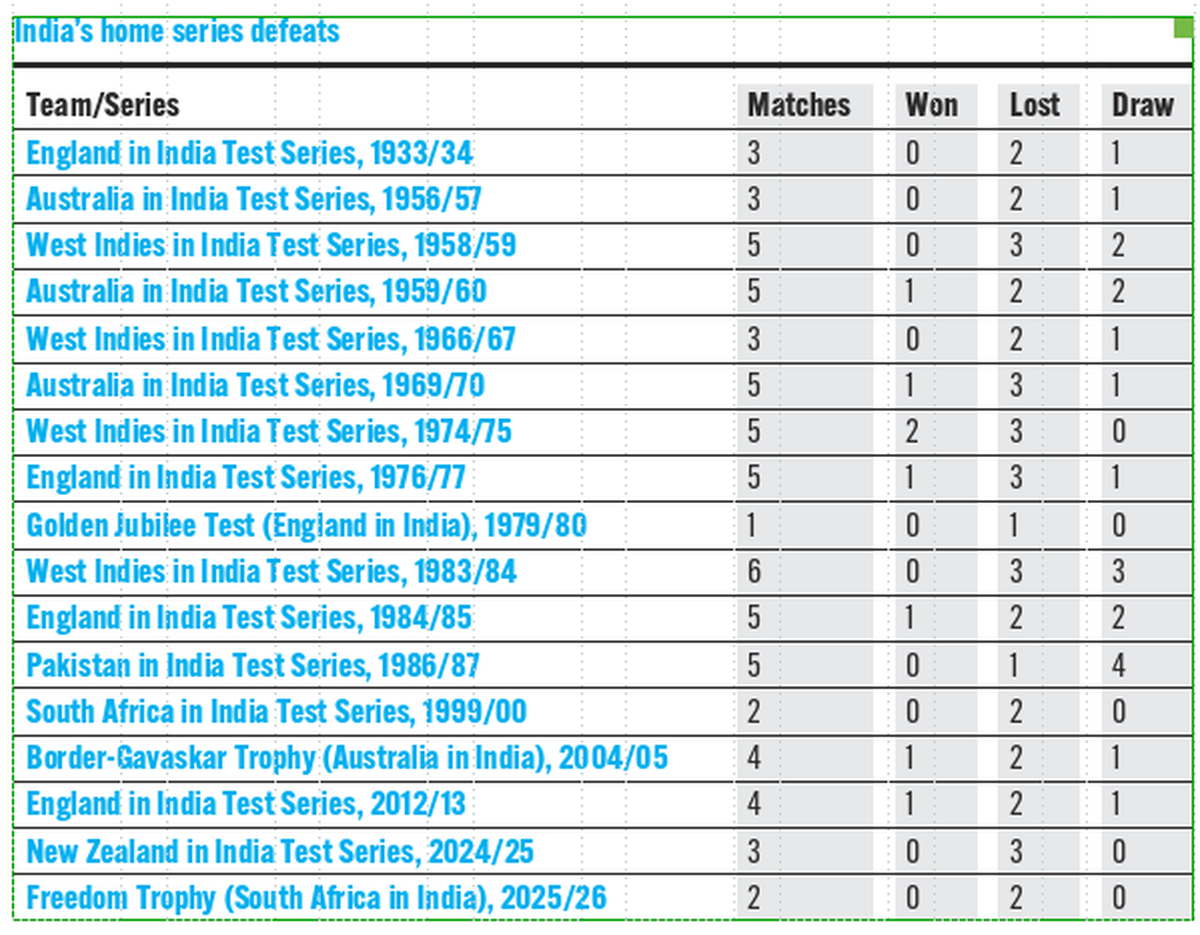
After losing just once in 34 Tests from 2013 to 2019, India went on to lose three of its next 19. Despite these stutters, India maintained its strong home record, pipping England and Australia following stiff battles.
However, the fault lines were evident and were eventually exploited by New Zealand late in 2024. The Kiwis became the first team in 12 years to overturn the spin gap, as they claimed a 3-0 series sweep no one saw coming.
The away spinners matched their Indian opponents in all regards, effectively negating the home side’s advantage. While Mitchell Santner dazzled in the second Test in Pune with a 13-wicket haul, Ajaz Patel stepped up at the Wankhede with 11 wickets.
A new-look Indian batting line-up, bereft of the experience of Pujara and Rahane, laboured futilely on sharp-spinning black-soil surfaces.
It also did not help India’s cause that its senior batters, Rohit Sharma and Kohli, endured a chastening series. While the former averaged 15.16, the latter did only fractionally better at 15.50. This is the lowest both have averaged in a home series in which they played at least six innings.
In totality, the seemingly unstoppable Indian ship of home Test superiority had its mast sliced by New Zealand.
South Africa, though, went one step further and overturned the vessel. At the centre of it all was Harmer.
Of the 25 wickets claimed by South African spinners in the series, 17 were Harmer’s.
The 36-year-old off-spinner had the ball on a string throughout, toying with Indian batters through his mastery over flight, pace and length, control earned across a long, winding and tumultuous career.
Experience edge
Thanks to a long stint with Essex in the English County system, Harmer has featured in 236 First-Class games and taken 1,017 wickets. The four Indian spinners combined have only 1,060 FC wickets, with nearly half belonging to Jadeja.
Washington presents the most interesting case of the four. He shares many traits with Ashwin: both hail from the same State, bowl off-spin and possess dogged batting styles. But in terms of off-spin acumen, Washington lacks the craft Ashwin had at a similar stage of his career.
That contrast is natural, considering Washington made his Test debut with a bank of just 12 First-Class matches, yielding 30 wickets. Ashwin, by comparison, had played 34 games and collected 157 wickets before his first Test.

Uneasy succession: R. Ashwin’s certainty forged India’s home dominance. Washington Sundar lacks the craft Ashwin had at a similar stage of his career.
| Photo Credit:
The Hindu Photo Library

Uneasy succession: R. Ashwin’s certainty forged India’s home dominance. Washington Sundar lacks the craft Ashwin had at a similar stage of his career.
| Photo Credit:
The Hindu Photo Library
What has worked in Washington’s favour is his ability with the bat. From 17 Tests, he has scored 885 runs at an average of 42.14. But his bowling average stands at 32.97. Against South Africa, Washington managed just a solitary wicket, not the output expected from a lead off-spinner.
It is clear that India’s selection policy for spinners, and bowlers by extension, heavily factors in their batting. In the away series against England, India benched Kuldeep throughout the five matches.
This stood in contrast to the weight of experience Harmer carried into the series, which included a near-career-ending tour to India in 2015. It can be no coincidence that Harmer, Maharaj and Ajaz all carried bruising memories of touring India in the past. With failure came experience, and with that, a blueprint for success.
Without taking anything away from him, it would be fair to say that Harmer’s imperiousness was magnified by the Indian batters’ glaring inability to handle the turning ball.
Batting rigidities
Since 2020, Indian batters have averaged just 35.26 against spin in Test cricket, the lowest in any decade since the 1960s.
Central to this struggle has been a growing rigidity in approach. This includes a reluctance to sweep and a curtailment of down-the-track footwork as a defensive option.
Indian batters since the turn of the decade have used the slog, reverse and conventional sweeps against only 3.6 per cent of all spin deliveries faced in Tests. Only Afghanistan fares worse on this metric.
When it comes to stepping down the pitch, there has been a dramatic shift in India’s approach post-Pujara. The former No.3 was a master of using his feet to defend and rotate strike against spin.
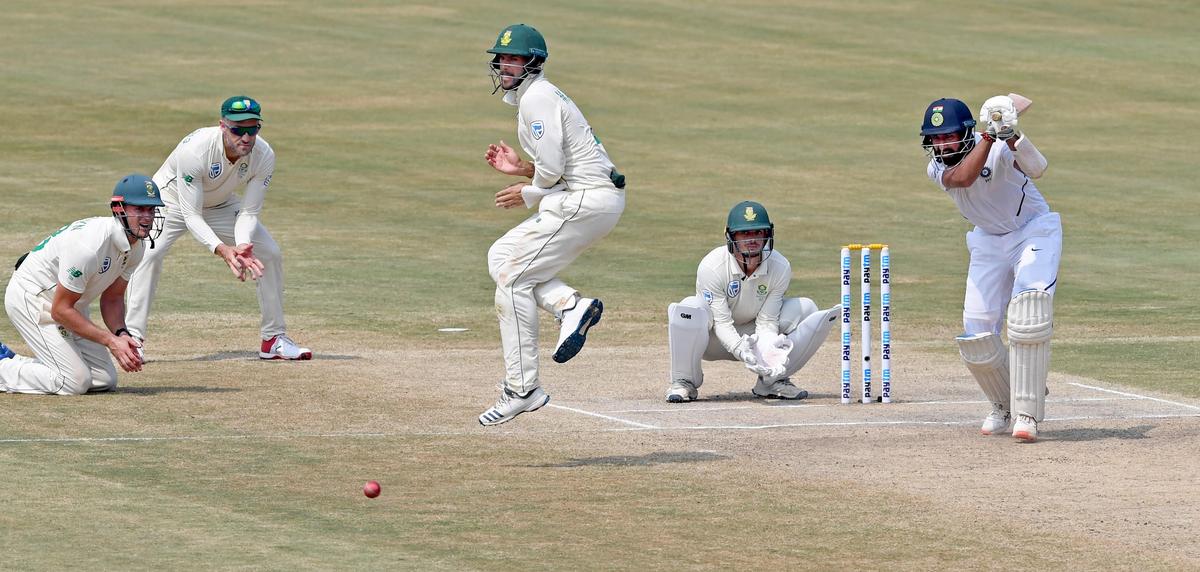
Old grammar: Cheteshwar Pujara steps out with the calm assurance that once defined India’s mastery of spin. In a series that exposed how far that certainty has faded, his method now feels like a relic from a more assured age.
| Photo Credit:
K.R. Deepak
Old grammar: Cheteshwar Pujara steps out with the calm assurance that once defined India’s mastery of spin. In a series that exposed how far that certainty has faded, his method now feels like a relic from a more assured age.
| Photo Credit:
K.R. Deepak
Pujara stepped out of his crease against 21.5 per cent of all spin deliveries he faced in Tests. Only 33.7 per cent of those resulted in attacking shots. But since his last Test in 2023, India has embraced a brasher tone: 69.4 per cent of all down-the-track shots played against spin have been aggressive.
The value of adding a defensive tint to this technique was visible in the batting of Tristan Stubbs, the highest scorer of the series.
Stubbs used his reach to good effect, constantly jumping out of his crease to block the spinners or nudge them for singles. This allowed him to work the field more effectively while disrupting line and length.
This was part of a broader judiciousness in footwork that South Africa displayed through the series.
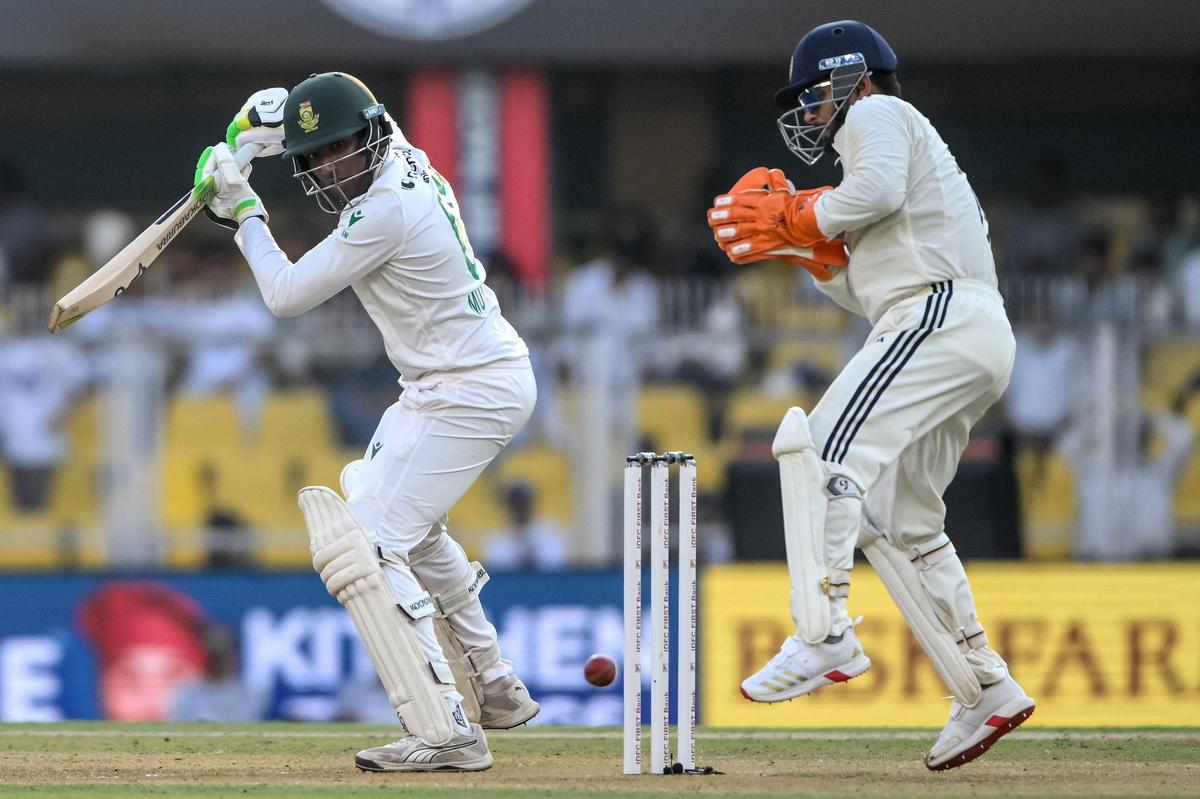
Footwork wins: Senuran Muthusamy rocks onto the back foot with quiet certainty. It was this simple geometry of movement, once instinctive to Indian batters, that South Africa applied better on turning pitches.
| Photo Credit:
AFP
Footwork wins: Senuran Muthusamy rocks onto the back foot with quiet certainty. It was this simple geometry of movement, once instinctive to Indian batters, that South Africa applied better on turning pitches.
| Photo Credit:
AFP
South Africa played 32.3 per cent of all spin deliveries off the back foot, compared to India’s 29.6. When the Proteas batters went back, they averaged 66.66, as against 23.87 when coming forward.
Indian batters were far more tentative in their footwork, often getting caught in between, particularly when dip and drift came into play. They averaged just 14.25 off the front foot against spin, while the back-foot average was 13.87.
Selection bias
Adding to the fragility of the current Indian batting line-up has been head coach Gautam Gambhir’s fixation with all-rounders.
Gambhir has often gone out of his way to accommodate all-rounders in his Test XIs, sometimes at the cost of specialist batters. In both Tests against South Africa, India picked three all-rounders along with two keeper-batters in Pant and Dhruv Jurel.
In Kolkata, India even promoted spin all-rounder Washington to No.3 at the expense of B. Sai Sudharsan.
In Guwahati, Sai Sudharsan returned to the XI along with pace all-rounder Nitish Kumar Reddy, who failed to make an impact with either bat or ball.
The self-inflicted damage extends to India’s batting pool. Sarfaraz Khan, who forced his way into the Test team with stellar domestic form, has fallen out of favour. Another in-form domestic batter, Karun Nair, received only a handful of opportunities in England before being sidelined.
Despite a recent dip in form, Sarfaraz still owns a First-Class average of 63.15. Karun has continued to pile on runs in domestic cricket, scoring 602 from just five matches in the ongoing Ranji Trophy season.
The India A side, long an established route into Test cricket, is now being used largely to provide match time to fringe players from the main squad. India A’s playing XI for its second match against South Africa in the lead-up to the Test series had nine Test regulars.
Structural drift
While it would be difficult to isolate a single root cause for India’s dual decline against spin, batting coach Sitanshu Kotak suggested it could be an outcome of the country’s recent fascination with fast bowling.
“This is one thing I have observed in the last five years, happening all over India. It is that we have been playing more First-Class cricket on green wickets, trying to bring the fast bowlers into the game for the first two days,” said Kotak ahead of the Guwahati Test.
“Spin comes into play, maybe on the third day. Because of this, there has been an increase in the role of the fast bowlers. If you keep the grass [like that], the ball will not spin as much as you expect,” he added.
With domestic pitches tilting towards pacers in recent years, a simultaneous decline in both the quality of spin bowling and the ability to bat against spin was perhaps inevitable.
The one thing in India’s favour is time. The side’s next home Test assignment is not until early 2027, against Australia. It is now up to the team management to find solutions.
Published on Dec 03, 2025


