
Devajit Saikia interview — on hosting the T20 World Cup, domestic cricket reforms and India’s global responsibility
Two months after it successfully hosted the Women’s ODI World Cup, the Board of Control for Cricket in India (BCCI) is gearing up for another ICC event – the men’s T20 World Cup.
While the tournament will be played across the five tried and tested venues in India, along with a phase in Sri Lanka, there are logistical challenges. But BCCI secretary Devajit Saikia tells Sportstar that by hosting events throughout the year, the operations team are well aware of how to shun the odds and deliver a successful event.
In a free-wheeling interview, Saikia also opens up on streamlining the players’ contract system, and about the gap between the salaries earned by the domestic players and the cricketers playing in the IPL.
Q: As another ICC event beckons, how’s the preparation going?
A: In a free-wheeling interview, Saikia also opens up on streamlining the players’ contract system, and about the gap between the salaries earned by the domestic players and the cricketers playing in the Indian Premier League (IPL).
After the Women’s ODI World Cup got over on November 2, our team immediately had to be on its toes for the T20 World Cup, so everybody was busy. The best part is that everything is sorted out as our team is very experienced and extremely professional in handling such (high-profile) events. The ICC is also giving us full support, and their team has been in India for the last few weeks. So, we are working in tandem.
I don’t think there will be any issues. The only challenge is that Sri Lanka is co-hosting, so there should be some coordination, which is happening in the right earnest with Jay Shah at the helm of the ICC, along with Sanjog (Gupta), CEO of ICC. Things are moving very quickly.
Our CEO, Hemang Amin, is also doing his job nicely. So, I am sure that this will be a wonderful tournament without any hiccups.
Ahmedabad has already bagged the 2030 Commonwealth Games, and efforts are on to bring the 2036 Olympics to India as well. So, in that context, how important does a men’s T20 World Cup become in terms of showing India’s administrative as well as organisational capability in hosting big events?
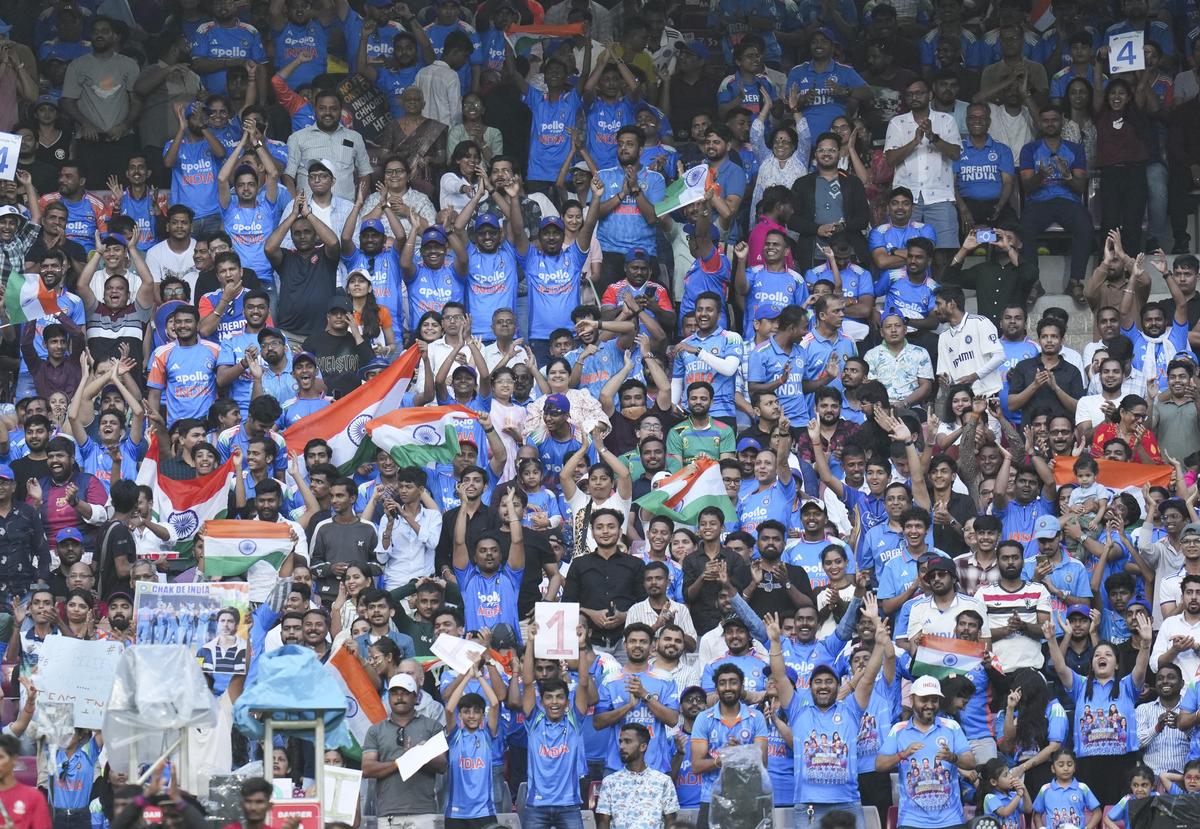
If you saw the 2023 Men’s World Cup, 50 overs, that was a wonderful experience. All the venues had full capacity, and there was not a single logistical issue.
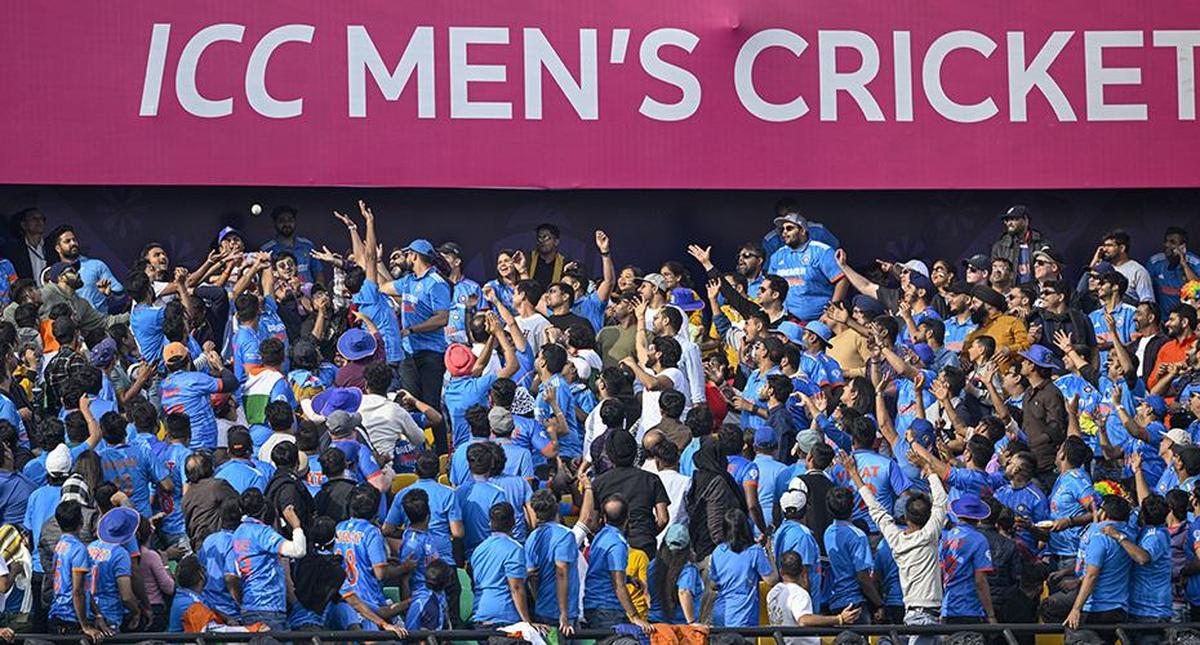
During the 2023 men’s World Cup, all venues had full capacity throughout the tournament, which Saikia termed a ‘wonderful experience’.
| Photo Credit:
K.R. DEEPAK

During the 2023 men’s World Cup, all venues had full capacity throughout the tournament, which Saikia termed a ‘wonderful experience’.
| Photo Credit:
K.R. DEEPAK
That gave us the confidence in the BCCI to host bigger events. Earlier, it was in 2011 (and in 2016). But with the new system, with the new periphery and the new infrastructure and the new level of crowd involvement, we had a challenge in 2023, and that gave us a very big boost to look for bigger events.
We hosted the Women’s World Cup in a few venues, and now the T20 World Cup will be a perfect platform to showcase our talent in the cricketing organisation, so that we can take on the challenges of bigger events also. Basically, the people are safe whether it is any other event other than cricket or it is cricket. The sports administrators, I am sure, are well-equipped and well-experienced to do all their jobs for hosting the Commonwealth, and if we are lucky to get the opportunity to host the 2036 Olympics, I am sure the Prime Minister’s dream will be fulfilled in a very positive way.
In the Women’s World Cup, relatively smaller venues were made to host the games, but for the men’s event, the traditional centres have been picked. What’s the reason behind it?
There are two ways of looking at it. One is that we have to take cricket to every nook and corner of the country. The bigger venues have hosted a lot of cricket over the years. The smaller venues are pretty new and have new infrastructure. All the infrastructure, all the stadiums which are coming up in the last few years are world-class.
Now, we have 30 international standard stadiums in our country to host any kind of international cricket matches. So, we also need to try and test those venues, and take the game to those areas – the two-tier cities, three-tier cities – where there is more crowd involvement and more opportunities and encouragement for the stakeholders, including the players and the guardians. If they see these kinds of events in smaller places, then there will be more interest generated, and that is going to help the overall development of the game.
As far as the bigger venues are concerned, the ICC told us that we must have five venues in our country. So, we want to showcase the best venues which are available in our kitty, so that the world will be watching these matches. We do not want to take any second chances. More people should come to the stadiums, and the best venues should be preferred.
There are logistical reasons behind it as well. All five venues have very good air connectivity. That is one of the areas where we had to look into. Also the number of quality hotels, which is also very important. In some of the second-tier or three-tier cities, the number of five-star category hotels is very limited. But in these five cities, there is wonderful infrastructure, as far as accommodation is concerned. No doubt other infrastructure is equally good.
When you have back-to-back events, both international and domestic, logistics often become a nightmare. How does the BCCI handle it?
Earlier, cricket was played for about six to seven months in a year, but now, it’s a 12-month calendar for the players. Identically for the administrators, we have to host matches throughout the year. So, this is a big challenge.
The only issue is that sometimes the weather poses some challenges. Otherwise, hosting these events back-to-back is not a problem. After hosting IPL matches back-to-back for two months, it is a big experience for us over the last few years.
That has actually groomed and systemised our whole ecosystem to take up bigger challenges. Hosting the IPL is a big challenge because if you see all the matches, not only on the day, there are double-headers also on some of the days. So, throughout that period, the BCCI team is on their toes.
Sometimes there are problems, too. If you remember last year, during the IPL, border tension came up, and we had to stall the tournament. Again, it was restarted. So, those were challenges. But at the same time, during the later stage of the IPL, there were weather issues because the pre-monsoon was already setting in Kerala and other regions.
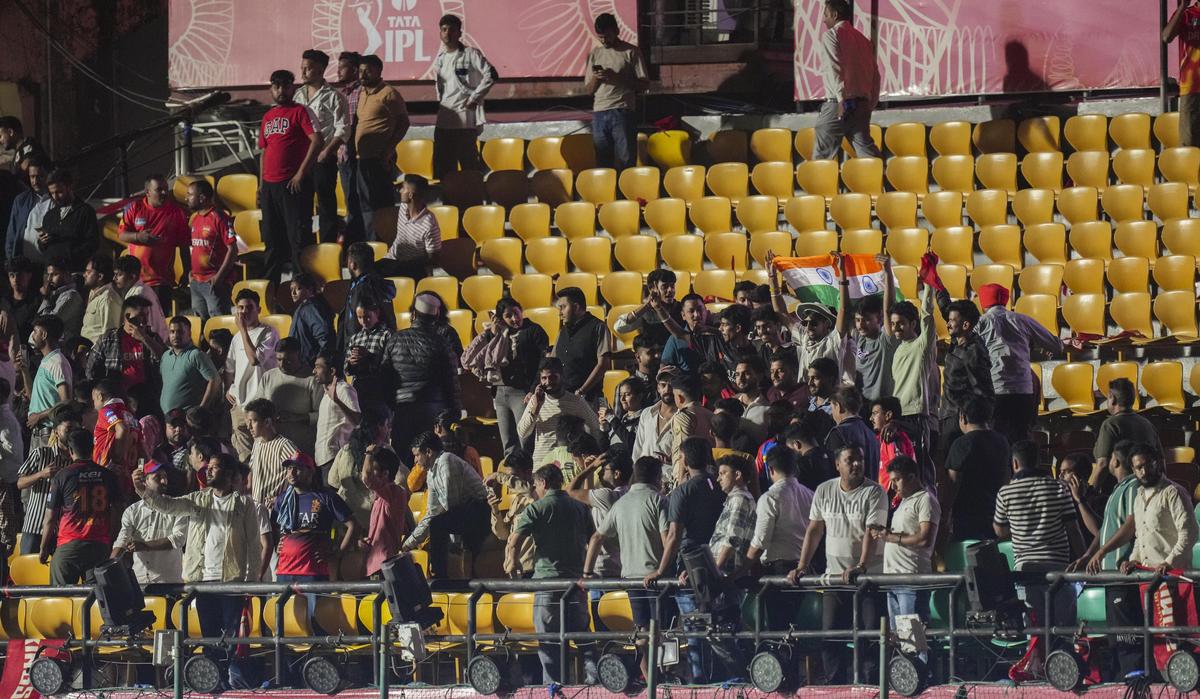
During last year’s IPL, border tensions and security concerns forced organisers to stall the tournament.
| Photo Credit:
PTI
During last year’s IPL, border tensions and security concerns forced organisers to stall the tournament.
| Photo Credit:
PTI
So, we had to shift some of the venues to make sure that the matches were not washed out. These are the challenges, but that has also groomed us, made us more experienced to take on bigger challenges.
You talked about the crowded calendar, both for the players and the associations. When there are so many events, how do you manage?
One big thing is that we have 30 international standard venues and stadiums. That is helping us. Otherwise, to get the matches on rotation, it takes two to three years, if we have 10 venues or 15 venues. Now with 30 venues, there is more footfall in the stadiums, and the stadiums are in use throughout the year. Otherwise, to keep a stadium ready for hosting any event, there is a lot of maintenance work that has to be done. So, frequent matches are rather helping us in a different way.
I’m sure more matches in our country will help our venues to be ready, and that will also help in maintaining the stadium better, because maintenance is a big cost factor. Otherwise, if we do not host these matches in this stadium for one or two years, it is a big white elephant.
So, these matches are really helping. For instance, venues like Rajkot and Vishakapatnam are now hosting frequent matches. That is helping the stadium to upkeep its facilities.
We always talk about the IPL, Women’s Premier League (WPL), the World Cup and the big-ticket events. But even when we look at domestic matches, not many Boards in any other sport in the world conduct as many matches at the age group level and senior level in domestic cricket as well. How challenging is managing it?
We have a very robust domestic structure. We host more than 2,500 matches during a period of six months. That is a big challenge because we have not only men’s but also women’s matches as well, various age groups and seniors, across three different formats. Some 20 years ago, there was only a single format, the multi-day. Now we have the ODIs, the T20s as well as the multi-day matches.
Earlier, there were very limited age groups. Now we have a U-15 category for girls also. Then, U-16 for boys, followed by U-19, U-23 categories. Our GM, Game Development, Abey Kuruvilla, has a big responsibility and has a very professional team under him. That is making things happen without any difficulties. You see, all the matches are going on smoothly. Sometimes we have to shift one match or two matches here and there, but those are very small issues. We always solve it overnight or in a few minutes. So, things are going on. Because of this robust system, we are finding so many players. We have a large bench strength.
While it has been a welcome move to mandate all the international players to feature in domestic tournaments when not on national duty, this time around, a large number of spectators missed out on watching star cricketers like Virat Kohli or Shubman Gill in action during the Vijay Hazare Trophy. Spectators were not allowed in most of the venues, and those matches were not even telecast live. Do you think that in such a scenario, the whole purpose gets lost?
That’s the biggest change that we have seen, that international cricketers are regularly playing domestic cricket. Earlier, I never got calls saying, “Why is this match not shown live?” or, “Which matches will be televised live?” Such questions wouldn’t come earlier, but now we are flooded with such queries from not only the media, but from the public.
Our system was that 100 domestic matches will be televised live. That was what we are following. But after the change of the policy, when the best players are playing domestic cricket, the cricket lovers want to watch domestic matches. So, we are going to change that policy. From 100, we are definitely going to increase the number, and for that, we are working closely with our telecasting partners. We are definitely going to increase the number of matches in the upcoming seasons.
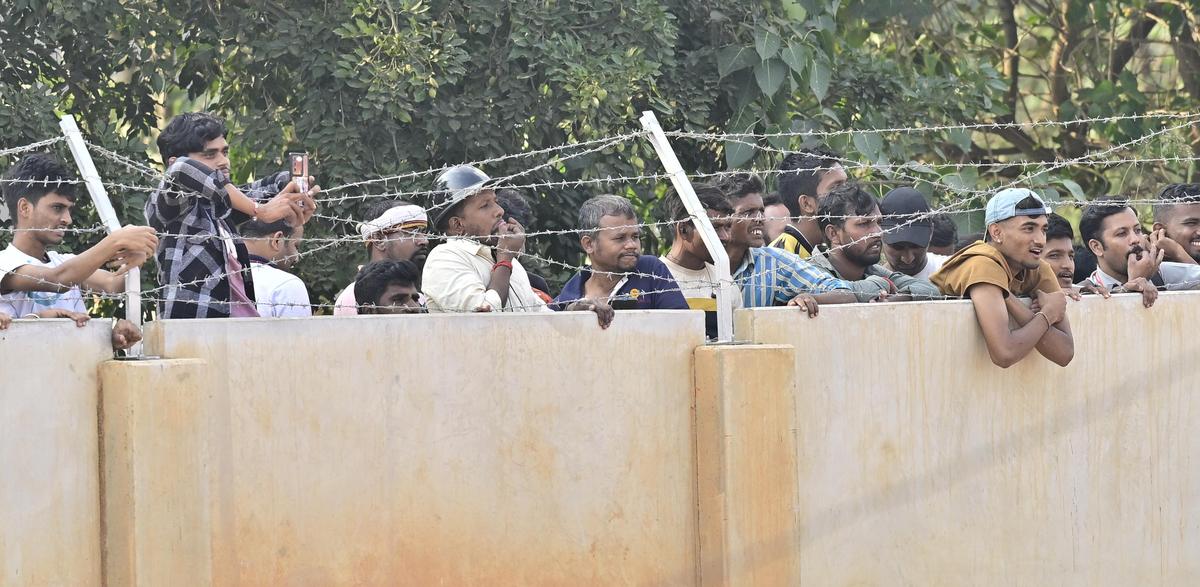
Many fans were unable to witness the Indian international players featuring in domestic tournaments and non-televised matches.
| Photo Credit:
K. MURALI KUMAR
Many fans were unable to witness the Indian international players featuring in domestic tournaments and non-televised matches.
| Photo Credit:
K. MURALI KUMAR
The biggest advantage of having the top players play domestic cricket is that it adds a lot of value to domestic cricket. The young boys get the opportunity to play with the best in the country or at the international level. They get to share the same dressing room. That will boost their confidence and give them more opportunities to learn the game in a harder way. At the same time, the players who are at the national level or who are the marquee players of our country are also making the most of their time when they are free.
So, they are more connected with the game. It is a win-win situation for both the young players as well as the experienced players.
With the huge pool of talent, the Central Contracts system is also being reworked. Could you take us through the new plan?
The plan will go ahead very soon. We are removing one category because the players who were eligible for the A-plus category are now playing just one of the three formats.
It is not that we are erasing or waiving the A-plus category. It’s just that the criteria which we have set to qualify a player for the A-plus category are not being fulfilled. Some of the players who were in that A-plus bracket have decided not to play in all three formats. Therefore, there are not enough players remaining to qualify and fulfil the eligibility criteria. A one-format player will not be eligible for A-plus, so that’s why we had to take a call. There is no heartburn.
How does the BCCI balance its commercial strength with the responsibility to the global game? Especially in this T20 World Cup, we see multiple associate nations coming and playing. In terms of this larger role of supporting the whole of cricket globally, what role can the BCCI play?
That is not our role. That role is to be played by the ICC, and the ICC is doing it wonderfully. All the ICC members are extremely happy. The ICC is giving them sufficient funds to promote the game in the remote areas of all the countries. We have 108 members in the ICC presently. And all the countries are getting sufficient funds to develop the game in their places. I am sure that will help.
The general perception was that very few countries play cricket. It is not correct. There are 12 full members, including India. With all the affiliated members, it goes up to 108. So, it is a big group of playing countries now.
Earlier, several associate nations would come and use India as a training base and play with the club sides as well. Do we see that continuing going forward as well?
Absolutely. Now we are helping many other countries. We are trying to help Fiji, Papua New Guinea and Namibia. Even the Karnataka and Assam state teams visited Namibia. Hardly a week ago, the Namibia women’s team came to Assam and played a few matches before travelling to Kathmandu for the ICC Women’s Qualifiers. So, this is an exchange programme.
We are also helping Malaysia. Malaysia is coming here, and even our teams are going. Dharamshala is being used by Thailand, so a lot of state associations are giving full support.
On the other hand, when there is a request from countries like Mongolia. They want coaches and some infrastructure help from BCCI, and we are forwarding it. Now we are trying to help the Maldives as well.
India has a legacy in cricket, and it is capable. We are doing our best to promote and also support all the countries that have shown interest in cricket. And going forward, we will see a lot of bigger tournaments coming our way.
Ahead of almost every ICC event, there are issues regarding visas for the players. This time too, reports suggested that visas for some of the USA players were delayed. Do you think that such situations essentially have an impact in terms of perception? How do you plan to address these issues going forward?
We are used to these kinds of small problems, and everything is solved with time. There is no problem that we cannot solve. Unless the people who are at the helm of affairs or somebody is deliberately creating a problem, then that problem is unsolvable. Rest, everything is solvable.
The BCCI is now headed by a former cricketer, Mithun Manhas, and you also were a former First-Class cricketer, so the expectations are obviously high. When you talk about putting players’ interests first, do you think that it’s high time to introduce a central contract system for the domestic players as well?
The BCCI cannot put its diktats on the state association. Everybody is autonomous, and they have to frame their own policy. All the associations are doing their best for the growth of the game. I am sure all associations are well supported by the BCCI, and they can take any welfare schemes for development of the game, as well as the players and also the other stakeholders, including the umpires, scorers, coaches, and training staff. They can formulate their policy, and sufficient fund is being pumped into all the state associations.
Not a single association is complaining that there is a dearth of funds for which they cannot take welfare measures. I am sure they are doing their best, and at the national level, the BCCI is obviously always supportive.
A lot of former players, including Sunil Gavaskar, keep talking about how, when it comes to the IPL, you see mystery spinners or batters coming and getting Rs. 7 or 8 crore. But at the same time, someone who is playing all three formats in domestic cricket is earning much less than that. How do you see this wide gap?
This is a market question. Whoever has value in the tournament, they get their best. We cannot envy anybody. But if you have to play in the Indian team, you have to play domestic cricket. From IPL, you cannot go directly. And to get into the IPL, you have to play for the country or for the state. That way, domestic cricket is like your basic qualification.
To get that platform, even if you don’t get money, you have to play so that you qualify to get into the zone of consideration for IPL franchises. To come into the limelight, you have to be a part of domestic cricket from the age-group level. So, it is not the money which is of prime concern at that level.
IPL is more commercial and has a different influence and quality. But as far as domestic cricket is concerned, it is hard cricket. If a player has to come to the national or zone level or qualify for international cricket, he has to take that channel.
First, he has to go to the club, district, state, zone and then the national level. Without going through all these roads and levels, no IPL franchisee will take a player straight away into the team. Even youngsters like Vaibhav Suryavanshi have played in domestic cricket, where he was not earning that kind of money.
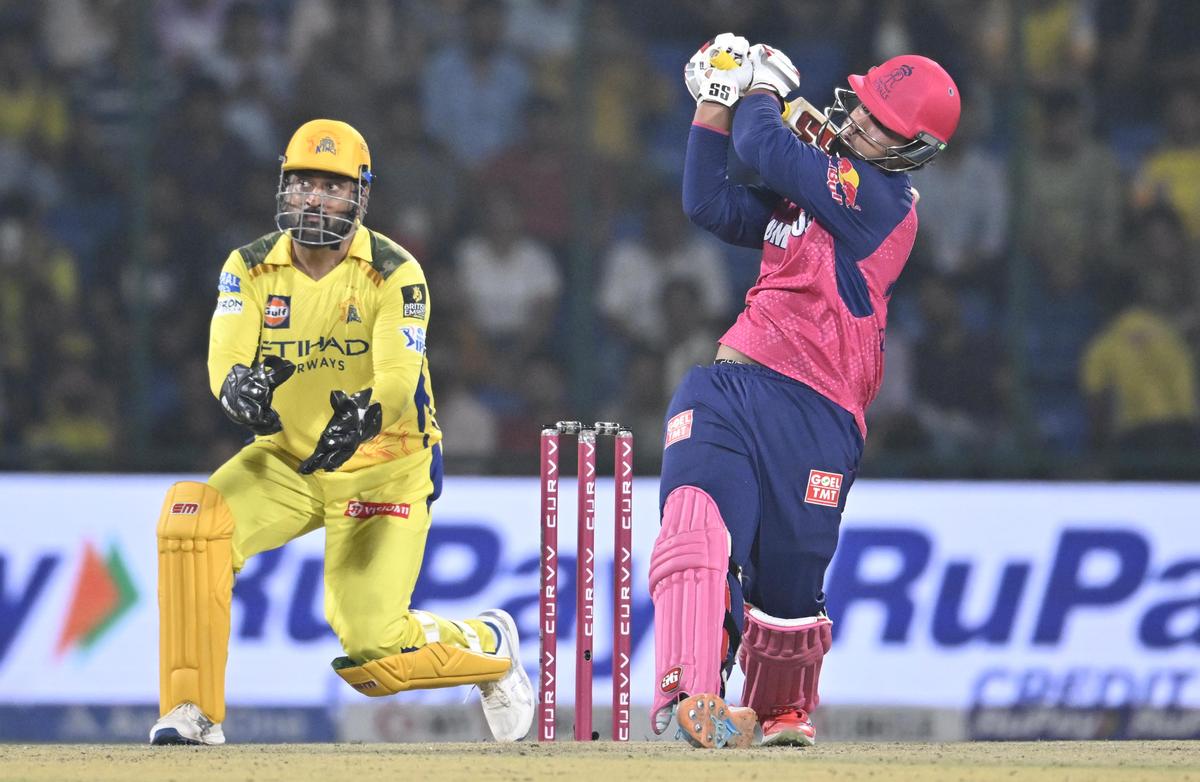
India’s teenage star Vaibhav Suryavanshi used the IPL as a launchpad, while regularly playing for Bihar in the domestic circuit as well.
| Photo Credit:
SHIV KUMAR PUSHPAKAR
India’s teenage star Vaibhav Suryavanshi used the IPL as a launchpad, while regularly playing for Bihar in the domestic circuit as well.
| Photo Credit:
SHIV KUMAR PUSHPAKAR
Or take the example of Riyan Parag. When he plays for Assam, he does not get the money that the IPL can afford. The BCCI has set a particular benchmark for remuneration for playing domestic cricket, which we are giving.
Whether you play IPL or not, it doesn’t matter. They get a handsome amount for playing domestic and everybody is getting a good sufficient amount if they play for the whole season. We are trying to streamline women’s cricket, and they are also almost getting the same amount nowadays.
We are upgrading domestic cricket. It is mandatory and the launching pad for any IPL player. So, without domestic cricket, nobody can straight away go to the IPL.
There are hardly 300 players in the IPL ecosystem, but if you look at the domestic, thousands of players are there. So, that kind of money cannot be generated to give to the domestic cricketers. But domestic cricketers are very happy, very well paid, and they get the platform to perform so that they can go and progress.
Over the last few months, there have been several debates and reports claiming that the BCCI is planning to do away with its head coach, Gautam Gambhir. These reports crop up after almost every series. Being the secretary of the Board, how do you react to this?
India is a country of 140 crore people, and everybody is a cricket expert. Everybody will have an opinion. It is a democratic country, and we cannot gag anybody. All the opinion makers are free to give their opinions, including the media. There is a lot of speculated news in the domain, and also various ex-cricketers, cricketers, or other people are also giving opinions. In social media, it is full of them.
But the thing is that we have a cricket committee in the BCCI, who are ex-cricketers. They are dedicated and make all the decisions. On the other hand, for team selection, we have five selectors. They also have to qualify to get into that position. They are the people who take that also. For every decision, there can be a counter-opinion. So those opinions we have to address, and we have to take into account. But the final decision is always taken by the cricket committee as well as the selectors.
After the immense success of the Women’s ODI World Cup, one expected the Women’s Premier League matches to be played across the country. But in reality, the tournament was restricted to just two venues – Navi Mumbai and Vadodara. What was the reason behind this?
Earlier, we hosted the tournament across four venues – Delhi, Lucknow, Vadodara and Navi Mumbai. But this time we are doing it only in two venues, because Delhi will be hosting the T20 World Cup, whereas there are issues with Lucknow.
In Lucknow, there is always a shortage of crowds for women’s cricket. Even for IPL matches, there is less crowd than in other venues. So, we are not requesting Lucknow to host women’s events because we want people to come and enjoy the game. That kind of response is not there from the crowd in Lucknow. Therefore, that was cut off…
So, we have been left with very few options. Vadodara is a wonderful venue. On the other hand, we have seen the crowd response and the facilities at the D.Y. Patil Stadium for the Women’s World Cup final. It was wonderful. So, we decided on these two venues, and that is helpful for us also logistically.
The crowd response and the facilities at the D.Y. Patil Stadium for the Women’s World Cup final were wonderful – Saikia.
| Photo Credit:
PTI
The crowd response and the facilities at the D.Y. Patil Stadium for the Women’s World Cup final were wonderful – Saikia.
| Photo Credit:
PTI
But in the coming times, when the number of teams in WPL also increases, the number of venues will also certainly be increased. Otherwise, we have very limited states because we have to look into the territory of those franchises. We cannot have a match in Kolkata or Chennai because neither of those cities has any WPL franchise. Therefore, all the other states are also ruled out. So, apart from those five places, we cannot go outside their territory.
You spoke about spreading the game. In recent times, Rajasthan Royals has made Guwahati its second home venue, while other teams have also picked a second home base in tier-two or tier-three cities. How much has this helped the cricketing ecosystem?
It has. IPL is so popular in India, and each of the 30 stadiums that we have is match-ready for the IPL. There is a lot of demand for hosting IPL matches. You see how the crowd response has been, how the whole area gets into a festive fervour. The whole ecosystem in that area, both financially and socially, gets a boost. So, there is a very big positive impact of IPL on the overall society of our country.
Everybody is willing to have an IPL match or an IPL venue in their state. But unfortunately, we have only 10 teams belonging to 10 different states or places. Under the various terms and conditions of IPL, each of the franchises can have two grounds. One home and one second home also. Even if Rajasthan hosted their match here, it is their home match. So all the IPL franchises have the option of opting for two venues. Last year, Delhi Capitals were also playing in Vizag, while earlier, KKR played in Ranchi.
Similarly, when Guwahati was not there, Rajasthan played some matches in Ahmedabad. So that option is there, and it is permitted under the regulations of IPL. That is helping not only the franchises, but also the other states which do not have an IPL team to host matches. Everybody gets the opportunity to enjoy the fruits of IPL.
When we talk about the IPL, we saw the incident of Mustafizur Rahman being asked not to be there in the tournament, which has led to other ramifications. In hindsight, do you think it could have been handled in any other way?
The matter is in the domain of the ICC. I saw reports recently about what the Bangladesh operators are saying. What is the subsequent action? ICC will take a final call. [At the time of the interview, Bangladesh was not replaced by the ICC].
We are also seeing a lot of these IPL franchises going and investing in other leagues elsewhere. While it is great for the global game, there is also an understanding that the money being earned from India is going and being invested elsewhere. How does the BCCI see this?
That is a totally commercial thing where the BCCI cannot have any say. India is a democratic country. Where these investors are investing, we do not have a policy to control somebody’s investment.
So, it will not be correct on our part, as a part of the BCCI, to make any comment on those kinds of things.
Over the last few months, quite a few senior coaches have left the Centre of Excellence (CoE) after their term ended. What’s the update in terms of new hiring?
There have been quite a few vacancies, where some coaches moved on. Troy Cooley’s term got over, and he also reached the age of superannuation. In his place, we will recruit someone else. The process is on, and we haven’t finalised anyone. We have already issued advertisements for the roles. Based on the candidates we receive, our team will decide.
After Nitin Patel moved on from the sports science department, there were advanced talks with Andrew Leipus, but it did not work out in the end due to his family commitments. We are looking for suitable candidates to work under VVS Laxman (who has been given a two-year contract extension till December 31, 2026).
Published on Jan 27, 2026


