
Decoding Linsey Smith’s raging success as England’s go-to new ball spinner
Only three England spinners were handed the new ball in the Women’s ODI World Cup before the 2025 edition – Enid Bakewell (1982), Patsy Lovell (1988), and Carole Hodges (1993).
Linsey Smith, bowling in subcontinental conditions in this edition, has gone well past her predecessors. The 30-year-old has taken 14 wickets in the tournament so far, with nine of them coming with the new ball. In this World Cup, the English bowler tops the list for most wickets taken in the PowerPlay by spinners.
Pakistan’s Sadia Iqbal and Smith’s compatriot Charlie Dean are a distant joint-second with two wickets apiece.
While Smith may belong to the ilk of left-arm spinners, her style of snaffling out wickets is unlike her colleagues. Her USP lies in the fact that she doesn’t produce much spin. She angles the ball into the right-handers and attacks the stumps.
All her PowerPlay victims have, unsurprisingly, been righties – she barely has left-handers to bowl to in the nets (she’s the only leftie in the England squad in the World Cup).
“One of her strengths is to really move the ball, so she can swing it. I know that as a right-handed batter. She’s become a key opener on our side,” England captain Nat Sciver-Brunt said of Smith.
ALSO READ | Pratika Rawal set to miss Women’s World Cup semifinal vs Australia
Smith’s seam-bowling background perhaps plays a big role, but the noticeable difference between her deliveries and those of another traditional left-arm spinner is that with her stock ball, the seam points towards fine leg for right-handers. This helps her angle the ball in, constantly bringing the stumps into play. In contrast, the other English left-arm spinner, Sophie Ecclestone usually has her seam pointing towards third man, helping the ball turn away.
“I am not your most traditional spinner. I am not going to get the turn and bounce that necessarily Sophie Ecclestone gets, which is why I think we work well together in the team,” Smith said after taking three for seven in four overs against South Africa in England’s campaign opener.
Ahead of the World Cup, head coach Charlotte Edwards had already conveyed to Smith that she would be opening the bowling.
In the second over of the innings against the Proteas and with just her second ball, Smith took a return catch to send rival skipper Laura Wolvaardt back. With the first ball of her second and third overs, Smith sent both Tazmin Brits and Marizanne Kapp back in similar fashion – deliveries which angled into the batters and breached their defence.
Brits’ defence was exposed on her first delivery against Smith, but for Kapp, it took a bit longer. After defending the first ball, Kapp had an lbw scare on the second. But a wider one was rightly punished through the covers by the South Africa veteran. On her sixth delivery against Smith, Kapp tried to defend the ball, but her timing was off. Smith didn’t really change what she was doing and that paid off.
While Smith hogged the limelight on that day, Ecclestone’s two wickets took the backseat. In some matches, it was the other way round. Against Sri Lanka, Smith couldn’t provide the PowerPlay wickets. It was Ecclestone who took four straight scalps in the middle overs to stifle the Lankan batters, while Smith restricted the run flow by giving away just 32 runs in eight overs.
Turning points
Ecclestone and Smith are almost identical in efficiency: the former has 12 wickets in six matches with a dot ball percentage of 60.6 and boundary percentage of 6.85, while the latter has a dot ball percentage of 62.5 and boundary percentage of 5.78.
However, 92.2 per cent of Smith’s deliveries spun less than 2.5 degrees – she has produced the lowest average turn amongst spinners who have taken at least five wickets in this World Cup. On the other hand, 43.4 per cent of Ecclestone’s deliveries turned between 2.5 and 4.5 degrees.
Another metric in which the two complement each other is delivery speed. While the average speed for both is in the late 70s, Ecclestone’s range is 91.85-66.16 kmph, showing that the world’s best women’s ODI bowler can vary the pace when needed. Smith’s range clocks between 84.34 and 72.40 kmph, indicating that she doesn’t really vary her pace.
While she has shone with the new ball, the win against India underlined her adaptability to the demands at the death.
With Ecclestone struggling against the likes of Harmanpreet Kaur and Smriti Mandhana, it was Smith who removed the latter in the 42nd over. The spinner also kept Sneh Rana and Amanjot Kaur quiet in the final few overs. With India needing 27 runs off 18 balls, Smith just conceded four runs before she defended 14 runs in the last over to help her side win.
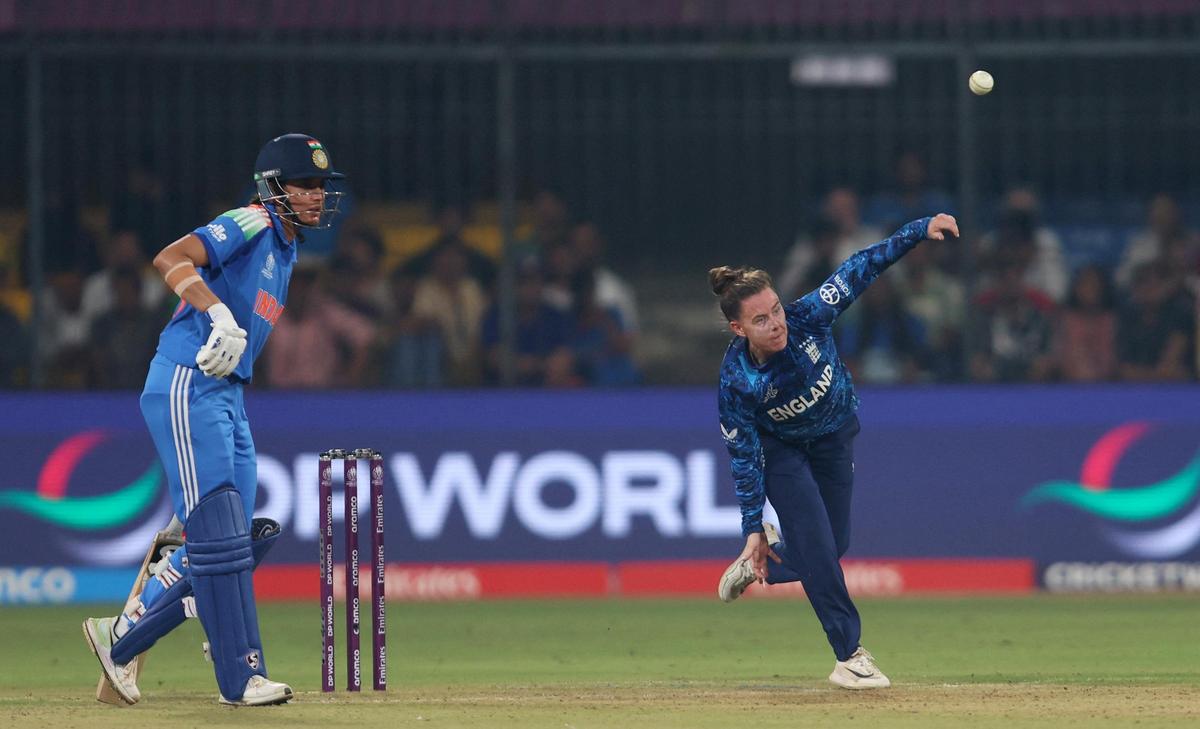
Linsey Smith in action against India at the World Cup.
| Photo Credit:
REUTERS

Linsey Smith in action against India at the World Cup.
| Photo Credit:
REUTERS
Since her ODI debut earlier this year against West Indies – where she picked a five-for – Smith has the most wickets by a spinner (22), followed by South Africa’s Nonkululeko Mlaba and India’s Deepti Sharma, both of whom have 20.
However, her time in the 50-over format came after a long wait. She’d made her T20I debut back in 2018 but after losing her contract with the ECB in 2019, she was out of international cricket action for about five years till she was included in England’s T20 World Cup squad last year. This year, she earned her maiden ODI debut after impressing in the domestic circuit with her side Hampshire.
With England facing South Africa in the spin-friendly Guwahati — 41 wickets out of the 63 at the Barsapara Stadium in this World Cup have been taken by spinners — Sciver-Brunt and Co. will hope that Smith can recreate the magic against the Proteas.
Published on Oct 27, 2025


