
T20 World Cup 2026: In Dipendra Singh Airee, Nepal cricket found its forever
When Nepal all-rounder Dipendra Singh Airee reached his half-century in nine balls at the 2023 Asian Games, he did more than just set a world record. He eclipsed a benchmark that Indian cricket fans know by heart: Yuvraj Singh’s 12-ball fifty from the 2007 Twenty20 World Cup.
The comparison was instant and inevitable, and Airee’s clips circulated alongside Yuvraj’s six-hitting burst against England, the gold standard of T20 destruction for an Indian audience. But to view Airee’s innings merely through that prism is to miss what his career actually represents.
His journey offers a more revealing look at how a developing Associate system can produce a specialised modern cricketer, not through sudden discovery, but through sustained exposure to a pathway.
The beginning
For Airee, the journey was less about a moment of arrival and more about his proximity to an existing structure. He credits his entry into the sport to having directly observed the professional ladder.
“By seeing our senior players studying in my school, I got inspired to pick up the cricket bat,” Airee explains. “I saw them regularly and watched them progress through the ranks to the point where they represented our national side. I started playing school cricket first, then Nationals, then the Under-19s, and then broke into the senior side.”
Airee acknowledges that while physical infrastructure remains behind full-member nations, the administrative focus has shifted toward the base of the pyramid.
READ: From astroturf to grass pitches, Italy navigates a new test at its first T20 World Cup
“The infrastructure back in Nepal is not at the desirable level, but we’re working towards that. As a start, our cricket association has invested heavily in grassroots cricket,” he says.
“So, if you perform well at the district and provincial level, you get a chance to represent the country in the U-19s and then make your way into the national side. The pathway is much like any other country.”
Specialisation and adaptation
Airee’s utility to the Nepali side is defined by his multi-faceted role. He has evolved from a one-dimensional player into a T20 utility option, offering middle-order stability and contributing with his off-spin.
Nepal captain Rohit Paudel views him as a tactical safety net. “He’s been one of the match-winners for Nepal for quite a while now. He’s consistent with bat and ball and sharp in the field,” Paudel said.
That dependability is reflected in Nepal’s unbeaten run at the Asia-EAP Qualifiers, where Airee was a central contributor. In the one-run win over the United Arab Emirates, he was dismissed for one but turned the game with the ball, taking three wickets, including that of the well-set Alishan Sharafu.
Airee believes his success lies in understanding the demands of the shortest format.
“T20 is about adapting to conditions and situations. If you cannot work towards that, you cannot survive the format,” he said.
“I didn’t plan to become a big hitter. I think I evolved with the game and tried to play as per the conditions.”
That evolution was most visible during his world-record nine-ball fifty against Mongolia at the Asian Games. While the innings drew global headlines, Airee frames it as situational rather than historic. “I never went for records. I went to play my game. I guess that was my day,” he said.
Team over individuality
Named in Nepal’s first-ever ODI XI against the Netherlands in 2018, Airee has since noticed a shift in the team’s mindset.
“Earlier, we used to have one or two players who carried the side. The team’s success relied on them,” he admitted.
“But now, things have changed. We work as a group and enjoy everyone’s success. Winning is the target.”
The Nepal Premier League has played a role in building that depth. By integrating international veterans into the domestic circuit, the league has acted as a testing ground for young players. One beneficiary is Gulsan Jha, whose development as an all-rounder has eased some pressure on Airee.
“The NPL has been a blessing. Youngsters get to share the dressing room with players like Martin Guptill and Faf du Plessis. That exposure helps them learn quickly,” Airee said.
The bigger picture
The long-term goal for Nepal remains getting Test status, an objective that demands sustained performance. While Associate nations often point to limited fixtures as a barrier, Airee frames the status as motivation.
“In the past few years, we’ve been doing well. We’re on the journey of becoming a Test-playing nation,” he said.
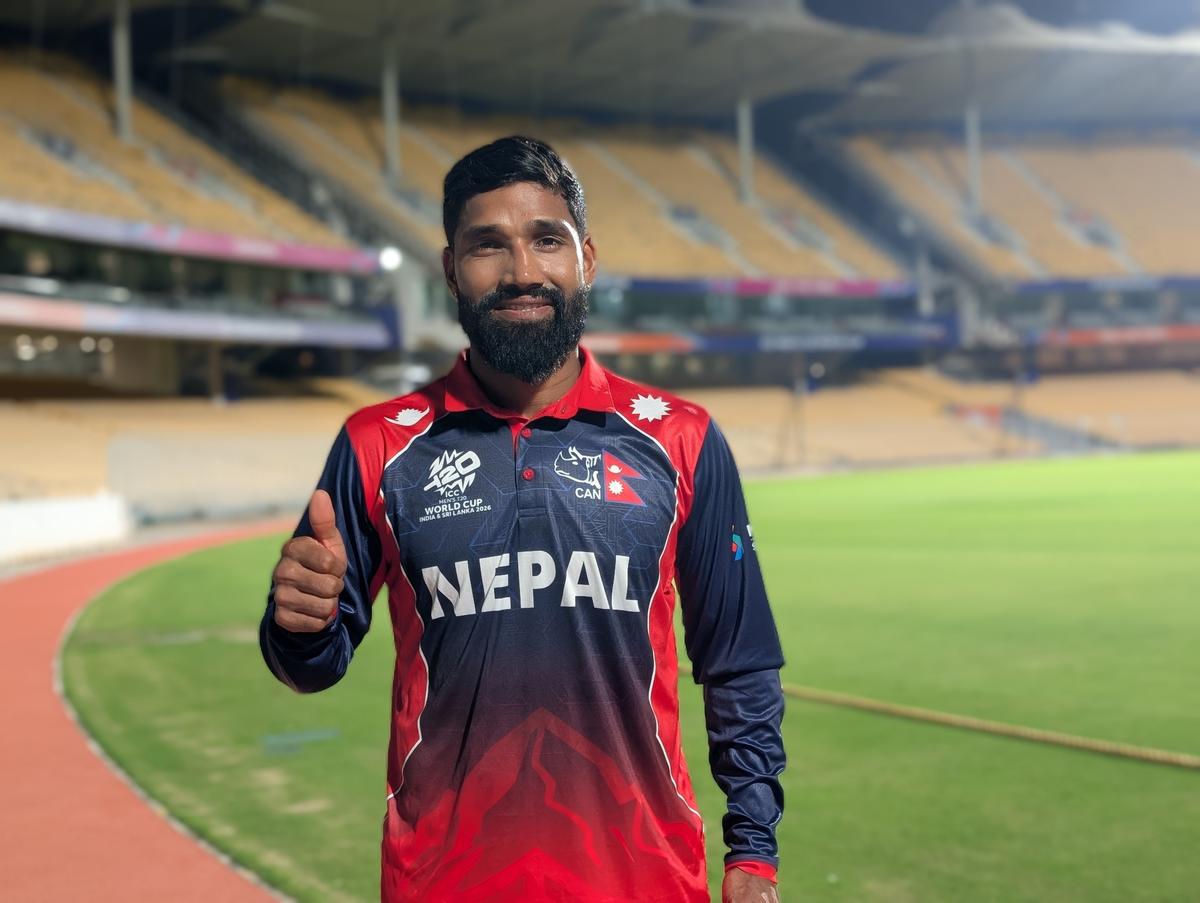
Airee is currently in Chennai to play the T20 World Cup warm-up fixtures for Nepal.
| Photo Credit:
Nigamanth P

Airee is currently in Chennai to play the T20 World Cup warm-up fixtures for Nepal.
| Photo Credit:
Nigamanth P
“Being an associate nation motivates us to reach greater heights. Our focus is to become the best among Associate teams. Everything else will follow.”
Nepal’s immediate mission is putting up a strong show at the upcoming ICC Men’s T20 World Cup, its third appearance at the event. As it opens its campaign against two-time champion England, the spotlight will not be solely on Airee’s individual impact but also on how the group responds under sustained scrutiny.
Published on Feb 04, 2026


