
The logic behind India’s ideal T20 World Cup XI
India, which begins its title defence of the Men’s T20 World Cup in a week, is being touted as the favourite. While its middle order has endured a fallow period in recent times, its gung-ho opener and varied bowling options, including Jasprit Bumrah and Varun Chakaravarthy, give it a massive edge. Here, I present an analyst’s perspective on the potential weaknesses in India’s batting line-up, in addition to arguing for its optimal playing XI.
Very little needs to be said about the juggernaut that is Abhishek Sharma. He has addressed his weaknesses against good and hard-length pace by expanding his shot range and moving around effectively at the crease. Tracking data shows that the range of his impact points against good and hard-length pace has expanded significantly. As a result, his strike rate (SR) against the 6–10 m length while facing pace has gone up from 113 in the 2022–23 IPL to 162 in 2024–25. For reference, the average batter struck the same lengths at 124 and 139 SR in these two eras. From being below average, Abhishek has zoomed ahead of his peers against the most common pace lengths any batter can face. The only chink in his armour could be his tendency to mistime balls wide outside the off stump, a weakness that teams have recently picked up on. From the start of 2024 to October 2025, pacers bowled 40% of their balls outside off to him; that figure has risen to 49% since. His SR against these balls is a measly 72.
Partnering him is Sanju Samson, who is back at the top of the order, but the series against England last year exposed his weaknesses against fast, bouncy deliveries in the 8–12 m range. In the IPL from 2022 to 2024, Samson faced fast balls that rose to a mean height of 0.96 m at the crease from this length, and averaged 26.75 at a strike rate of 147. Against England in 2025, he got out five times, facing 26 such balls, scoring just 32 runs. The average height of these deliveries at the crease was 1.12 m, a steep hike. At the World Cup, Samson could be troubled by fast bowlers with extra bounce likely to bowl inside the PowerPlay: Jofra Archer, Marco Jansen, Josh Hazlewood and the ilk. His sub-10 averages against the stronger international sides and his recent failures against New Zealand might push him out of the team, with the in-form Ishan Kishan taking his place.
Moving down the order, Tilak Varma is a high-intent batter against pace, but his flair against the faster bowlers hides his issues against spin. Most worryingly, he can be tied up by a slow left-arm bowler from around the wicket. Against incoming spin in the 2–6 m range, pitched on off stump or straighter, Tilak strikes at a 104 SR in the IPL and T20Is played in India. The average left-hand batter strikes at 124 for the same balls. With Suryakumar Yadav slotted in at number four and weak against slow left-armers, India might be pairing two batters who can be easily tied down by left-arm spin. Good T20 sides look to minimise such clusters of negative match-ups, and Axar Patel could be the man to shake things up as a spin-hitter at 4 or 5. Moreover, if Kishan replaces Samson at the top, India will have three left-handers starting, which is not ideal.
Ideally, Hardik Pandya would walk in at number five. His recent hitting profile has tilted towards spin-bashing, with noticeable weaknesses appearing against hard-length and short balls. However, he still does well against slot and yorker-length pace, and to maximise the spin deliveries Axar can face, Hardik has to move down and be the “pivot” at number six. With his sound batting skills, he can also anchor the innings in case of a collapse, with others hitting around him.
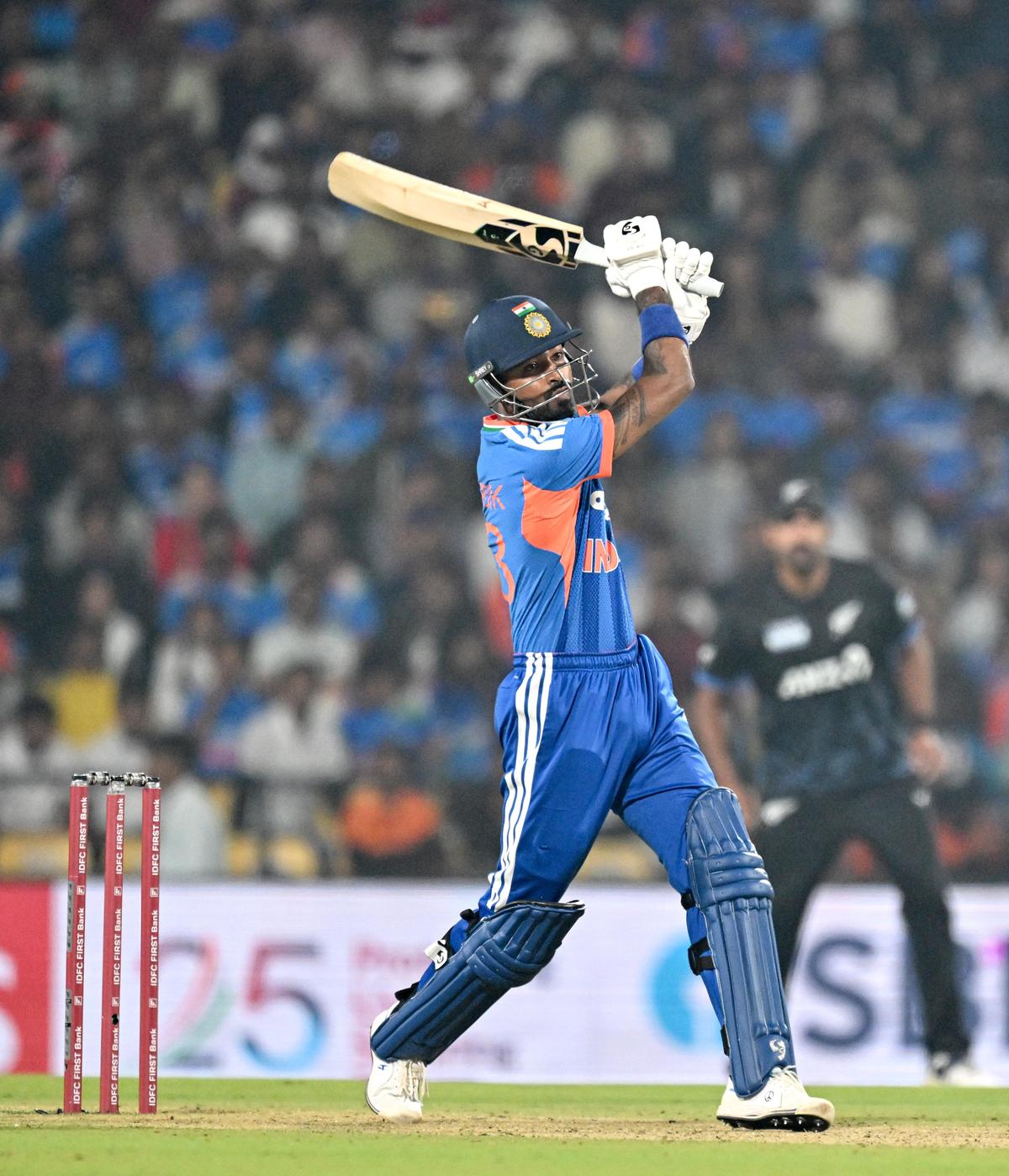
With his sound batting skills, Hardik Pandya can also anchor the innings in case of a collapse, with others hitting around him.
| Photo Credit:
K R DEEPAK

With his sound batting skills, Hardik Pandya can also anchor the innings in case of a collapse, with others hitting around him.
| Photo Credit:
K R DEEPAK
While Rinku Singh is set to bat at seven, the number eight spot remains up for debate. India has looked to play Axar at that position recently, but that might be a waste of his spin-hitting abilities. In the slog overs in the last two years, Axar has scored at 0.27 runs per ball slower than the average batter against pace, considering game situation, line and length. He has a strike rate of 72.4 against short-of-good-length pace and 54.5 against short balls. Axar is a far better hitter of spin than of pace, scoring 0.27 runs faster than the average batter against spin, given the match situations, lines and lengths he faces. Moreover, he strikes full-length spin at a whopping 257 SR and good-length spin at 140 SR, making him an ideal batter to get some boundaries for India in the middle overs, when they have traditionally struggled to get going against the slow bowlers.
In the Nagpur T20I against New Zealand, India played both Axar and Shivam Dube. With Axar set as the spin-hitter, Dube has to walk in at seven or eight, which is suboptimal. He struggles against the 2–4 m length, scoring at 117 SR in T20Is played in India and the IPL, while the average batter in these games hits that length at 142 SR. In addition, against the hard length (8–10 m), Dube strikes at a paltry 113 SR, while the average batter strikes at 139. Against the 0–2 m yorker length, his strike rate is 82, while the average batter goes at 119 SR. These three are lengths he is most likely to face from international bowlers in the slog overs. His inclusion at number eight provides only nominal batting “depth”, and his skills are wasted late in the innings.
On the balance of his bowling and batting skills, and the relative weaknesses of Shivam Dube, Harshit Rana might be the best option at eight. His ability to bowl the 5–6 m length and swing the ball up front, coupled with his dipping, cutting slower ones, provides India the flexibility to use Jasprit Bumrah in the last 10 overs. Also, Harshit can serve as a handy number eight, tonking a few bonus sixes at the end once in three games.
Hardik, Arshdeep and Harshit can take care of the PowerPlay, with all three of them likely to take early wickets with their ability to get lateral movement. Arshdeep and Bumrah can operate in the slog overs, with the former executing his swinging yorkers and steep bouncers. The middle overs can be controlled with a combination of Harshit and Hardik hammering the hard lengths, and Varun and Axar (pic, right), with an over or two of Bumrah thrown in. This combination gives the captain six bona fide bowling options, with seven and a half batters at the ideal positions to maximise their match-ups. Tilak Varma and Hardik can stabilise the innings in the event of a collapse, while Axar plays disruptor and Rinku provides late-order ballast.
Both Tilak Varma and Axar have had injury scares recently. In case Tilak misses out, Ishan Kishan or Shreyas Iyer are ready replacements. While Kishan is weak against pace, he is a better hitter of in-spin, which makes him an ideal pairing with Suryakumar at four. Iyer has shown massive improvements in his handling of pace, but playing two right-handers at three and four might reduce the possible runs India can score off the spinners. Replacing Axar, on the other hand, might be close to impossible for India. It is tough to find a slow left-arm all-rounder who hits spin well, but with the injury to Washington Sundar being reported as serious, Riyan Parag might be slotted in as a middle-order hitter who can deliver two overs of defensive spin.
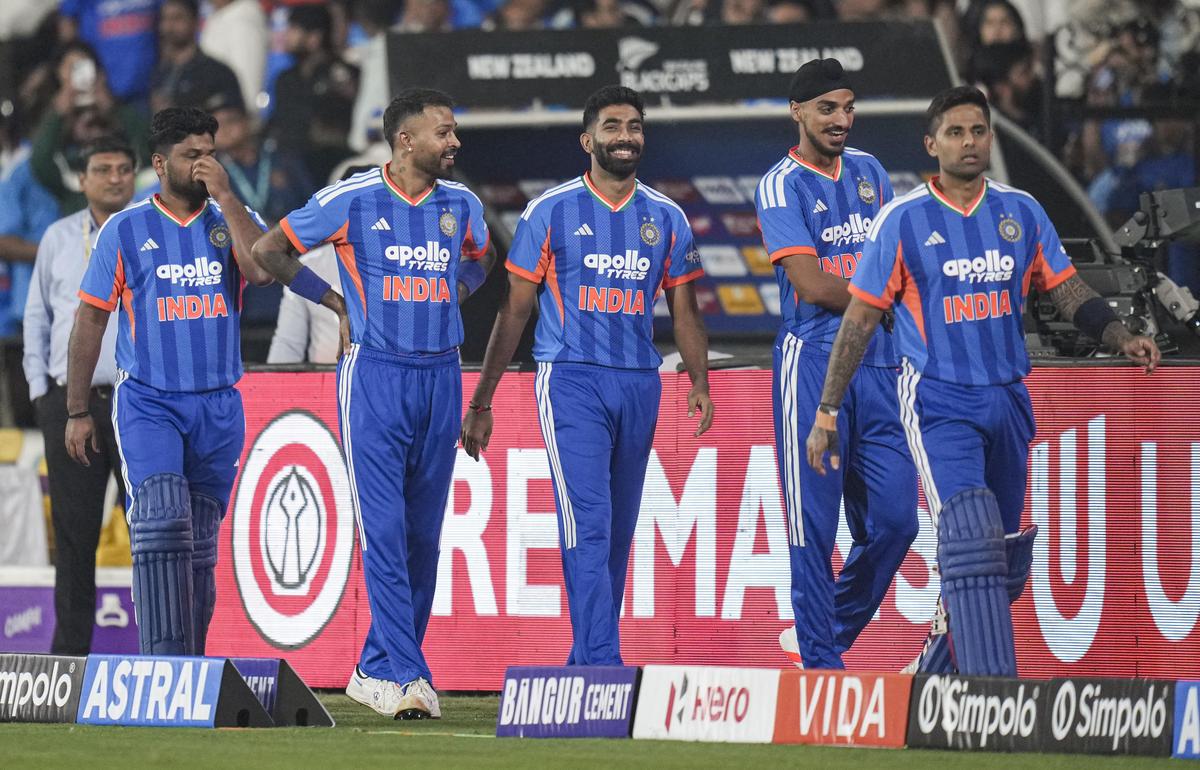
India, which begins its title defence of the Men’s T20 World Cup in a week, is being touted as the favourite.
| Photo Credit:
PTI
India, which begins its title defence of the Men’s T20 World Cup in a week, is being touted as the favourite.
| Photo Credit:
PTI
My ideal India XI would be:
Ishan Kishan (wk), Abhishek Sharma, Tilak Varma, Suryakumar Yadav, Axar Patel, Hardik Pandya, Rinku Singh, Harshit Rana, Arshdeep Singh, Jasprit Bumrah, Varun Chakaravarthy
The author is a physicist based in France. He worked as the consultant analyst for the India Men’s team from 2022 to 2024.
Published on Feb 01, 2026


