
Why India’s Test Team and Ranji Trophy are drifting into parallel worlds
The Indian management’s insistence on Test regulars plying their wares in the Ranji Trophy has lent some much-needed relevance to the country’s premier First-Class tournament.
The marker was laid down last season when stalwarts Virat Kohli and Rohit Sharma were required to turn up for their domestic teams following their dismal run in the Border-Gavaskar Trophy, with Kohli managing 190 runs in five matches and Rohit just 31 in three. Shubman Gill, K.L. Rahul, and Ravindra Jadeja were among the others who returned to test themselves in the attrition of four-day First-Class cricket though there were no immediate Test matches at that time.
However, the spotlight has been away from the Ranji Trophy this season, courtesy of a packed international calendar. Back-to-back Test series against West Indies and South Africa sandwiched a white-ball tour to Australia, restricting players’ availability. Only Yashasvi Jaiswal and Jadeja, both not in the touring party to Australia, made a solitary appearance for their respective State sides.
The sprinkling of stardust left was also taken away because of India-A’s series against South Africa-A at home, and another batch of players departing for the Asia Cup Rising Stars in Qatar. As a consequence, Bengal was left without its captain, Abhimanyu Easwaran and stand-in captain Abishek Porel. Defending champion Vidarbha had to let go of its leading wicket-taker Harsh Dubey.
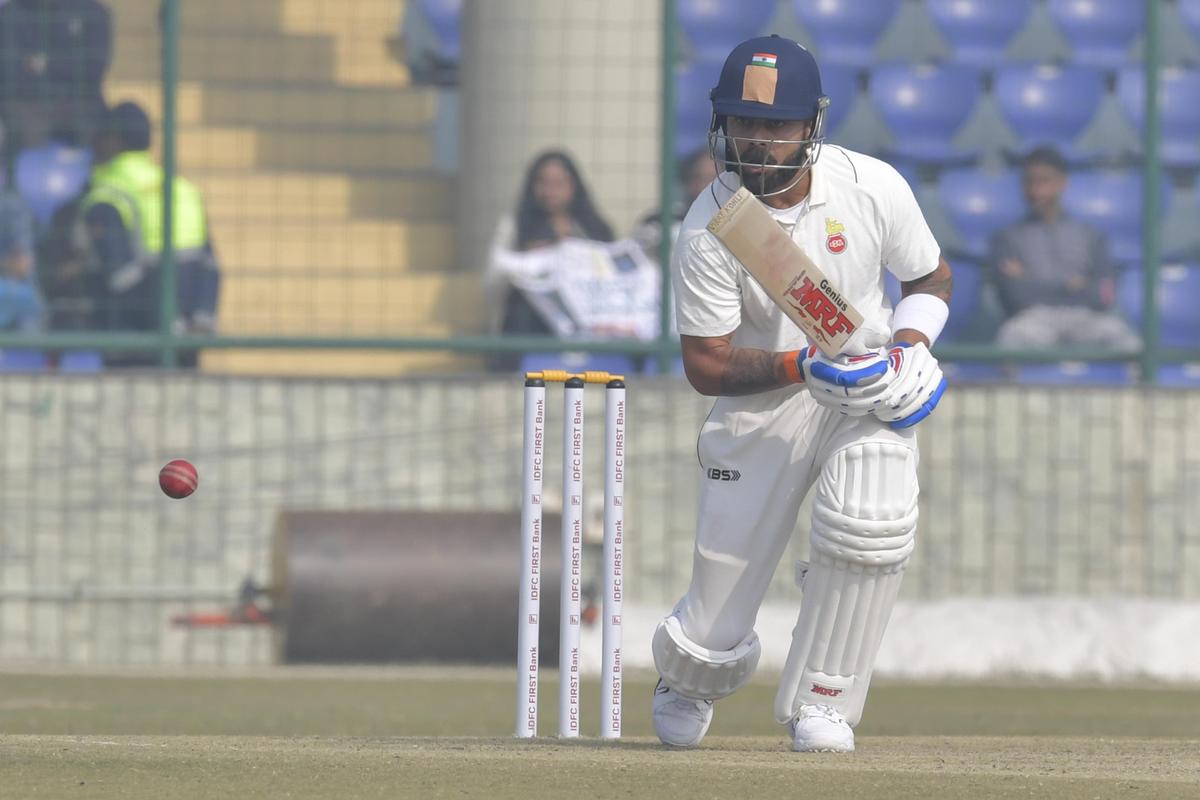
Earlier this year, Virat Kohli made a rare appearance for the Delhi team in its final league stage match of the Ranji Trophy, against Railways.
| Photo Credit:
SHIV KUMAR PUSHPAKAR

Earlier this year, Virat Kohli made a rare appearance for the Delhi team in its final league stage match of the Ranji Trophy, against Railways.
| Photo Credit:
SHIV KUMAR PUSHPAKAR
Despite India’s head coach Gautam Gambhir reiterating his commitment to domestic cricket, there seems to be little synergy between the Ranji Trophy and the Indian Test team.
Nitish Kumar Reddy, still unclear about his role in the Test side, was made to join the India-A One-Day squad instead of his domestic outfit Andhra when he was omitted from the starting lineup for the first Test against South Africa in Kolkata. Similarly, Prasidh Krishna, a regular in the Test team, was taken away from the Ranji Trophy when picked for the limited-overs series against South Africa-A. Even the significance of Ranji Trophy performances has appeared to deteriorate.
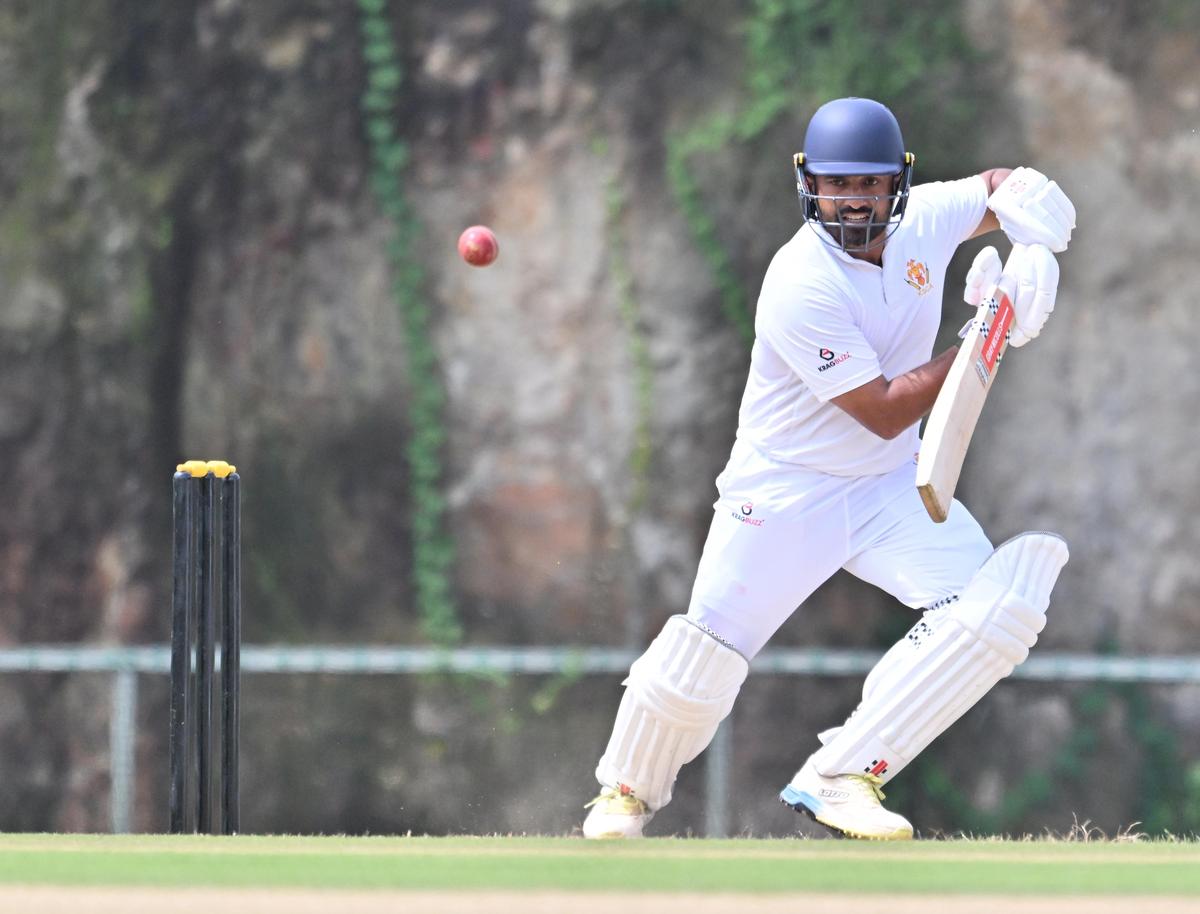
Karun Nair’s 602 runs in five matches for Karnataka this Ranji Trophy season, featuring both a century and a double hundred, have still failed to earn him a longer look from the Indian Test selectors.
| Photo Credit:
Nirmal Harindran
Karun Nair’s 602 runs in five matches for Karnataka this Ranji Trophy season, featuring both a century and a double hundred, have still failed to earn him a longer look from the Indian Test selectors.
| Photo Credit:
Nirmal Harindran
Karun Nair charted a course back into the Indian side with the help of prolific seasons with Vidarbha in the Ranji Trophy.
However, he is out of favour again following a string of middling essays against England in the Anderson-Tendulkar Trophy. His 602 runs in five games this year for Karnataka, which include a century and a double century, have been insufficient in making a case for a slightly longer rope.
Mohammed Shami’s attempts at winning another shot in the Indian team have been in vain, too. He has 20 wickets in four games at an average of 18 this season, but was not even considered for the A-side that played two multi-day games against South Africa-A. Mumbai all-rounder Shams Mulani has 28 wickets in five games, the third-highest this season. He has chipped in with the bat too and scored 285 runs at an average of 57. But his consistent performances have been overlooked, and he has found no place even in the India-A setup, let alone India.
India’s drubbing at the hands of the Proteas has also brought into focus the disconnect between the Ranji Trophy and international cricket in terms of playing conditions.
This year, the pitches on offer have been flatter than usual, despite the BCCI advising the State units to produce livelier tracks. Till the fifth round of this season, bowlers’ strike rate in the first two innings of a match stood at 66, the worst since 2017/18. Though the batters’ average over the first two innings has increased only marginally, their dismissal rate (balls faced per wicket) has ticked past 64 deliveries this year. In Tests played in India, batters’ dismissal rate has been 64 or more only twice (2016/17 and 2017/18) in the last 10 years.
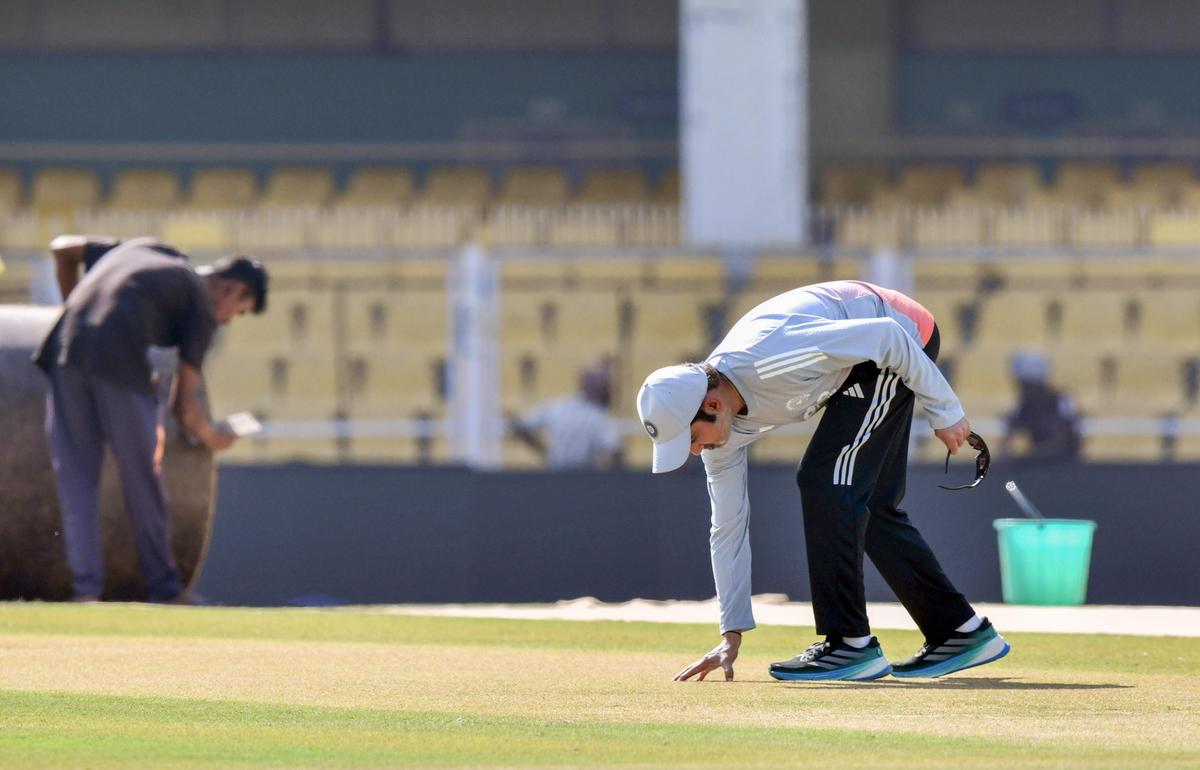
India head coach Gautam Gambhir has repeatedly stressed the importance of domestic cricket, but flatter Ranji pitches this season have raised questions about how closely conditions mirror Test demands.
| Photo Credit:
ANI
India head coach Gautam Gambhir has repeatedly stressed the importance of domestic cricket, but flatter Ranji pitches this season have raised questions about how closely conditions mirror Test demands.
| Photo Credit:
ANI
The team scores are another gauge of the conditions. Teams have scaled 500 runs in 24 innings this season, just five short of last season’s tally and on course to near the haul of 37 from 2012/13 — the highest since the turn of the millennium.
Batters lasting longer at the crease has reflected in the results too. Out of the 80 games in the Elite Groups, only 43 matches have culminated in a result. A result rate of 53 per cent in the Ranji Trophy is the lowest since 2016/17. It has been over 60 per cent for the last five seasons. The table-toppers at the mid-season interval — Karnataka, Bengal, Vidarbha, and Mumbai — have played out nine draws so far. Last season, the group winners had a cumulative total of nine draws after the final round. Yet, the relatively consistent conditions have bridged the gulf in skill between the traditional heavyweights and the rest, making this Ranji Trophy more evenly contested.
Jammu & Kashmir’s (J&K) first win over seven-time champion Delhi has been the highlight of the season. The Paras Dogra-led side sits second in Group D with 20 points, and could have been top if not for its agonising 35-run reverse against Mumbai. J&K’s success has rested on the strength of its pace unit, led by Auqib Nabi, who has 29 wickets in five games at an average of 13.67.
Similarly, Services, Jharkhand, and Haryana — sides devoid of international stars — have punched above their weight and are in contention for making the knockouts. On the other hand, Tamil Nadu finds itself languishing in the bottom half of its group.
The smaller units have proved stiff opponents for the bigger sides, even in instances where it might not be evident in terms of points won. Nagaland, which played in the Plate Group last season, nearly eked out a first-innings lead against Tamil Nadu courtesy of a century from Imliwati Lemtur.
Nagaland’s fortunes this season pose a question for the Plate Group and its members. The side nearly pulled off a heist against a domestic giant but also fell to three innings defeats. Isolated from the tournament, Plate sides might gain better exposure from facing top-drawer teams in a couple of rounds every season.
However, this is not the only predicament the Ranji Trophy is confronted with. Multiple captains and head coaches have raised their displeasure with the mid-season interval, which holds the potential of running down their team’s momentum accumulated through five rounds.
There are, however, voices in favour of the break. Mumbai captain Shardul Thakur, who was among the first few cricketers to raise questions over the packed scheduling of the Ranji Trophy, expressed his satisfaction over the new system, while Siddhesh Lad, too, believes that, keeping the larger interest in mind, this is the right move.
“I feel this is the right thing to do. Obviously, as a guy who is in form, it could break my momentum. But it is also about workload. In the last five games, we have fielded for 100–150 overs, and then batted, and as our coach Omkar Salvi says, the Ranji Trophy is like a marathon. Here, you need to keep going slowly. If you see the workload of the bowlers, it’s a right thing to take a break, play T20, One-Dayers and then again get back to red-ball,” Lad told Sportstar.
The switching of formats might mimic an international calendar, but for a tournament which is still, in essence, a supply line for the senior side, a sustained run in one go would arguably fetch the best performances.
Additionally, more support from the Ranji Trophy — in conditions and quality of players — at a time when the Indian team is transitioning to a new generation is a justified demand. But it is only one end of the bargain. Holding the feeder system relevant is down to the top tier, too.
Published on Dec 03, 2025


