
Madan Lal open to separate coaches for different formats, questions India’s intent after series loss to South Africa
For ages, teams dreamt of beating India (men) at home in Tests. And on most occasions, it remained only a dream. But over the last year, things have changed immensely.
India has lost two of the last three Test series at home — against New Zealand in 2024 and South Africa in 2025 — under the coaching of Gautam Gambhir.
Once considered a giant in red-ball cricket, India is now placed precariously – fifth – in the World Test Championship points table, with the defeat against South Africa further denting its hopes of making it to the final of the tournament.

India lost a Test series to South Africa on home soil for the first time in 25 years.
| Photo Credit:
RITU RAJ KONWAR

India lost a Test series to South Africa on home soil for the first time in 25 years.
| Photo Credit:
RITU RAJ KONWAR
When India started the WTC cycle with a draw against England in July-August, there was hope. But things went awry as defending world champion South Africa toyed with the Indian team, handing it embarrassing defeats in Kolkata and Guwahati.
“What was the need for such hue and cry over the pitch?” questioned Madan Lal.
ALSO READ: WTC 2025-27 Points Table updated after IND vs SA, 2nd Test
Being a member of India’s 1983 World Cup-winning team and a former national selector, Lal believes the home team should not have doctored the surface in Kolkata, which eventually boomeranged.
“In Test cricket, you cannot chop and change your team. Why did you have to make so many changes to the team that played so well against England?
“You should have continued with players like Prasidh Krishna and Akash Deep and given them the much-needed confidence. In such conditions, Prasidh could have come in handy as he could have hit the deck,” Lal, who is also a former India coach, told Sportstar.
“I fail to understand how South Africa could access those conditions so well and we faltered. They scored runs and then their spinners maintained line and length and reaped the benefits, whereas, we were constantly thinking of the pitch.
“When your team is so good, why do you need to prepare such bad wickets? By that, you are allowing the opponent to come back, because the toss is in your hand, and on those bad surfaces, they would make the most of the early advantage,” he said.

Simon Harmer celebrates taking a fifer against India during second Test match in Guwahati.
| Photo Credit:
RITU RAJ KONWAR
Simon Harmer celebrates taking a fifer against India during second Test match in Guwahati.
| Photo Credit:
RITU RAJ KONWAR
At Eden Gardens in Kolkata, the team management’s demand for a rank-turner backfired as the batters lacked application and patience against South Africa’s spinners. It was a similar story in Guwahati as well, where Marco Jansen proved a threat to India’s top-gun batters.
Lal blamed it on the temperament.
“I got the impression that these players are not serious about Test cricket anymore. I would call it the IPL (Indian Premier League) effect, where the mentality is to hit every delivery for a six or a four. But that’s not the case with Test cricket. Here, you need to hang in there and bat for long. That’s the only way you can score runs,” he said.
“At times, I kept wondering that if you are going to pick players based on their IPL performances, then what’s the need for playing the Ranji Trophy. That’s your ultimate platform to find players who can bat for long, but it seems like they are turning a blind eye towards the premier tournament,” Lal said.
“If your Test team is in shambles, the whole setup will go down. I am not sure if our players are too keen on playing Test cricket. Maybe, they are more interested in playing T20Is and ODIs…”
For a long time, India has failed to cement its No.3 slot. Since the England series, the team management has made frequent changes, but nothing has worked. After handing a longer rope to Sai Sudharsan, Washington Sundar was suddenly elevated. And, Lal believes that these changes hurt the team.
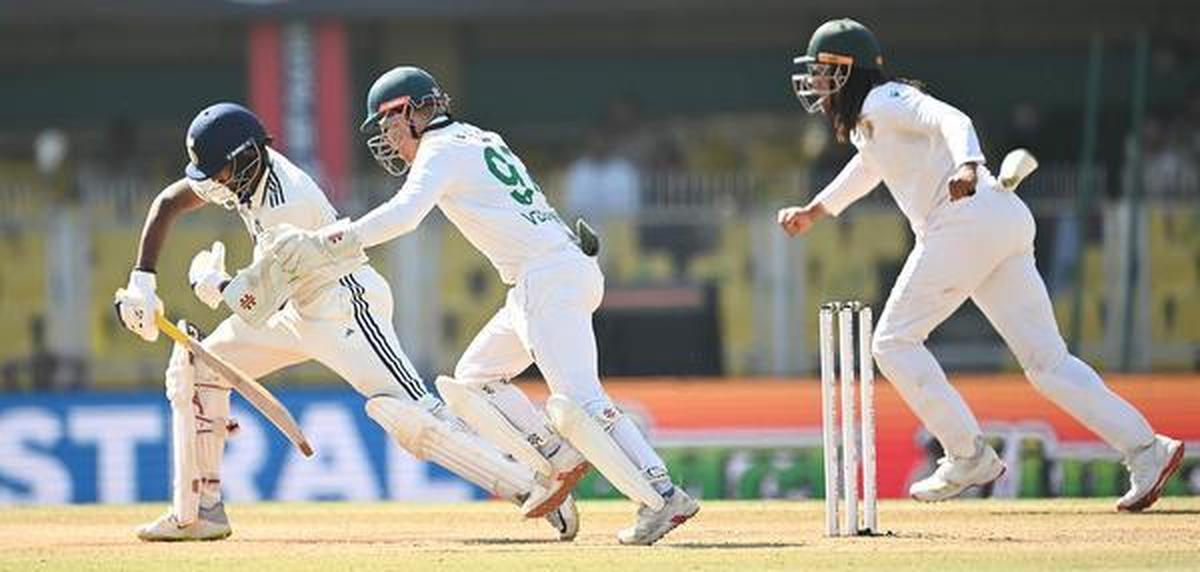
South African players celebrate after Sai Sudharsan’s wicket taken by Senuran Muthusamy during the 5th day of second Test at Barsapara Stadium stadium in Guwahati.
| Photo Credit:
RITU RAJ KONWAR
South African players celebrate after Sai Sudharsan’s wicket taken by Senuran Muthusamy during the 5th day of second Test at Barsapara Stadium stadium in Guwahati.
| Photo Credit:
RITU RAJ KONWAR
“Why do you need a batting line-up up to No.8 or No. 9? At home, keep things simple and go with five or six batters, have one all-rounder, two spinners and the remaining could be pacers. That’s it. You are picking players, but not even using them properly, so why pick them?” Lal questioned.
However, he believes that it’s unfair to put the blame entirely on head coach Gambhir.
“It’s a collective failure. It’s easiest to sack the coach. Yes, he has made mistakes, but putting all the blame on him is also not fair, because at the end of the day, the players, too, have made mistakes,” he said.
“The head coach and the players are equally accountable. But I wonder, what was the batting coach (Sitanshu Kotak) doing? Yesterday, most of the batter got out to deliveries, which were going away.
“Why couldn’t the batting coach sit down with the boys and tell them not to worry about the turn and just play every ball by its merit. The South African bowlers were just maintaining line and length, and our guys looked clueless…”
ALSO READ: Gambhir on his future as Test coach: Up to BCCI to decide
In Gambhir’s tenure, India has lost 10 of the 19 Tests it has played. So, what should be the way forward?
“It would actually not be a bad idea to have two separate coaches for two formats. Since there’s so much cricket throughout the year, it would be important for both the coaches to watch domestic cricket and spot talents.
“Only then will this plan work. But having two separate coaches for red-ball and white ball may not be a bad idea after all,” Lal said.
Published on Nov 27, 2025


