
Finders Keepers: Can India field both Pant and Jurel together in its Test team?
Few dilemmas in sport are as welcome as a problem of plenty.
The Indian Test team now faces that very problem, with two world-class wicketkeepers in its ranks: Rishabh Pant and Dhruv Jurel.
Pant’s credentials as one of the finest wicketkeeper-batters in the world are beyond dispute, while Jurel has emerged as a more-than-capable understudy.
After a series of impressive performances, including a maiden Test hundred against West Indies, Jurel has forced a fresh question: can India fit both these gifted keeper-batters into one Test XI?
Former India wicketkeeper and broadcaster Saba Karim believes it is possible, given Jurel’s rising stature with the bat.
“Jurel’s recent form strengthens his case, but team balance also depends on giving opportunities to specialist batters waiting on the bench. Going purely by form, it’s not an impossible combination,” said Karim.
India’s recent home Test series against West Indies offered a glimpse of how both Pant and Jurel could feature together. The team selection told two contrasting stories: one of opportunity unfulfilled, and another of a youngster quietly cementing his place.
Nitish Kumar Reddy, billed as a batting all-rounder, was barely used with the ball and didn’t get enough time with the bat. Across four innings against West Indies, he bowled four of India’s 290 overs and was not utilised even when the home team had to bowl close to 120 overs in the second Test in Delhi. In Ahmedabad, Jurel scored his hundred after walking in at No.5, while Reddy was left unused at No.8.
Since his debut against England in early 2024, Jurel has looked increasingly secure. Batting in the lower middle order, he displayed a mature balance between defence and attack. Earlier, he built his innings by alternating between the two. The West Indies series revealed another layer — the ability to rotate strike without taking undue risks. It showed how much he has evolved as a Test batter in just seven matches.
“He has become settled now. When a player knows he’ll be in the squad, he plays with a free mind,” Jurel’s childhood coach Phool Chand told Sportstar.
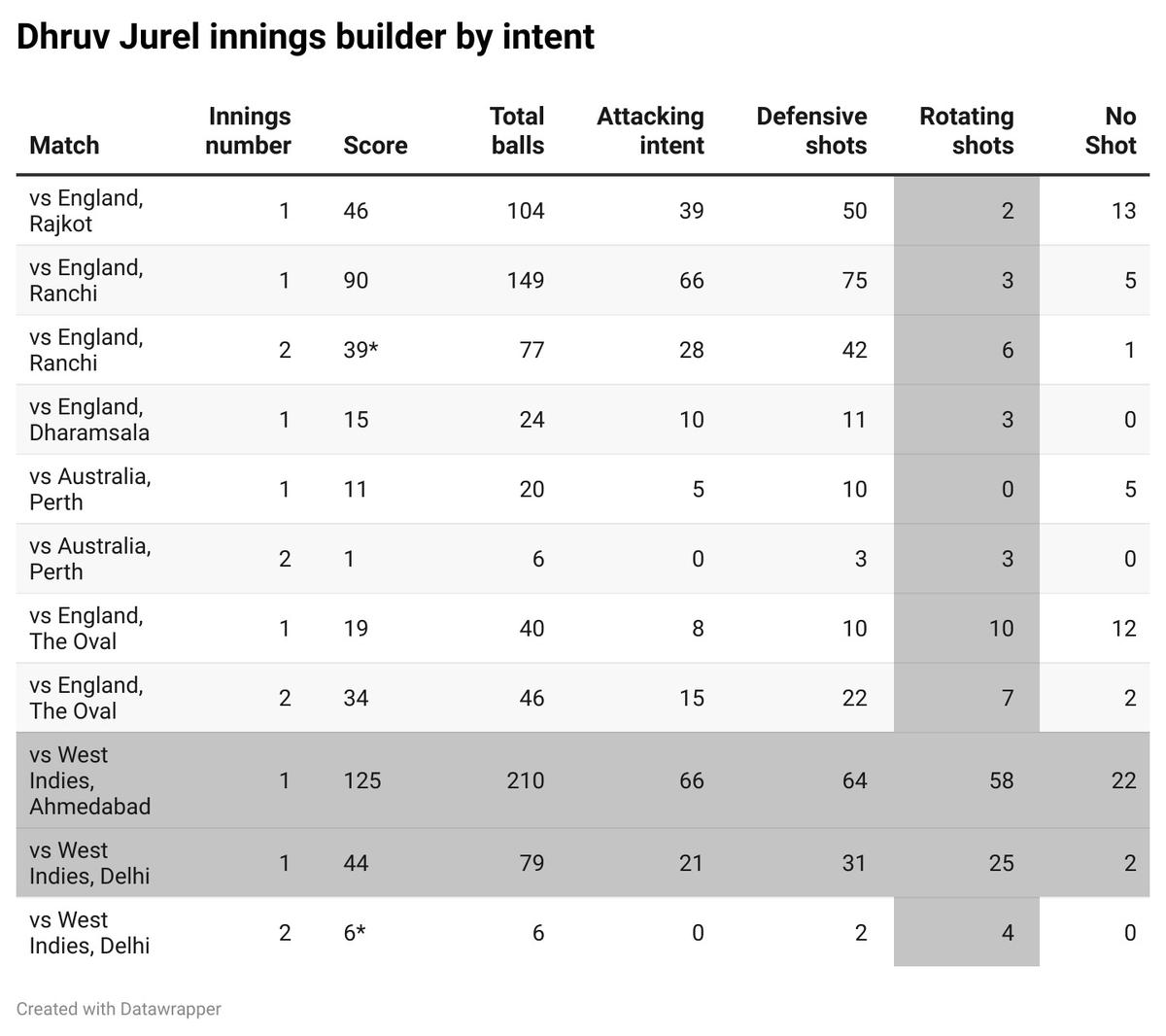
Jurel now bats with calm assurance and range, capable of playing every shot in the book. His 125 in the Ahmedabad Test proved he could hold his place on batting merit alone. His versatility only enhances his value as a wicketkeeper with modern glovework and the ability to contribute as a sharp outfielder.
“It’s refreshing to see how far wicketkeepers have evolved. Earlier, few of us worked on outfielding. Today’s keepers train to be assets anywhere on the field, which is why they add value even when they’re not behind the stumps,” said Karim.
With the management keen on playing at least five bowlers at home, including two all-rounders in Ravindra Jadeja and Washington Sundar, Jurel’s inclusion in place of Reddy should provide greater batting assurance without compromising wicket-taking ability. If India ever plays both Pant and Jurel together, the next question is obvious: who keeps wickets?
Pant’s batting is rooted in the unorthodox. Jurel, by contrast, is textbook in his approach. Yet behind the stumps, the contrast flips. As Karim observed, Pant and Jurel represent two distinct eras of wicketkeeping.
“Jurel can be classified as a modern-day wicketkeeper, his setup, stances, movements, and footwork reflect today’s approach. Pant, meanwhile, follows the older style, his stance and glovework are more in line with what we’ve seen from traditional keepers.”
Karim notes that Jurel’s technique minimises strain while keeping his body aligned with the line of the ball. “His footwork stays in sync with the pitch’s variations, which allows him to react better to whatever comes behind the stumps. Pant’s keeping relies heavily on reflexes and hand-eye coordination, which is why he remains highly effective.”
According to Karim, two aspects stand out in Jurel’s keeping: his upright stance and his collection technique.
“Jurel’s stance and collection are his biggest strengths. He stays slightly more upright, even to spinners, keeping his head and alignment towards the ball. That helps him rise with the delivery, the most basic but crucial aspect of wicketkeeping.”
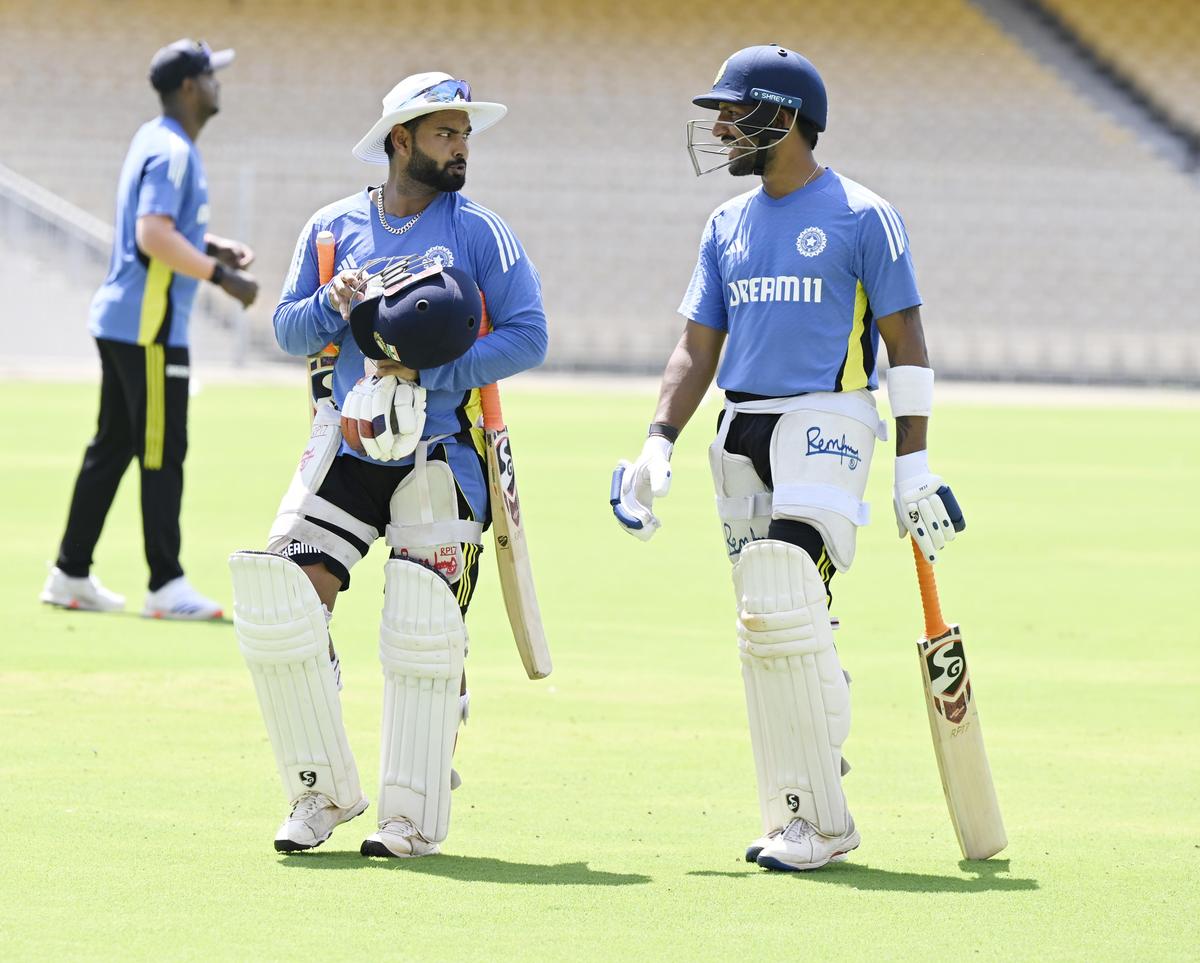
Rishabh Pant and Dhruv Jurel during a practice session in 2024.
| Photo Credit:
RAGU R

Rishabh Pant and Dhruv Jurel during a practice session in 2024.
| Photo Credit:
RAGU R
Another subtle difference lies in their arm positioning while standing up to the stumps.
“When standing up to the stumps, Jurel keeps his arms slightly away from his knees, allowing free hand movement. Pant, however, positions his arms between his legs, which can restrict his reach and make him bring his hands forward to complete movements,” Karim explained.
Even if Jurel appears the more technically refined keeper, India would hesitate to shift the gloves from Pant, given how it could affect the left-hander’s batting rhythm.
Since his debut in 2018, only Virat Kohli has scored more Test runs for India than Pant (3427). The 28-year-old also has eight hundreds in the format, the most by an Indian wicketkeeper.
Logic suggests that removing the burden of wicketkeeping might free Pant to focus solely on batting. History, however, offers mixed evidence.
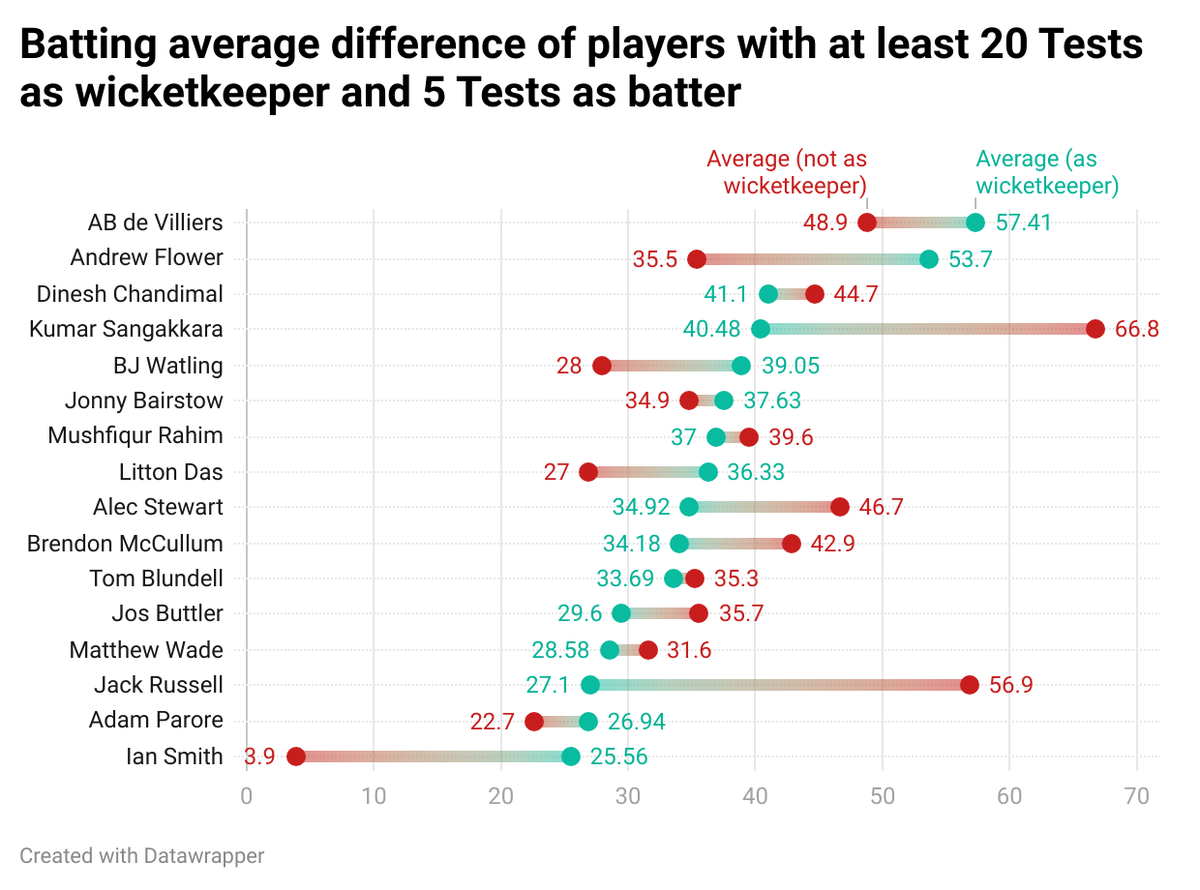
In men’s Tests, 85 players have kept wicket in at least 20 matches, but only 16 of them have played five or more games as pure batters. The difference in their batting averages between keeping and non-keeping games is narrow: seven performed better as wicketkeepers, while nine improved without the gloves. The standouts among the former are South Africa’s AB de Villiers and Zimbabwe’s Andy Flower, the only two wicketkeepers to average over 50 with the bat in matches where they kept (with a 20-match cutoff). De Villiers averaged a strong 48.9 when he wasn’t the keeper, while Flower’s average dropped by nearly 20 runs once he gave up the gloves.
Australian analyst Jarrod Kimber, in his book The Art of Batting, argues that taking away one skill from a multi-faceted cricketer can dull his edge with the bat. Kimber’s argument was referenced in discussions about the possibility of Pant playing purely as a batter.
While much of this remains hypothetical, Pant’s Test career shows he thrives under pressure and often produces his best when challenging the game’s norms.
Published on Nov 05, 2025


