
Rachael Haynes: India now has depth and nuance around selection to go with its superstar talent
When India and Australia played out a 781-run thriller in the deciding ODI of a three-match series in New Delhi a few weeks ago, bearing witness in the commentary box was Rachael Haynes.
In many ways, life’s full circle was taking another revolution for Haynes. She had been part of the leadership group in the Australian side which turned around an already successful team into an unbeatable monster.
Alongside Meg Lanning and then coach Matthew Mott, Haynes helped Australia recover from the disappointment of the shock upset in the 2017 World Cup (at the hands of Harmanpreet Kaur and India) to go on to win the next four World titles (2018, 2020 and 2023 T20 World Cups and the 2022 ODI showpiece) and a Commonwealth Games gold medal to cement their position as the game’s gold standard.
Cut to 2025 and Haynes – a six-time World Cup winner – was watching along as this new standout international rivalry pushed the boundaries of possibility once more, ahead of an eagerly awaited ODI World Cup no less.
As Australia gears up to defend its one-day crown, the 38-year-old – now at the helm of affairs for Sydney Sixers in the Big Bash and WBBL – spoke to Sportstar about the switch in approach to the format in 2017, the grind behind creating the Australian juggernaut, and what the eco-system can learn from the Aussie way of doing cricket.
Excerpts:
Q: How are you feeling about this Aussie side as they get started in the World Cup this time?
In terms of their aspirations for the World Cup, Australia is the number one side in this format in the world and has had a really decent run ahead of this tournament. They’re definitely going to be there and thereabouts at the business end. The series they just played in India against India showed it’s not going to be straightforward for any team.
It’s a positive thing that we’re walking into this World Cup and there’s close competition between lots of different sides. We’ve seen India have a lot of success recently and beat some really high-quality opponents in England and Australia. It’s going to be a fantastic tournament.
Q: We have to speak about that 2017 World Cup and what came after. What do you remember about that phase now?
A: We didn’t reach the stage of the tournament that we would have liked. We got knocked out by India with Harmanpreet Kaur playing an incredible innings in that tournament. It forced us to have that moment of introspection on what was really important for us as a side, about the style of play we wanted to consistently bring to life. We thought about how we could individually improve our games to then bring the team success, especially under pressure. That’s essentially the innings Harmanpreet played. It was some of the cleanest ball striking we had seen, and to manage that under that kind of pressure helps you learn a lot about yourself.
We zeroed in on being fearless and saw what that could look like for each player. I couldn’t play the way Alyssa Healy or Meg Lanning do, but there were other strengths that I could bring to the squad. Putting the onus on the individual galvanised the squad. We were all invested in each other’s success and improvement. We celebrated all these little milestones, and it brought the group together in a way that just winning can’t.
It was really a special period to be part of and, pleasingly, it’s great to see that sort of team evolve again and continue to want to push what’s possible and get better.
Q: Australia’s approach to ODIs completely changed. How did that higher aggression come about?
A: Success leaves clues, right? People look at what other people are doing and replicate that. If you stand still as a player or team, eventually you will be caught up on. This is the foundation of the Australian way, and one of the strengths we have is the foundation of our domestic competitions. It has matched up to and trained the players for the way the game is going internationally.
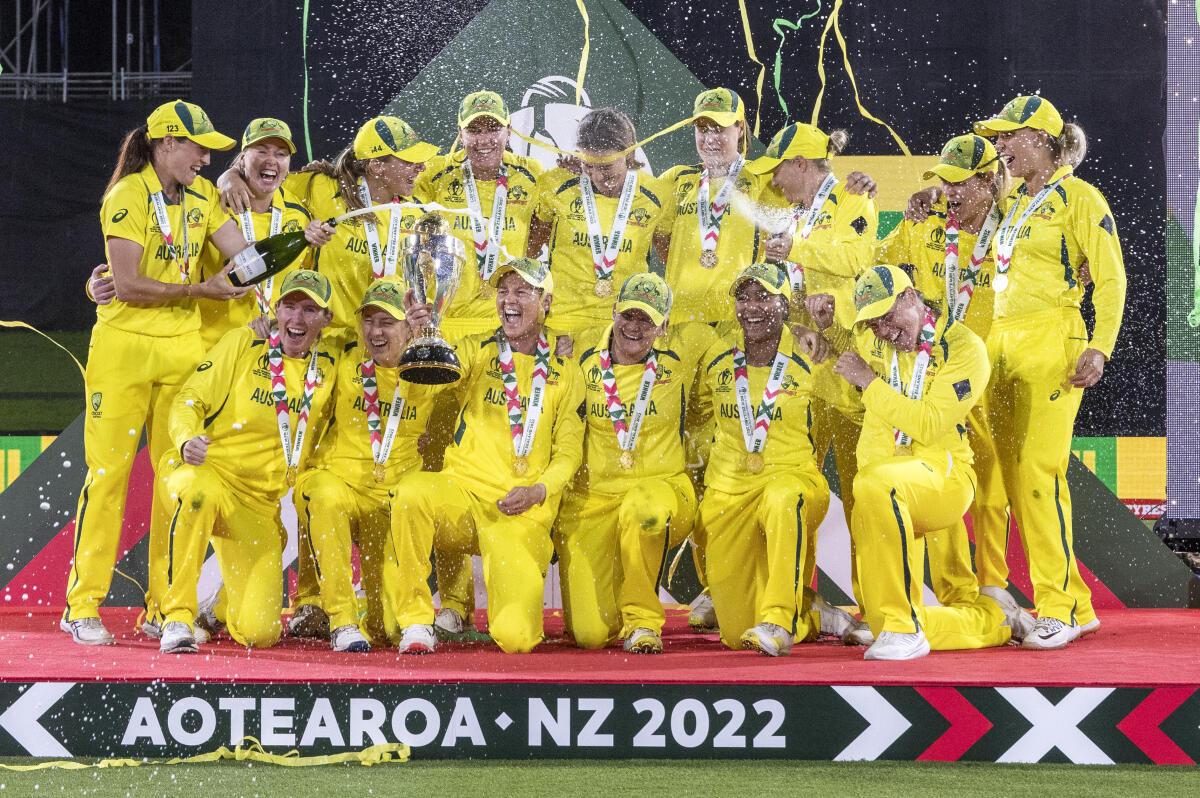
Australian players celebrate winning the ICC Women‘s World Cup in 2022.
| Photo Credit:
AP

Australian players celebrate winning the ICC Women‘s World Cup in 2022.
| Photo Credit:
AP
The reality is, with how increasingly aggressive the batters are playing, how much more they’re taking the game on, you do need to have different layers to your game as a bowler. Likewise, as a batter, with bowlers having different plans that they can turn to, you’ve got to make sure that you have options to turn to when trying to counteract.
The strength of our domestic system definitely contributed to the success of our national team. We’re seeing something similar as well in the Indian setup, too, particularly with the Women’s Premier League, which is now three iterations old. We see domestic players gaining experience and experience under pressure, more importantly.
It’s no great surprise to me that teams like India now have more depth in their lineup and can execute well in tense games because they’re facing those situations more frequently. Australia’s strength also comes from the fact that its ODI form and dominance never faltered, even in the T20 era.
Q: We’re seeing a massive increase in the number of 300+ scores in ODIs now. Against this, a game like the third ODI between India and Australia where 780+ runs were scored, where does it figure against the trends in the game?
A: It is very revealing of the kind of depth both squads have. Look at how Beth Mooney and Smriti Mandhana both approached their innings. Very fearless and attacking brand of cricket was on show.
But to play in that manner, you need to have confidence in who’s to come after you. It’s really hard to have that attacking mindset if you’re worried about getting out and not getting the runs you want the team to get. Both backed their natural game. If you watched Beth in that game, it felt like she didn’t hit the fielder even once. Every time she played a shot, it went through the gap. She was scoring runs at will. And then Smriti comes out, and it’s more of the same. She played beautiful shots down the ground and almost toyed with the bowlers at will.
There’s more of a T20 mindset coming into ODI cricket now. When conditions allow, players are more willing now to throw caution to the wind and back their own game and the depth their teams have.
Q: Bowlers get the raw end of the deal, don’t they? Especially with surfaces getting flatter, too. Is there a way to balance this?
A: Fans want to see more runs, don’t they? They enjoy it when runs are flowing and boundaries are hit at regular intervals. I do have a soft spot for the bowlers, and I say this despite being a former opening bat who loved to score runs. I hope at some point, there is a greater contest between bat and ball, because it falls too far in one direction. It can be disheartening for that group of players and for the generation you’re trying to inspire to come through as well. If people see more runs getting scored, they are more inclined to take up batting than bowling.
A positive that comes with more runs being scored is a greater level of athleticism on the field and the skills bowlers now have to counteract the high scoring rates. It’s all adding to the spectacle.
Q: How hard is a title defence? Australia has struggled sometimes to do consecutive titles, like the three-peat that didn’t happen in 2024.
A: Tournament play is tricky. The ODIs are a longer format in a longer tournament. You need to find the right time where you’re playing well, winning cricket but ensure you’re not peaking too early. You need to build momentum into the back end of the tournament and hopefully into the finals.
It’s tough to go back-to-back. I played through a really successful period for Australia and consider myself lucky. But it was not easy at all. We always felt, as an Australian side, that people really went hard in wanting to and trying to best us. So we had to be at our best all the time, as the opponent is going to throw everything at us. It’s the same story this time. It’s a challenge for sure.
Q: Is India vs Australia the biggest rivalry in international cricket? It is increasingly throwing out some entertaining games in World Cups.
A: I think even in bilateral series as well…There’s always been a healthy rivalry against India. India has always been a side that’s had superstar talent. The big difference now is the squad has so much more depth and nuance around selection, match-ups, and those kinds of elements. That’s the detail that matters when you’re going up against strong opponents. I’ve really enjoyed watching that. It’s reinforced to me how valuable a competition like WPL is to contributing to the success of the national team for India as well.
Think about players like Richa Ghosh, Jemimah Rodrigues, and see how much their game has evolved over the last two years. Not only have they improved as individuals but India is getting better as a team. Even watching Deepti Sharma more recently… Look at how she’s evolved with the bat. You’re not just relying on Smriti Mandhana and Harmanpreet Kaur to have these incredible innings. There are a bunch of different players who can stand up at any moment. That helps produce these close matches with sides like Australia and as a cricket fan, I am enjoying watching that.
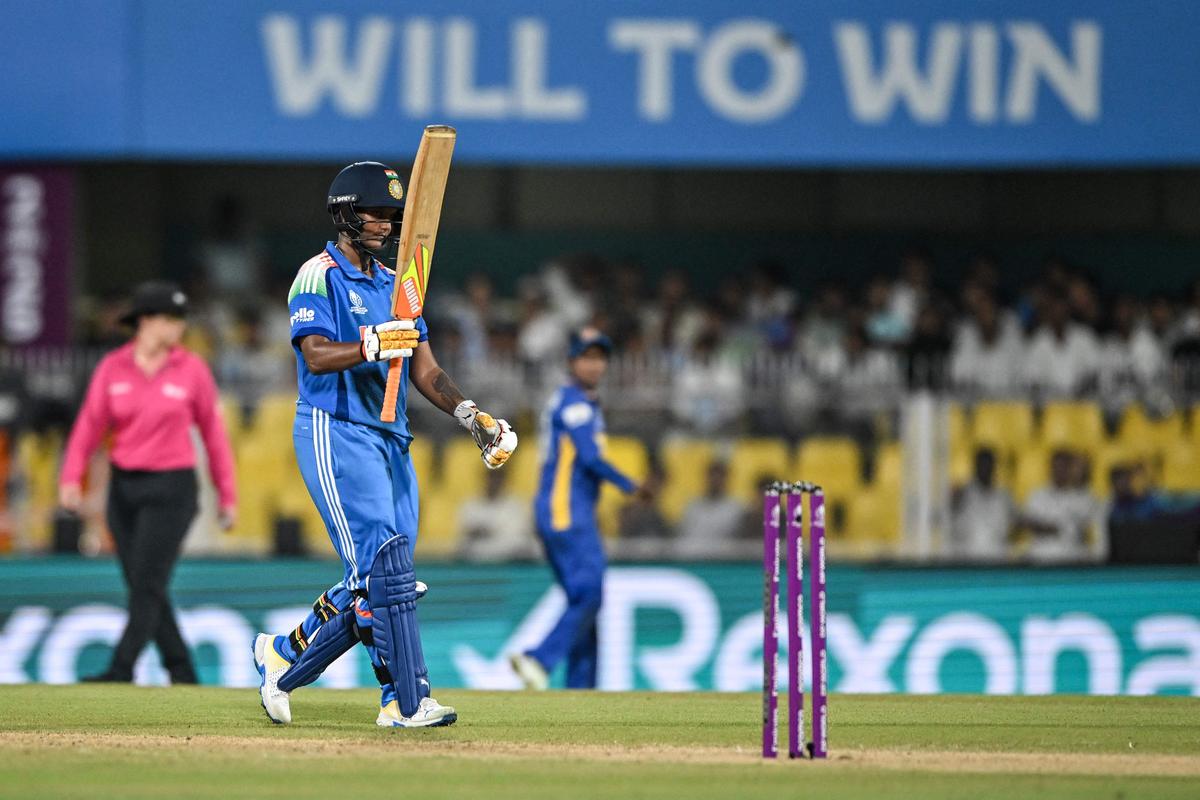
Haynes feels Deepti Sharma contributions with the bat has helped ease the pressure on Smiti Mandhana and Harmanpreet Kaur.
| Photo Credit:
AFP
Haynes feels Deepti Sharma contributions with the bat has helped ease the pressure on Smiti Mandhana and Harmanpreet Kaur.
| Photo Credit:
AFP
As much as I love Australian cricket and I love seeing us win games, I think that rivalry and close competition are important. From that 412 game, you see the number of bowlers Australia deployed because they prioritise all-rounders so much. It’s a template India has been trying to learn from.
Q: As someone now on the administration side of things and with coaching experience too, how hard is it to develop that pool of all-rounders?
A: It all starts in our pathway systems. We encourage players to be multi-skilled and not just sort of focus on batting or bowling at the expense of anything else. And fielding is a big priority. It’s linked to athleticism and your ability to cut off runs, which is handy on quick-scoring grounds, regardless of the format.
The Australian team is at a place where these all-rounders are some of the best players in the world. It might not always be the case, but it certainly shows the value of having all-rounders, particularly in your top six. You have so much flexibility in your side, particularly in the white ball formats.
You are very vulnerable if you go into a game with only five bowlers. You need everything to go well for your bowling group then, and if time has taught us one thing, it is that it’s inevitable that an opposition batter will have a good day. So you will need options that can tangibly contribute. So yes, we’re glad we have these all-rounders, and it has not come up by accident.
Q: Same applies for Australia’s pace pool. The talent is coming in steadily. What is the system doing right to ensure that? It’s something India is working towards as well.
A: In Australia, conditions probably help a bit as we’ve got fast, bouncy wickets which encourage people to want to bowl fast. Another component is talent ID and depth charts, and tracking players through the system.
We always talk about role models. In the women’s game, we’ve been lucky to have players like Catherine Fitzpatrick and Ellyse Perry. We have young Darcy Brown at the moment. Making people aware of these players also goes a long way in bringing in more interested aspiring players. Look at India. You had Jhulan Goswami, and she was amazing. Very tricky to face as a batter. You have to be purposeful and ensure you’re creating enough opportunities for talents like that and those skill sets to come through.
Q: With the World Cup expanding from the next cycle, what can other nations do on the development front? World events sometimes feel like they are operating in two tiers.
A: The big thing that stands out is the difference in the domestic structures. The top three nations are underpinned by solid domestic structures. Boards are investing, and that is really important when it comes to developing talent and establishing depth that then pushes up into the international arena and goes on to represent those respective countries.
In this World Cup too, things will be close. That fourth slot in the semis is a tricky one to judge. You imagine that maybe South Africa, New Zealand are competing for that. That said, you are underestimating your opponent if you step into a world event thinking that you will automatically beat someone or get through. Cricket can be quite humbling at times.
There are probably off-field disparities in the levels of investment but when you get on the field, it comes down to who performs on that day.
Q: What are your hopes for this World Cup for the sport at large?
A: I am really excited for this Indian side that they get to play a home World Cup. I had the privilege of doing that more recently in the T20 World Cup in 2020. Going on to win the World Cup helped generate a lot of momentum for the women’s game and excitement around it. I am excited for India to have the opportunity to inspire a new generation of players. I hope the tournament itself is a great success and helps lay the foundation for the game to continue to evolve.
Time has shown that the game will move ahead. It’s for administrators to use their time in the sun to take the game forward for themselves.
Published on Oct 01, 2025


